UPERC declares proposed electricity tariff hike by UPPCL as unlawful
Source:indiatvnews ↗
Why It Matters
Understanding the regulation of infrastructure sectors, the statutory powers of State Electricity Regulatory Commissions (under the Electricity Act 2003), and mechanisms like FPPCA is crucial for UPPSC GS Paper 3 (Economy and Infrastructure) and GS Paper 2 (Statutory and Regulatory Bodies).
Summary
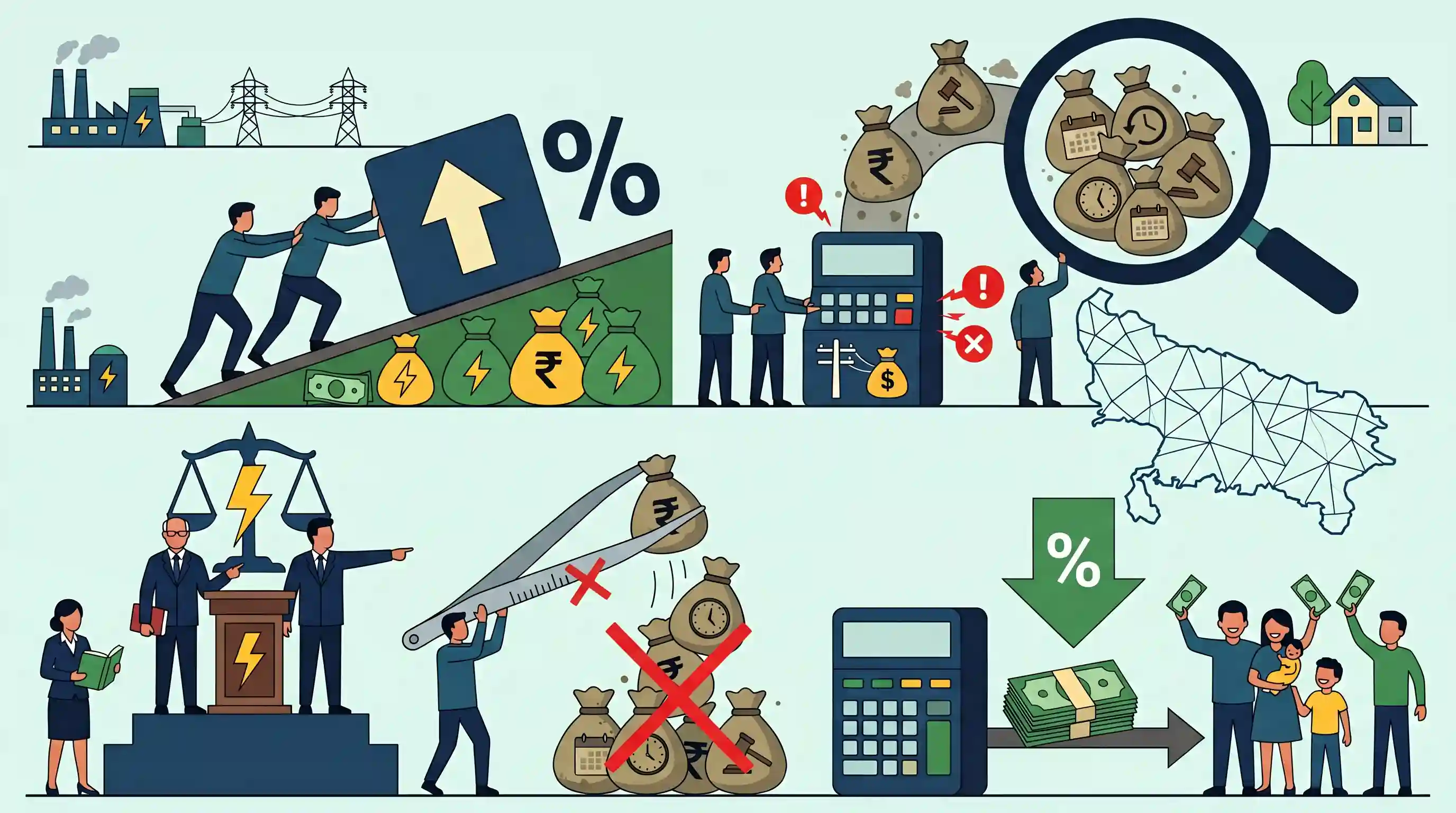
The Uttar Pradesh Electricity Regulatory Commission (UPERC) declared the state power utility UPPCL's attempt to impose a 10% fuel surcharge hike on electricity bills as unlawful. UPPCL violated Regulation 16.1 of the UPERC Multi-Year Tariff (MYT) Regulations, 2025, by incorrectly including Rs 1,400 crore of historical, prior-period liabilities (such as past NTPC bills and APTEL order dues) in its FPPCA calculation for March 2026. The UPERC noted that a correct, strictly regulatory calculation would actually reduce power tariffs by 2% for state consumers, and ordered UPPCL to submit a corrected tariff computation.
Key Points
- The Uttar Pradesh Electricity Regulatory Commission (UPERC) struck down Uttar Pradesh Power Corporation Limited's (UPPCL) proposed ~10% electricity tariff hike (via fuel surcharge) as unlawful.
- UPPCL had attempted to load approximately Rs 1,400 crore of historical dues and prior-period liabilities (including past NTPC bills and past APTEL judicial orders) into the Fuel and Power Purchase Cost Adjustment (FPPCA) calculation for March 2026.
- According to Regulation 16.1 of the UPERC Multi-Year Tariff (MYT) Regulations, 2025, previous-period liabilities cannot be included in the monthly FPPCA calculations.
- A correct calculation of FPPCA, strictly excluding the historical dues, would have resulted in a tariff reduction of approximately 2% for UP consumers, rather than a 10% increase.
- The Uttar Pradesh State Electricity Consumers' Council, led by Chairman Avdhesh Kumar Verma, formally protested the move, leading to the regulatory intervention by UPERC Chairman Arvind Kumar and Member Sanjay Kumar Singh.
Important Terms
Electricity Act, 2003

A landmark central legislation that consolidated India's electricity laws, unbundled state electricity boards to promote competition, and mandated independent regulatory commissions at central and state levels.
UPSC context
GS Paper III (Infrastructure: Energy); crucial for understanding power sector reforms, regulatory frameworks, and DISCOM financial restructuring.
Appellate Tribunal for Electricity
A statutory, quasi-judicial tribunal established under the Electricity Act, 2003, to hear appeals against orders of Central and State Electricity Regulatory Commissions.
UPSC context
GS Paper II (Statutory/Regulatory Bodies) and GS Paper III (Energy); tests dispute resolution mechanisms and regulatory oversight in infrastructure.
Uttar Pradesh Electricity Regulatory Commission
An autonomous state-level statutory body corporate established under the electricity reform framework to regulate the power sector, set tariffs, and resolve disputes in UP.
UPSC context
GS Paper II (Statutory/Regulatory Bodies); relates to cooperative federalism, decentralisation, and state-level utility tariff regulation.
Uttar Pradesh Power Corporation Limited
The state-owned company responsible for planning, electricity transmission, and distribution in Uttar Pradesh, managing multiple regional distribution utilities (DISCOMs).
UPSC context
GS Paper III (Infrastructure: Energy); representative of state DISCOM structures and challenges regarding financial health and subsidy management.
Uttar Pradesh Rajya Vidyut Upbhokta Parishad
A prominent state-level consumer advocacy group in Uttar Pradesh that represents public and domestic consumer interests during electricity tariff and policy hearings.
UPSC context
GS Paper II (Governance and Public Participation); highlights civil society's role as a watchdog in utility regulation and public services.
Prelims Trap
Appeals against the decisions of the Appellate Tribunal for Electricity (APTEL) must be filed in the respective High Court before approaching the Supreme Court.
Under Section 125 of the Electricity Act, 2003, appeals from APTEL lie directly to the Supreme Court of India on questions of law, bypassing the High Courts.
Static Concepts Connected
What is the statutory status and judicial hierarchy of the Appellate Tribunal for Electricity (APTEL)?
- Statutory Origin: Established under Section 110 of the Electricity Act, 2003, to hear appeals against orders of Central and State Electricity Regulatory Commissions (CERC/SERCs).
- Judicial Hierarchy: Appeals against APTEL decisions lie directly to the Supreme Court of India under Section 125, completely bypassing the jurisdiction of State High Courts.
- Expanded Jurisdiction: Its mandate was subsequently extended to cover appeals against decisions under the Petroleum and Natural Gas Regulatory Board (PNGRB) Act, 2006.
What is the Fuel and Power Purchase Cost Adjustment (FPPCA) mechanism?
- Core Purpose: FPPCA is a regulatory formula that allows power distribution companies (DISCOMs) to adjust consumer tariffs monthly or quarterly to pass through volatile fuel costs.
- Legal Framework: Mandated by Rule 14 of the Electricity (Amendment) Rules, 2022, to prevent the accumulation of regulatory assets and financial distress for DISCOMs.
- Strict Limits: Under rules like Regulation 16.1 of UPERC, it cannot be used as a backdoor to recover historical, prior-period operational debts.
Cross-Topic Patterns
DISCOM debt and state fiscal health
State-run DISCOM losses directly trigger fiscal stress for states, as governments regularly absorb these liabilities under power sector reform packages, constraining capital expenditure in social sectors.
Regulatory independence vs populist tariffs
The clash between state utilities attempting tariff hikes and regulatory commissions blocking them highlights the delicate balance of maintaining independent oversight while avoiding hyper-inflationary burdens on consumers.

APTEL's direct appeal jurisdiction and SERC power-tariff regulatory mandates under the Electricity Act are prime for GS-2/GS-3 integration in 2026.
Linked PYQs · 2
Linked PYQs · 2
- 2025UPPSC_PRELIMSGS1
Which of the following Department prepares the National Indicator Framework Progress Report related to Sustainable Development Goals in Uttar Pradesh? 1. Department of Finance 2. Department of Education 3. Department of Planning Select the correct answer from the code given below:
- 2018UPPSC_PRELIMSGS1
Which of the following is an extra constitutional agency?
