Macroeconomic Growth Rates and Agrarian Distress Challenges
Source:The Hindu ↗
Why It Matters
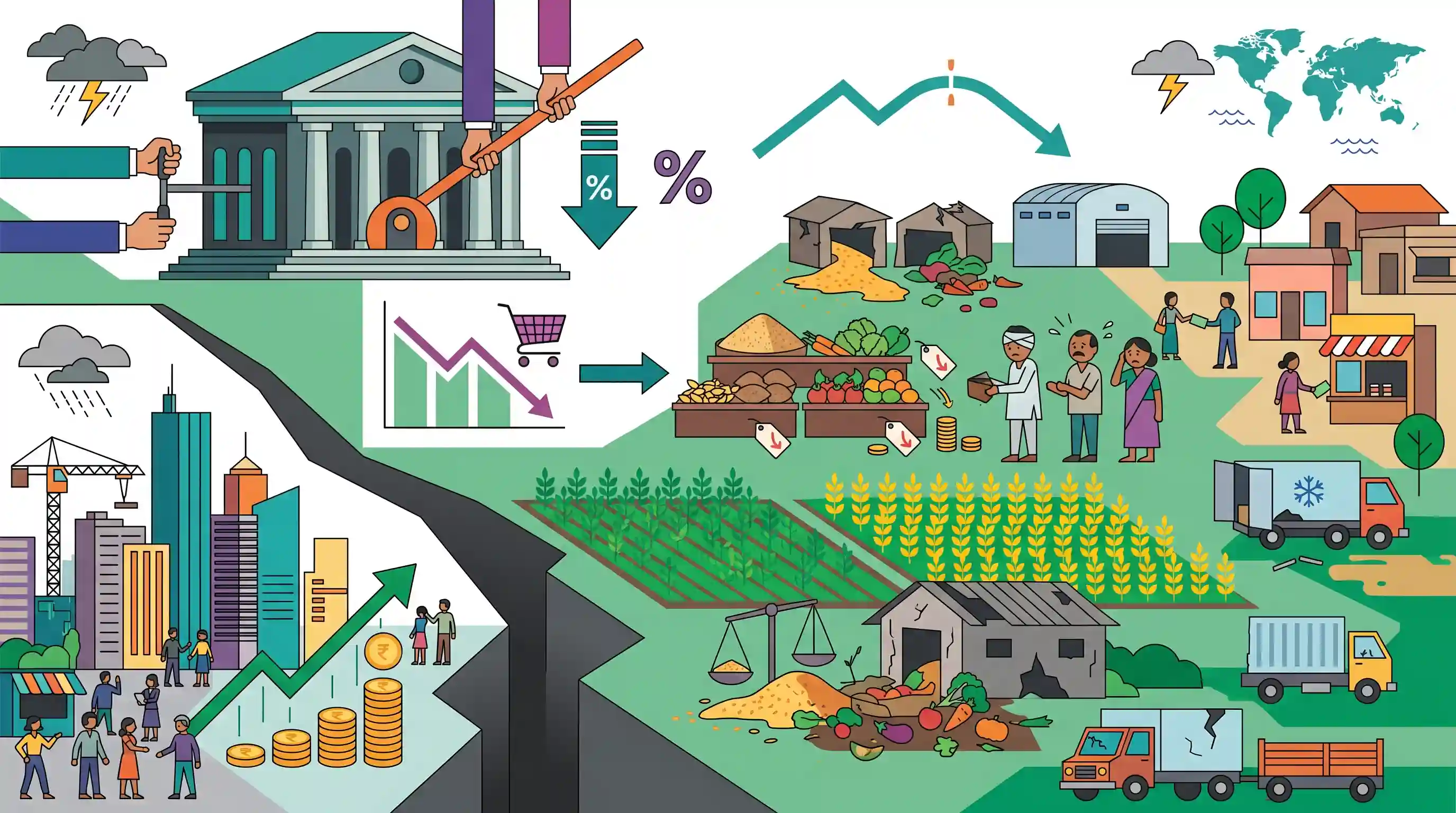
It perfectly links macro-economic indicators (monetary policy, repo rate, inflation) with micro-economic structural bottlenecks in agriculture (supply chain issues, post-harvest losses, farmer incomes). This intersection of monetary policy and agricultural distress is highly relevant for GS3 Economy and Agriculture.
Summary
The article highlights a complex dichotomy in India's macroeconomic landscape: while the RBI has cut repo rates in response to easing retail inflation to spur growth, this drop in inflation is largely driven by crashing agricultural prices. The steep fall in food prices devastates the incomes of small and marginal farmers, who lack holding capacity and face ₹1.52 trillion in annual post-harvest losses due to inadequate cold storage and supply chain infrastructure. Consequently, rural consumption is dampened, widening the urban-rural divide and posing a structural risk to India's domestic demand-driven growth story amid global uncertainties.
Key Points
- The RBI reduced the repo rate by 25 basis points in both February and April to stimulate economic growth as retail inflation eased.
- The fall in inflation is largely driven by a crash in food prices, with perishables like tomatoes dropping by 80% to ₹1/kg, forcing farmers to dump their produce.
- Small and marginal farmers, comprising 86% of the sector, are disproportionately affected due to lack of holding capacity, with average monthly incomes ranging from just ₹10,218 to ₹13,661.
- A severe lack of cold storage and transport infrastructure causes annual post-harvest agricultural losses of ₹1.52 trillion.
- The resulting decline in farmer incomes suppresses rural consumption demand, threatening India's overall economic growth and widening the rural-urban consumption divide.
Important Terms
Reserve Bank of India (RBI)

India’s central bank responsible for managing money supply and interest rates. It uses the repo rate to target retail inflation (4% +/- 2%) while ensuring liquidity for economic growth.
UPSC context
GS Paper 3 (Economy); tested for its role in monetary policy, inflation targeting, and managing liquidity during growth slowdowns.
Ministry of Food Processing Industries (MoFPI)
The federal ministry focused on minimizing post-harvest losses and enhancing value addition. It implements the PMKSY scheme to develop cold chains and supply chain infrastructure across India.
UPSC context
GS Paper 3 (Agriculture); vital for topics like supply chain management, food security, and doubling farmers' income through processing.
NABARD
The apex development bank for India's rural economy. It facilitates credit flow to farmers and funds vital rural infrastructure like irrigation and storage through the Rural Infrastructure Development Fund.
UPSC context
GS Paper 3 (Economy/Agriculture); tests knowledge of institutional credit, rural development, and financial inclusion strategies in agrarian sectors.
National Sample Survey Office (NSSO)
An agency under MoSPI that conducts nationwide surveys on consumption, employment, and poverty. Its data is the primary source for assessing the urban-rural economic divide.
UPSC context
GS Paper 3 (Economy); essential for analyzing socio-economic indicators, household expenditure trends, and inclusive growth policy effectiveness.
Prelims Trap
"A sustained decrease in headline retail inflation consistently leads to an increase in rural purchasing power."
While lower inflation benefits consumers, food deflation often means a crash in farm-gate prices. This destroys rural incomes and actually suppresses rural purchasing power.
Static Concepts Connected
What dictates the "holding capacity" of small and marginal farmers?
- Credit obligations: Immediate need for cash post-harvest to repay informal loans and meet consumption needs forces immediate liquidation (distress sale).
- Storage deficit: Absence of accessible, affordable scientific godowns or cold chains at the Panchayat level limits the ability to store perishables.
- Financial integration: Limited access to Negotiable Warehouse Receipts (e-NWR) prevents farmers from getting pledge financing against stored produce.
How do Headline and Core CPI differ in the context of RBI's monetary policy?
- Headline CPI: Total inflation including volatile food and fuel. The RBI's official statutory mandate (4% +/- 2%) is strictly based on Headline CPI (Combined).
- Core CPI: Excludes volatile food and fuel components. It provides a better picture of underlying, long-term macroeconomic demand and price trends.
- The Indian dichotomy: Because food carries a high weightage in CPI (~46%), food price crashes disproportionately drag down headline inflation, even if core inflation remains sticky.
Cross-Topic Patterns
Monetary Policy vs. Agrarian Reality
Rate cuts stimulate industrial borrowing, but when low inflation is driven by food price crashes, rural consumption drops, creating a two-speed macroeconomic recovery.
Price Discovery vs. Physical Infrastructure
Digital price discovery (e-NAM) fails to prevent distress sales if physical infrastructure (village-level cold chains and warehousing) remains inadequate for perishables.

Expect a 2026 Prelims statement linking headline CPI fluctuations directly to agrarian terms of trade and rural consumption patterns.
Linked PYQs · 5
Linked PYQs · 5
- 2020PrelimsGS1
If the RBI decides to adopt an expansionist monetary policy, which of the following would it not do ? 1. Cut and optimize the Statutory Liquidity Ratio 2. Increase the Marginal Standing Facility Rate 3. Cut the Bank Rate and Repo Rate Select the correct answer using the code given below:
- 2025MainsGS3
Elaborate the scope and significance of supply chain management of agricultural commodities in India.
- 2024MainsGS3
Elucidate the importance of buffer stocks for stabilizing agricultural prices in India. What are the challenges associated with the storage of buffer stock? Discuss.
- 2020MainsGS3
What are the challenges and opportunities of food processing sector in the country? How can income of the farmers be substantially increased by encouraging food processing?
- 2017MainsGS3
How do subsidies affect the cropping pattern, crop diversity and economy of farmers? What is the significance of crop insurance, minimum support price and food processing for small and marginal farmers?
