Chhattisgarh Establishes Dedicated Good Governance Department
Source:Indian Express ↗
Why It Matters
Provides concrete, state-level examples (case studies) of e-governance, grievance redressal, and institutional convergence that aspirants can use in GS Paper 2 answers relating to transparency, accountability, and citizen-centric administration.
Summary
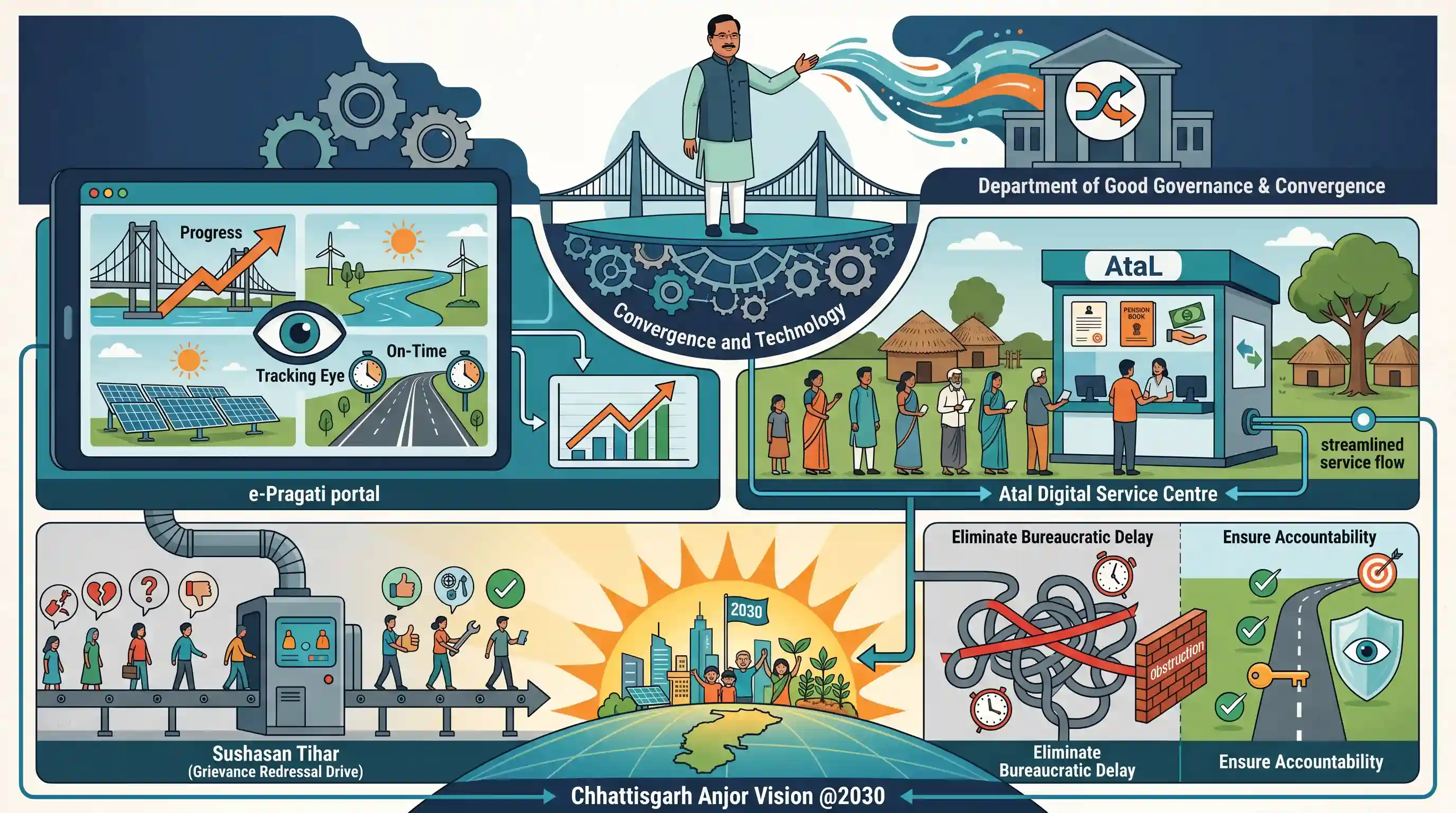
Chhattisgarh Chief Minister Vishnu Deo Sai emphasized the critical role of technology and convergence in delivering good governance during an event. Highlighting the state's pioneering move to establish a Department of Good Governance and Convergence, he outlined numerous digital initiatives aimed at transparency and public service delivery. Key reforms include the e-Pragati portal for monitoring large-scale infrastructure projects, the establishment of Atal Digital Service Centres in panchayats for streamlined public services, and massive grievance redressal drives like Sushasan Tihar. The state aims to eliminate bureaucratic delays and ensure accountability through extensive e-governance implementation, setting out a roadmap for growth under the 'Chhattisgarh Anjor Vision' to be achieved by 2030.
Key Points
- Chhattisgarh is the first state in India to establish a dedicated Department of Good Governance and Convergence.
- The e-Pragati portal was launched to monitor infrastructure projects over ₹25 crore, ensuring inter-departmental coordination, transparency, and time-bound implementation.
- To improve service delivery in rural areas, Atal Digital Service Centres have been set up in panchayats to act as one-stop solutions for Aadhaar, pensions, banking, and utility bills.
- The state has launched several grievance redressal mechanisms, including a centralized CM Helpline and the Sushasan Tihar initiative, through which 41 lakh applications were disposed of via direct village outreach.
- Technology adoption has been prioritized through initiatives such as E-Office, biometric attendance, online mineral transport permits, and digitised property registration to promote transparency.
Important Terms
Department of Good Governance and Convergence

A pioneering state department established by Chhattisgarh to streamline welfare policy implementation and integrate digital initiatives like the Digital Secretariat for transparent public service delivery.
UPSC context
GS Paper 2 (Governance). Relates to administrative reforms and specialized institutional mechanisms for ensuring transparency and accountability.
Chhattisgarh Anjor Vision
A strategic developmental roadmap for Chhattisgarh outlining goals for 2030 and 2047, focusing on doubling GSDP, infrastructure expansion, and sustainable socio-economic growth.
UPSC context
GS Paper 2/3 (Planning/Economic Development). Relevant for understanding state-level long-term development strategies and economic planning.
Sushasan Tihar
A statewide 'Good Governance Festival' in Chhattisgarh featuring intensive grievance redressal camps designed to provide on-the-spot solutions and deliver government services at the citizens' doorsteps.
UPSC context
GS Paper 2 (Governance). Tests knowledge of grievance redressal mechanisms and citizen-centric governance models.
Atal Digital Service Centres
Digital hubs established at the Gram Panchayat level in Chhattisgarh to provide essential online services, cash transactions, and official certificates to rural populations.
UPSC context
GS Paper 2 (E-governance). Crucial for topics related to digital inclusion and ICT-enabled public service delivery in rural India.
e-Pragati portal
A digital monitoring platform used to track large-scale infrastructure projects in real-time, aimed at ensuring proactive governance, accountability, and timely completion of development works.
UPSC context
GS Paper 2 (E-governance). Tests the application of technology in project management and administrative efficiency.
Prelims Trap
The e-Pragati portal is a central government enterprise architecture initiative launched under the Digital India mission.
UPSC often misattributes state portals to the Centre. While Andhra Pradesh had an earlier framework named e-Pragati, Chhattisgarh recently launched the e-Pragati portal specifically to monitor infrastructure projects.
Static Concepts Connected
What are the four evolutionary phases of E-Governance?
- Information Phase: Basic digital presence where governments provide static information to the public via websites.
- Interaction Phase: Two-way communication enabling citizens to download forms, contact officials, or submit basic requests.
- Transaction Phase: Full end-to-end electronic transactions for services like tax payments, license renewals, and property registration.
- Transformation Phase: Seamless, integrated service delivery across multiple departments (convergence) fundamentally altering the citizen-government relationship.
What is the concept of 'Convergence' in public administration?
- Definition: The synergistic integration of multiple departmental schemes, funds, and functionaries to avoid duplication and optimize resource utilization.
- Practical Example: Merging MGNREGA funds with the Swachh Bharat Mission to build rural sanitation infrastructure, shifting away from siloed administrative approaches.
Cross-Topic Patterns
Governance convergence & Multidimensional Poverty
'Convergence' in governance directly tackles multidimensional poverty by ensuring siloed welfare schemes (health, sanitation, nutrition) are delivered cohesively at the grassroots, a frequent theme in GS-2 and GS-3 Mains.
Infra monitoring & fiscal prudence
Tracking projects over ₹25 crore via portals connects e-governance directly to GS-3 fiscal consolidation, reducing capital expenditure cost overruns and delays in infrastructure deployment.

State-level e-governance initiatives (Sushasan Tihar, e-Pragati) are prime candidates for match-the-following Prelims questions in 2026.
Linked PYQs · 2
Linked PYQs · 2
- 2024MainsGS2
e-governance is not just about the routine application of digital technology in service delivery process. It is as much about multifarious interactions for ensuring transparency and accountability. In this context evaluate the role of the 'Interactive Service Model' of e-governance.
- 2023MainsGS2
e-governance, as a critical tool of governance, has ushered in effectiveness, transparency and accountability in governments. What inadequacies hamper the enhancement of these features ?
