Goldman Sachs Upgrades India Growth Forecast on Oil Price Drop
Source:Indian Express ↗
Why It Matters
Understanding how global commodities (crude oil, urea) and geopolitical events influence domestic inflation, subsidy bills, and monetary policy decisions is a core part of the UPSC GS-3 syllabus regarding the Indian Economy.
Summary
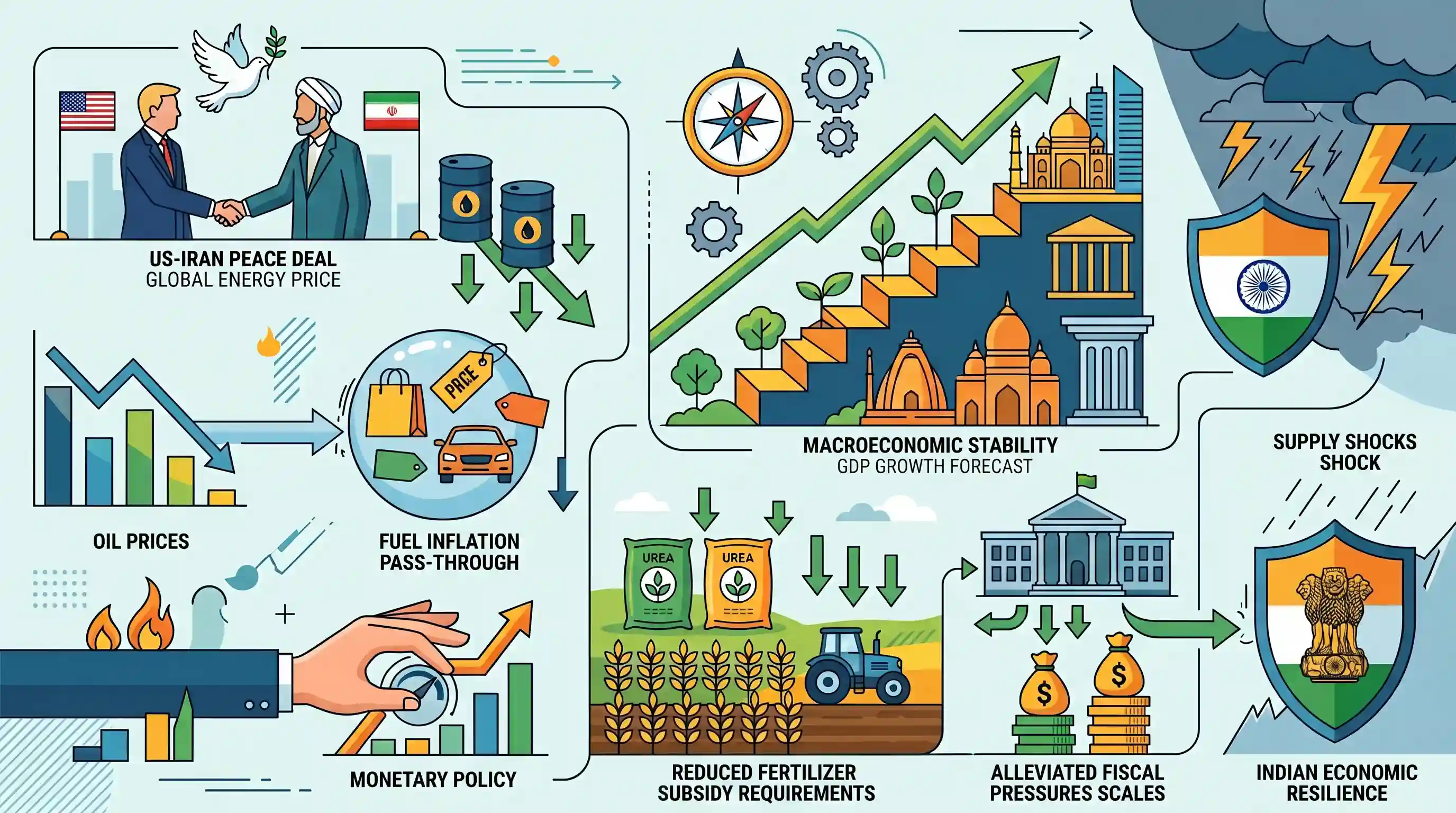
Global investment firm Goldman Sachs has raised India's real GDP growth forecast for CY26 and FY27, citing the positive macroeconomic impact of declining crude oil prices following a recent US-Iran peace deal. The drop in energy and petrochemical prices diminishes the risk of fuel inflation pass-through, prompting a lower core goods inflation forecast. Furthermore, a sharp correction in global urea prices is anticipated to substantially reduce India's fertilizer subsidy requirements, thereby alleviating near-term fiscal pressures. This upgraded outlook highlights the Indian economy's resilience against global supply shocks, contrasting with the RBI's earlier cautious stance on inflation and growth.
Key Points
- Goldman Sachs upgraded India's real GDP growth forecast for CY26 to 6.8% and FY27 to 6.5%, attributing the revision to falling global crude oil prices.
- The drop in oil and petrochemical prices reduces the risk of fuel cost pass-through to consumers, prompting a downward revision in core goods inflation estimates.
- A significant correction in global urea prices is expected to curtail the government's fertilizer subsidy bill, easing India's near-term fiscal deficit pressures.
- The optimistic outlook follows an earlier move by the RBI's Monetary Policy Committee, which had lowered its growth projection to 6.6% while hiking the inflation forecast.
- The Indian economy remained resilient amid West-Asian geopolitical shocks, supported by fiscal measures that absorbed rising energy costs.
Important Terms
Real GDP

The total market value of all final goods and services produced within a country in a specific period, adjusted for inflation (constant prices).
UPSC context
GS Paper 3: Essential for understanding macroeconomic growth, national income accounting, and measuring the economy's actual productive capacity.
Core Inflation
A measure of inflation that excludes volatile food and energy/fuel prices, reflecting underlying, persistent price trends in the economy.
UPSC context
GS Paper 3: Crucial for Monetary Policy analysis, distinguishing between temporary supply shocks and structural demand-driven price pressures.
Fertilizer Subsidy
Government financial support to ensure farmers receive fertilizers (like urea) at affordable rates, covering the gap between production/import costs and retail prices.
UPSC context
GS Paper 3: Key fiscal component affecting the budget deficit and agricultural input costs in India.
Monetary Policy Committee (MPC)
A six-member statutory body under the RBI Act, 1934, responsible for fixing the benchmark interest rate (repo rate) to maintain price stability.
UPSC context
GS Paper 3: Central to banking and economic stability topics; tests knowledge of inflation targeting and institutional frameworks.
US-Iran Peace Deal
A landmark diplomatic agreement (June 2026) that reopened the Strait of Hormuz, significantly lowering global crude oil and energy-related commodity prices.
UPSC context
GS Paper 2 & 3: Illustrates the impact of West Asian geopolitics on India's energy security and macroeconomic stability.
Prelims Trap
"A drop in global crude oil prices has no impact on core inflation as fuel is explicitly excluded."
Core inflation excludes the direct fuel index, but crude oil dictates transport and manufacturing input costs. This 'fuel pass-through' indirectly impacts core goods inflation.
Static Concepts Connected
How do global crude oil prices impact India's broader macroeconomic indicators?
- Current Account Deficit: Falling oil prices shrink the import bill, naturally narrowing the CAD and supporting Rupee stability.
- Imported Inflation: Lower fuel costs reduce transport and production expenses across sectors, suppressing general price levels beyond just the fuel basket.
- Fiscal Space: Cheaper oil decreases the political/economic need for the government to cut excise duties, preserving tax revenues.
How does the urea subsidy operate within India's fiscal policy?
- Statutory Pricing: Urea is provided to farmers at a fixed Maximum Retail Price (MRP). The Centre pays the difference between production cost and MRP to manufacturers.
- Revenue Expenditure: Fertilizer subsidies are purely revenue expenditure, offering no direct long-term asset creation but essential for food security.
- Import Dependence: Because India heavily imports natural gas (feedstock) and finished urea, global price drops directly reduce the fiscal deficit pressure.
Cross-Topic Patterns
Middle East geopolitics & agricultural subsidies
US-Iran detente stabilizes global energy supply, directly shrinking India's fertilizer import bill and freeing up government revenue expenditure for domestic capital infrastructure.
Monetary policy vs. Supply-side shocks
The MPC manages inflation via demand-side tools (repo rates), but relies heavily on government fiscal interventions (like excise duty cuts) to absorb external supply-side energy shocks.

Expect a Prelims question linking global crude price drops simultaneously to CAD, core goods inflation, and revenue expenditure in 2026.
Linked PYQs · 5
Linked PYQs · 5
- 2022PrelimsGS1
With reference to the Indian economy, consider the following statements: 1. If the inflation is too high, Reserve Bank of India (RBI) is likely to buy government securities. 2. If the rupee is rapidly depreciating, RBI is likely to sell dollars in the market. 3. If interest rates in the USA or European Union were to fall, that is likely to induce RBI to buy dollars. Which of the statements given above are correct?
- 2022PrelimsGS1
In India, which one of the following is responsible for maintaining price stability by controlling inflation?
- 2025PrelimsGS1
Suppose the revenue expenditure is ₹ 80,000 crores and the revenue receipts of the Government are ₹60,000 crores. The Government budget also shows borrowings of ₹ 10,000 crores and interest payments of ₹ 6,000 crores. Which of the following statements are correct? I. Revenue deficit is ₹ 20,000 crores. II. Fiscal deficit is ₹ 10,000 crores. III. Primary deficit is ₹ 4,000 crores. Select the correct answer using the code given below.
- 2025PrelimsGS1
A country's fiscal deficit stands at ₹50,000 crores. It is receiving ₹10,000 crores through non-debt creating capital receipts. The country's interest liabilities are ₹1,500 crores. What is the gross primary deficit?
- 2018MainsGS3
How would the recent phenomena of protectionism and currency manipulations in world trade affect macroeconomic stability of India?
