US Sovereign Debt and Macroeconomic Implications for Gold Prices
Source:Indian Express ↗
Why It Matters
Understanding the interplay between US fiscal policy, global debt, and gold prices is critical for UPSC aspirants, as it directly impacts India's macroeconomic stability, exchange rates, and balance of payments.
Summary
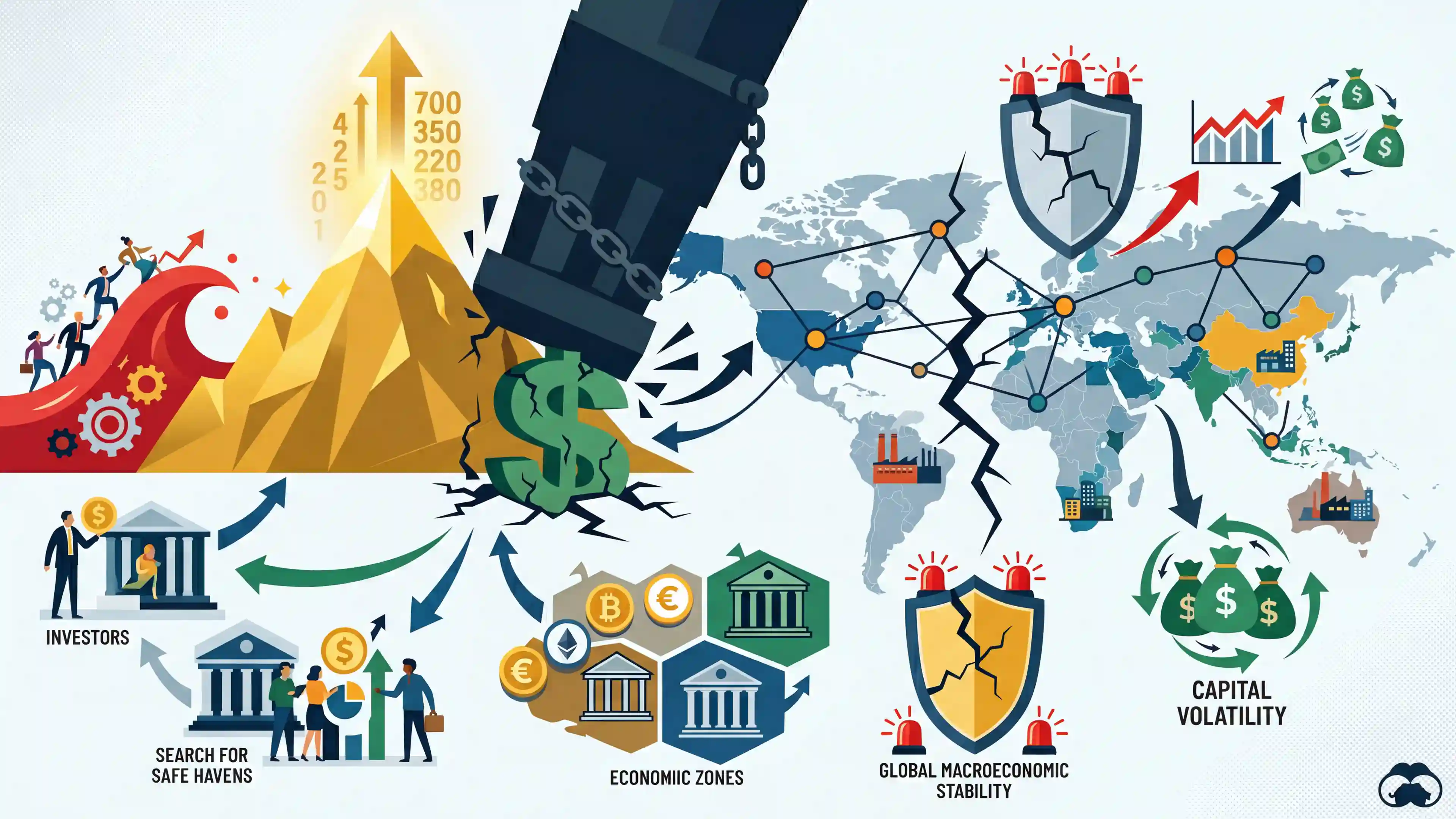
Gold prices are poised for a massive surge, potentially reaching $5,000, driven by the dual catalysts of the 'Trump Rally' and a staggering $38 trillion US national debt. These factors are systematically eroding confidence in the US dollar and the broader fiat currency system. As investors and central banks increasingly turn to gold as a safe-haven asset, the global financial system faces severe fragmentation risks. This shift highlights a growing trend of de-dollarization and raises alarms about global macroeconomic stability, particularly for emerging economies facing imported inflation and capital volatility.
Key Points
- The US national debt has ballooned to $38 trillion, creating a systemic risk or 'time bomb' that threatens the stability of the global financial architecture.
- The so-called 'Trump Rally' reflects market anticipation of expansionary fiscal policies, deregulation, and protectionism, which could exacerbate inflation and deficit spending.
- A projected surge in gold prices to $5,000 per ounce underscores growing global anxieties regarding fiat currencies and a gradual shift towards de-dollarization by central banks.
- The combination of soaring sovereign debt and inflation fears poses significant macroeconomic challenges for developing nations, including potential capital flight and imported inflation in India.
Important Terms
De-dollarization

The global process of reducing reliance on the US dollar as the primary reserve currency, medium of exchange, and unit of account in international trade and finance.
UPSC context
GS Paper II & III: International Relations and Economy; tests understanding of global financial shifts, currency sovereignty, and India’s strategic trade interests.
Sovereign Debt
The total financial obligations or liabilities owed by a central government, typically in the form of bonds and securities, to both domestic and external lenders.
UPSC context
GS Paper III: Indian Economy; concerns fiscal policy, debt sustainability, and the macroeconomic impact of global debt crises on emerging markets.
Fiat Currency
Government-issued currency that is not backed by a physical commodity like gold or silver but derives its value from government decree and public trust.
UPSC context
GS Paper III: Economy; fundamental concept in money and banking, differentiating between legal tender and commodity-based monetary systems.
Safe-haven Asset
An investment that is expected to retain or increase its value during periods of high market volatility, economic turmoil, or geopolitical instability.
UPSC context
GS Paper III: Economy; focuses on investment patterns, risk management, and gold’s role as a hedge against inflation and currency depreciation.
Imported Inflation
A rise in domestic prices caused by the increasing cost of imported goods or inputs, often driven by international commodity price hikes or domestic currency depreciation.
UPSC context
GS Paper III: Economy; critical for understanding the external factors affecting India’s Consumer Price Index (CPI) and exchange rate management.
US Federal Reserve
The central banking system of the United States, responsible for managing monetary policy, interest rates, and global liquidity, which significantly influences emerging market capital flows.
UPSC context
GS Paper III: Economy; tests knowledge of the 'taper tantrum', foreign portfolio investment (FPI) dynamics, and global monetary interdependencies.
Prelims Trap
Rising US sovereign debt yields increase Foreign Portfolio Investment (FPI) into emerging markets like India.
Higher US yields actually trigger capital flight from emerging markets, as investors pull money back to the US for safer returns. This drains FPI and weakens the Rupee.
Static Concepts Connected
How do surging global gold prices impact India's Balance of Payments (BoP)?
- Current Account (CAD): Gold is a major import. Surging prices inflate the import bill, widening the trade deficit and the Current Account Deficit (CAD).
- Currency Depreciation: A widening CAD increases demand for foreign exchange (dollars) to pay for imports, exerting downward pressure on the Indian Rupee.
- Capital Account pressure: To finance a wider CAD without depleting forex reserves, India becomes heavily reliant on volatile Capital Account inflows like FPI.
What is 'Imported Inflation' and how does it restrict central banks?
- Mechanism: It occurs when rising global commodity prices or a depreciating domestic currency make imported goods (like oil and electronics) more expensive locally.
- RBI Policy Dilemma: It forces the RBI to maintain tight monetary policy (higher repo rates) to control inflation, even if domestic economic growth is slowing and needs stimulus.
Cross-Topic Patterns
De-dollarization & Strategic Autonomy
Rising US debt and weaponization of the dollar are accelerating the Global South's push toward local currency trade (e.g., Special Rupee Vostro accounts) and gold-backed reserves to ensure strategic autonomy.
Fiscal Expansion & Twin Deficits
The anticipated US protectionism and fiscal expansion mirror India's own historical vulnerabilities to the Twin Deficit hypothesis, where high fiscal deficits inevitably spill over into widening current account deficits.

Expect a multi-statement Prelims question linking US bond yields, gold-induced CAD widening, and RBI's forex interventions.
Linked PYQs · 3
Linked PYQs · 3
- 2018MainsGS3
How would the recent phenomena of protectionism and currency manipulations in world trade affect macroeconomic stability of India?
- 2015MainsGS3
Craze for gold in Indians has led to a surge in import of gold in recent years and put pressure on balance of payments and external value of rupee. In view of this, examine the merits of the Gold Monetization Scheme.
- 2020PrelimsGS1
"Gold Tranche" (Reserve Tranche) refers to
