India growth faces global headwinds requiring proactive policy support
Source:Indian Express ↗
Why It Matters
The article highlights the structural imbalances in India's growth (services vs. manufacturing) and exposes its vulnerability to global economic shocks. For UPSC aspirants, it is a prime case study on how external headwinds (protectionism, supply shocks, geopolitical conflicts) transmit to domestic macroeconomic indicators (inflation, currency depreciation, BoP stress) and the ensuing policy responses required from fiscal and monetary authorities.
Summary
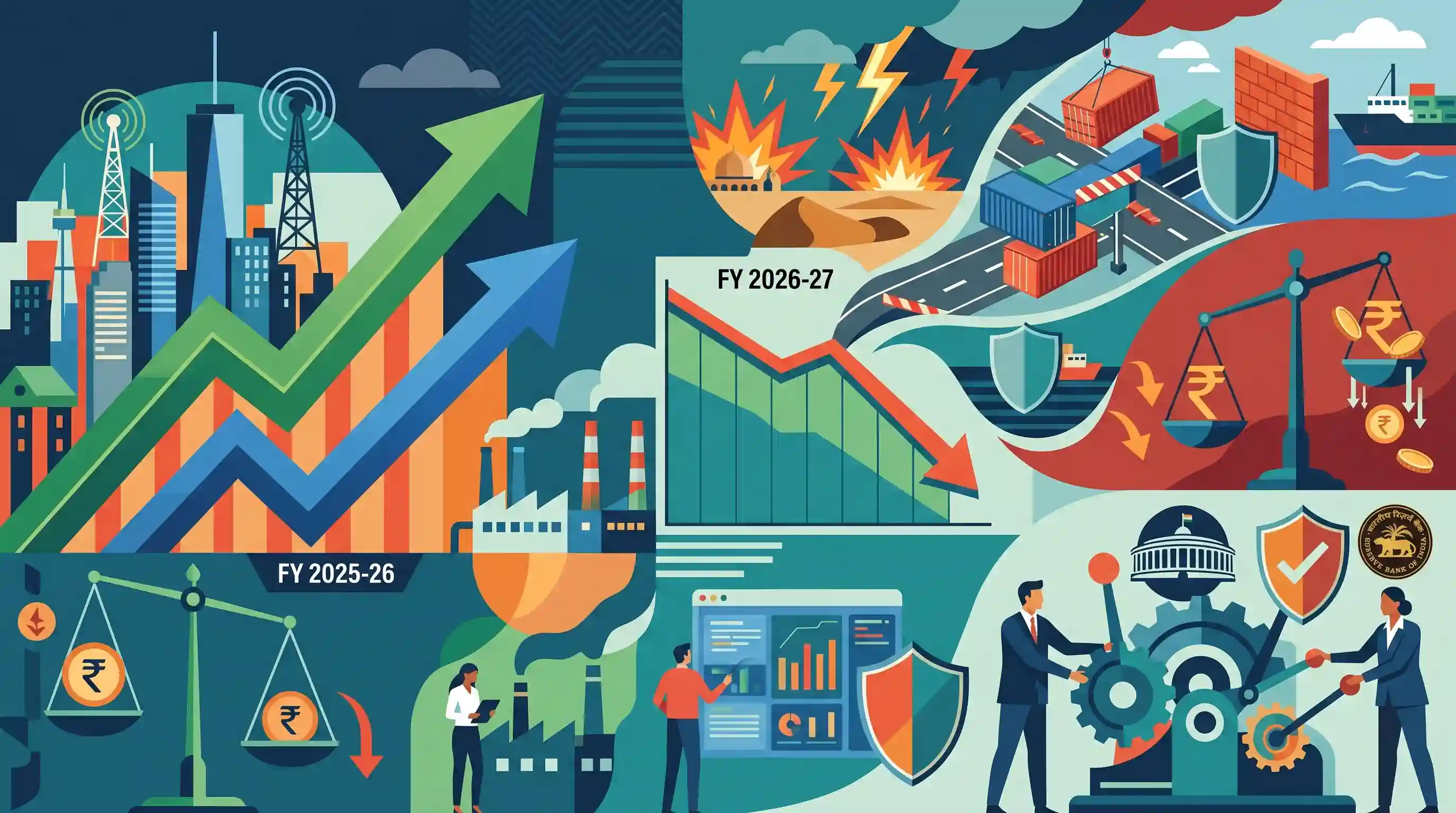
The Indian economy concluded FY 2025-26 with a robust real GDP growth of 7.7%, fueled predominantly by the services sector, although manufacturing continued to lag and nominal growth fell short of expectations. Looking ahead to FY 2026-27, the RBI projects a slowdown to 6.6% as the economy faces significant external headwinds. Factors such as volatile energy prices stemming from the West Asia conflict, supply chain bottlenecks, and the looming risk of protectionist trade policies (e.g., Trump tariffs) pose risks to macroeconomic stability. Consequently, India's balance of payments and currency valuation are expected to face pressure, making coordinated and proactive policy interventions by both the government and the RBI essential to sustain growth and stability.
Key Points
- India achieved a solid 7.8% real GDP growth in Q4 of FY 2025-26, capping the full-year growth at 7.7%.
- Economic expansion was largely driven by a nearly 10% growth in the services sector, while the manufacturing sector remained weak and nominal GDP growth underperformed at 8.9%.
- The RBI has forecasted a growth deceleration to 6.6% for FY 2026-27, representing a 1.1 percentage point drop from the previous year.
- Impending economic headwinds include global supply chain disruptions, rising energy and commodity prices due to conflicts in West Asia, and the threat of global protectionism such as proposed Trump tariffs.
- These external vulnerabilities threaten to strain India's balance of payments and put downward pressure on the currency, necessitating targeted fiscal and monetary policy support.
Important Terms
Reserve Bank of India (RBI)

India's central bank and regulatory body responsible for monetary policy, inflation targeting (4% ± 2%), and maintaining financial stability. It manages currency issuance and foreign exchange reserves.
UPSC context
GS3 (Indian Economy). Tests knowledge of monetary tools (repo rate), inflation mandates, and its role as 'lender of last resort.'
Balance of Payments (BoP)
A comprehensive ledger recording all economic transactions between residents of a country and the rest of the world, comprising the current account (trade) and capital account (investments).
UPSC context
GS3 (External Sector). Vital for analyzing currency resilience, trade deficits, and sovereign credit ratings.
Real vs. Nominal GDP
Nominal GDP measures output at current market prices, while Real GDP is adjusted for inflation using constant base-year prices to capture actual physical growth.
UPSC context
GS3 (Growth and Development). Tests ability to identify 'inflation illusion' and assess true economic performance over time.
Protectionist Trade Policies
Economic measures, such as tariffs or quotas, implemented to restrict imports and favor domestic manufacturers over foreign competitors.
UPSC context
GS3 (International Trade). Evaluates the impact of global trade barriers on India’s exports and manufacturing competitiveness.
Union Government
The central executive authority of India, which manages fiscal policy, national budgeting, and broad economic reforms to complement the RBI's monetary stability.
UPSC context
GS2/GS3. Focuses on fiscal consolidation, capital expenditure (Capex), and the legislative framework for economic growth.
Macroeconomic Stability
A state of economic health characterized by low, stable inflation, sustainable fiscal and current account deficits, and steady, predictable GDP growth.
UPSC context
GS3 (Indian Economy). Represents the ultimate policy goal; tests the ability to balance growth imperatives against external shocks.
Prelims Trap
A narrow gap between India's real and nominal GDP growth indicates high domestic inflation.
False. A narrow gap implies a low GDP deflator. Since the deflator measures broader inflation across all domestic production, a small gap signifies subdued overall inflation or deflationary trends, not high inflation.
Static Concepts Connected
How does the GDP Deflator differ from CPI and WPI?
- Comprehensive coverage: Covers all domestically produced goods and services, unlike the fixed consumer or wholesale baskets used by CPI and WPI.
- Import exclusion: Excludes prices of imported goods entirely, whereas the CPI basket includes imported consumer items consumed domestically.
- Calculation formula: It is not based on a fixed survey but calculated automatically as the ratio of Nominal GDP to Real GDP, multiplied by 100.
What are the primary components of the Balance of Payments (BoP)?
- Current Account: Records trade in goods (merchandise/trade balance), trade in services (invisibles), and unilateral transfers like NRI remittances and grants.
- Capital Account: Records cross-border capital transactions, including FDI, FPI, External Commercial Borrowings (ECBs), and NRI banking deposits.
- Forex Reserves: Acts as the balancing item; overall BoP deficits or surpluses are managed by drawing down or adding to the RBI's foreign exchange reserves.
Cross-Topic Patterns
Protectionism vs. Make in India
Rising global tariffs threaten India's export-driven manufacturing goals under the PLI scheme, forcing a policy shift towards new FTAs to secure diverse market access.
West Asia conflict & Imported Inflation
Geopolitical shocks in West Asia raise global crude prices, simultaneously widening India's Current Account Deficit (CAD) and importing inflation, which complicates RBI's interest rate easing cycle.

Expect a 2026 prelims question linking a low GDP deflator to WPI trends, testing how narrow real-nominal GDP gaps impact debt-to-GDP.
Linked PYQs · 4
Linked PYQs · 4
- 2023MainsGS3
Faster economic growth requires increased share of the manufacturing sector in GDP, particularly of MSMEs. Comment on the present policies of the Government in this regard.
- 2018MainsGS3
How would the recent phenomena of protectionism and currency manipulations in world trade affect macroeconomic stability of India?
- 2024MainsGS3
What are the causes of persistent high food inflation in India? Comment on the effectiveness of the monetary policy of the RBI to control this type of inflation.
- 2022PrelimsGS1
With reference to the Indian economy, consider the following statements: 1. An increase in Nominal Effective Exchange Rate (NEER) indicates the appreciation of rupee. 2. An increase in the Real Effective Exchange Rate (REER) indicates an improvement in trade competitiveness. 3. An increasing trend in domestic inflation relative to inflation in other countries is likely to cause an increasing divergence between NEER and REER. Which of the above statements are correct?
