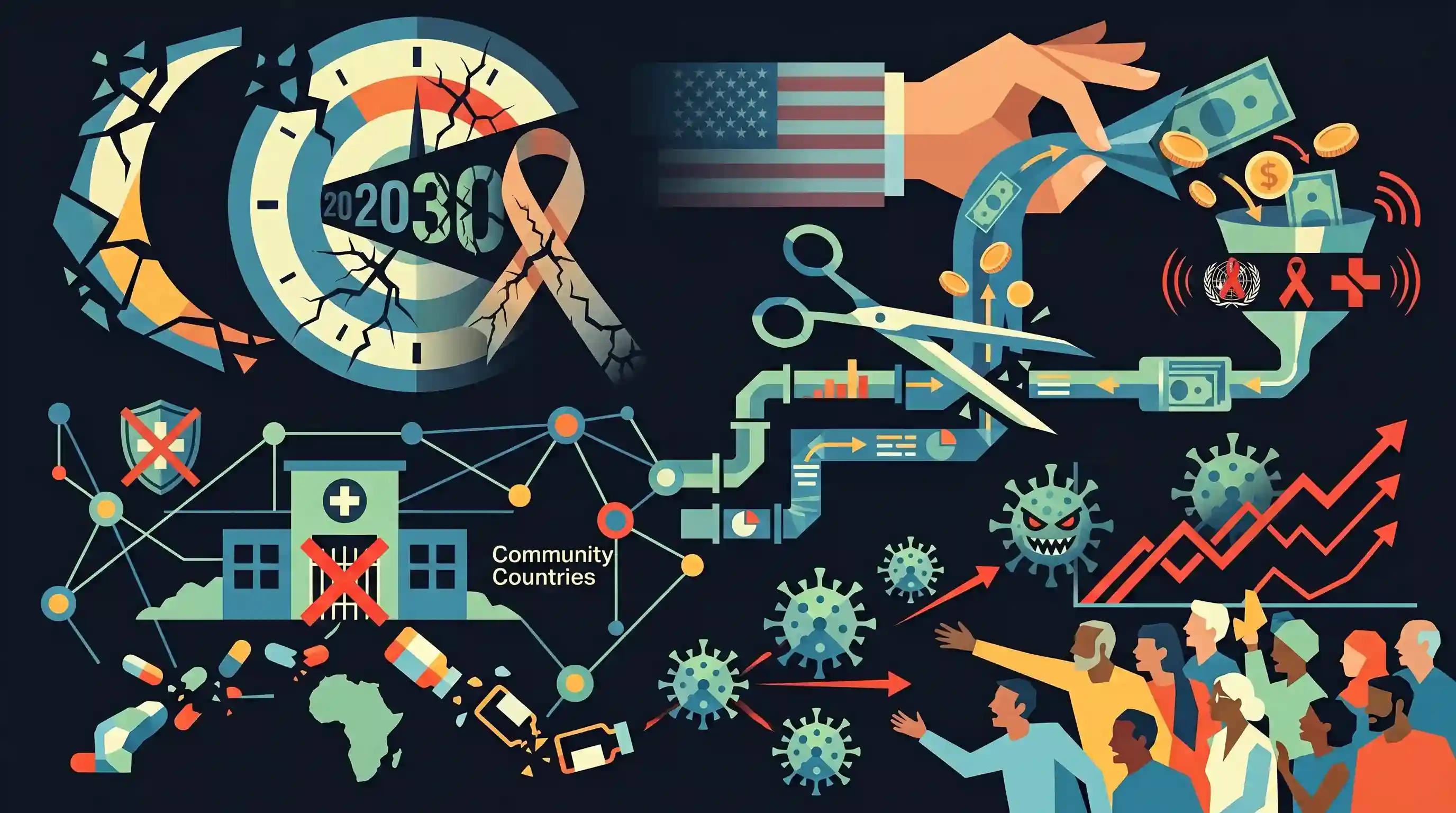
US funding cuts threaten global target to end AIDS by 2030
Source:The Hindu ↗
Why It Matters
The withdrawal of major international healthcare funding underscores the vulnerability of global health initiatives to domestic political shifts in donor countries. This is crucial for understanding the challenges in achieving Sustainable Development Goals (SDG 3) and the necessity of resilient, self-reliant public health infrastructure to combat infectious diseases like HIV/AIDS.
Summary
UNAIDS has warned that the global goal to eradicate AIDS as a public health threat by 2030 is slipping further out of reach, a situation significantly exacerbated by recent cuts in U.S. foreign aid for HIV/AIDS programs. With 1.3 million new infections recorded in 2023, the global trajectory was already faltering. However, the suspension of critical international funding is now actively disrupting the supply of life-saving antiretroviral treatments and forcing the closure of essential community prevention clinics. Countries like South Africa, which bears the highest global burden of HIV cases, face severe public health crises as a direct consequence of these financial constraints.
Key Points
- The global objective to end AIDS as a public health threat by 2030 is increasingly off-track, exacerbated by recent reductions in global health funding.
- In 2023, there were 1.3 million new HIV infections globally, indicating that eradication efforts were already struggling to meet targets.
- Cuts to U.S. foreign aid are directly causing disruptions in the supply of life-saving HIV treatments and forcing the closure of community prevention clinics.
- South Africa, which has the world's highest number of people living with HIV (approximately 8 million), is particularly vulnerable to these funding shortfalls.
Important Terms
UNAIDS

The Joint United Nations Programme on HIV/AIDS leads global efforts to end the epidemic by 2030. It coordinates 11 UN organizations and provides strategic direction, data, and technical support to countries.
UPSC context
GS Paper II: International institutions and their mandates. Important for global health governance and multi-agency coordination.
PEPFAR
The U.S. President’s Emergency Plan for AIDS Relief is a major foreign aid program providing funding for HIV prevention and treatment globally. It is the largest commitment by any nation to a single disease.
UPSC context
GS Paper II: Effect of policies of developed countries on global public health and India's interests.
Antiretroviral Therapy (ART)
A daily regimen of medications that suppresses HIV replication. It prevents progression to AIDS, restores immune function, and reduces viral load to undetectable levels, making the virus untransmittable (U=U).
UPSC context
GS Paper III: Science and Technology—developments in health and medicine and their impact.
SDG 3.3
A specific United Nations target under Sustainable Development Goal 3 to end the epidemics of AIDS, tuberculosis, malaria, and neglected tropical diseases as public health threats by 2030.
UPSC context
GS Paper II: Issues relating to Social Sector and Health management and global policy targets.
National AIDS Control Programme (NACP)
India’s flagship initiative managed by NACO, currently in Phase V (2021–2026). It focuses on free treatment, reducing new infections by 80%, and eliminating HIV-related stigma and discrimination.
UPSC context
GS Paper II: Government policies and interventions for development in health sectors.
95-95-95 Targets
A UNAIDS strategy aiming for 95% of people living with HIV to know their status, 95% of those to receive treatment, and 95% of those to achieve viral suppression by 2030.
UPSC context
GS Paper II/III: Health sector milestones and strategic management of communicable diseases.
Prelims Trap
"The global target under SDG 3 is the complete eradication of the HIV virus by 2030."
SDG 3.3 aims to end AIDS as a 'public health threat' by reducing transmission and mortality, not achieving absolute global viral eradication, as HIV currently remains incurable.
Static Concepts Connected
How does HIV affect the human body and what is the role of ART?
- Target Cells (CD4): HIV is a retrovirus that directly attacks and destroys CD4 T lymphocytes (white blood cells), severely compromising the body's immune system.
- ART Mechanism: It suppresses viral replication and reduces the viral load to undetectable levels. While it prevents progression to AIDS, it is a management tool, not a complete cure.
- Transmission Vectors: It spreads via infected bodily fluids (blood, semen, breast milk), shared unsterilized needles, and mother-to-child transmission during pregnancy or birth.
What are the communicable disease targets under Sustainable Development Goal 3?
- Target 3.3: Target 3.3 explicitly aims to end the epidemics of AIDS, tuberculosis, malaria, and neglected tropical diseases (NTDs) by 2030.
- Public Health Threat: Ending a disease means reducing its incidence and mortality to a level where it no longer constitutes a major public health burden, not necessarily global biological eradication.
Cross-Topic Patterns
Health diplomacy and aid reliance
The disruption of global HIV goals due to U.S. budget cuts illustrates how domestic policy shifts in developed nations (like PEPFAR cuts) can critically cripple developing-world public health infrastructure.
India's self-funded NACP shield
While global clinics face closure from international aid cuts, India insulated its National AIDS Control Programme (Phase-V) by structuring it as a fully GoI-funded Central Sector Scheme.

Expect a 2026 prelims statement testing the distinction between ending a disease as a 'public health threat' (AIDS) vs total eradication.
Linked PYQs · 3
Linked PYQs · 3
- 2021MainsGS2
“Besides being a moral imperative of a Welfare State, primary health structure is a necessary precondition for sustainable development.” Analyze.
- 2019PrelimsGS1
Which one of the following statements is not correct?
- 2013PrelimsGS1
Which of the following diseases can be transmitted from one person to another through tattooing? 1. Chikungunya 2. Hepatitis B 3. HIV-AIDS Select the correct answer using the codes given below.
