Goa Proposed Social Media Ban for Minors and Child Protection
Source:Indian Express ↗
Why It Matters
The regulation of children's digital footprints is a critical contemporary governance issue. This proposed ban highlights the tension between child welfare in the digital era and the practicalities of enforcing age restrictions online, a theme directly relevant to the role of the NCPCR and the broader impacts of technology on society.
Summary
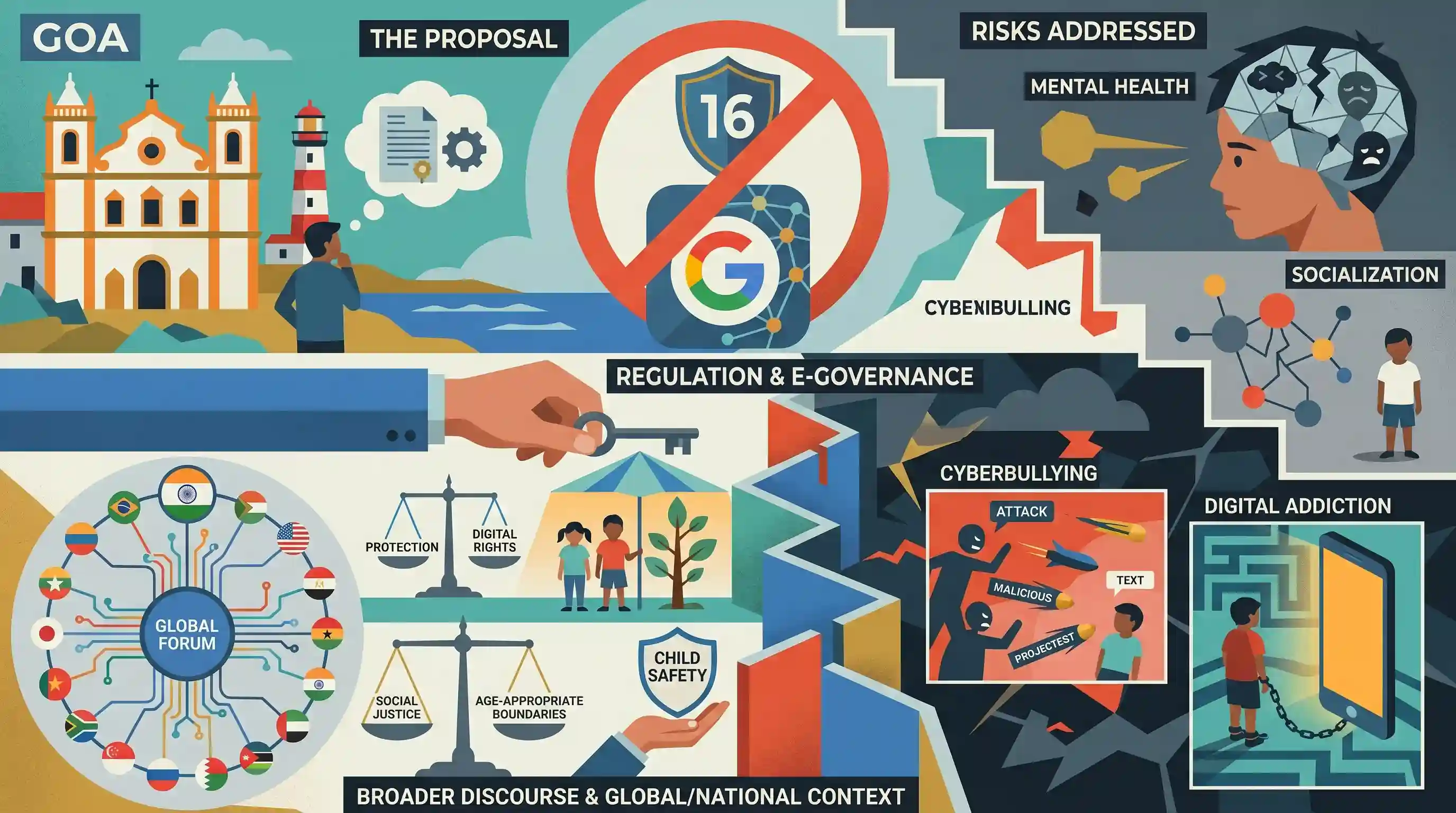
The Goa government is reportedly evaluating a proposal to ban social media use for children under the age of 16. This potential move aims to address growing concerns regarding the impact of digital platforms on the mental health and socialization of young people. By seeking to mitigate risks like cyberbullying and digital addiction, Goa's initiative reflects a broader global and national discourse on regulating cyberspace to ensure child safety and enforce age-appropriate digital boundaries.
Key Points
- The Goa government is considering implementing a ban on social media usage for children under the age of 16.
- The proposed regulation aims to shield minors from the adverse psychological and social effects of social media, including addiction, cyberbullying, and exposure to inappropriate content.
- This initiative mirrors emerging global trends (such as recent legislative efforts in Australia) to strictly regulate children's digital access and enforce stringent age verification.
- While aimed at child protection, the move raises implementation challenges and debates over digital rights, privacy, and the balance between protecting youth and restricting their access to information.
Important Terms
Digital Personal Data Protection (DPDP) Act, 2023

India’s primary law governing personal data; it classifies individuals under 18 as children, mandating special protections like parental consent and prohibiting behavioral tracking or targeted ads for minors.
UPSC context
GS Paper II (Governance) and GS III (Cyber Security). Critical for understanding privacy rights and digital regulation in India.
Verifiable Parental Consent
A legal requirement under the DPDP Act where data fiduciaries must authenticate that a minor's personal data processing is authorized by a legal guardian, typically through government-backed IDs or tokens.
UPSC context
GS Paper II (Social Justice/Vulnerable Sections). Tests knowledge of the technical and legal challenges in protecting child rights online.
Information Technology (IT) Rules, 2021
Regulations under the IT Act, 2000, governing social media intermediaries and digital news; current proposals suggest amending these to enforce age-based restrictions or bans for users under 16.
UPSC context
GS Paper II (Executive/Governance). Essential for questions on social media regulation, intermediary liability, and digital ethics.
Cyberbullying
The act of harassing, intimidating, or demeaning individuals via digital platforms; cited as a primary driver for the Goa government's proposal to ban social media for minors.
UPSC context
GS Paper III (Cyber Security) and GS Paper II (Social Issues). Relates to the impact of technology on societal mental health.
Digital Sovereignty
The principle that a state has the authority to regulate digital activities within its borders; this includes balancing child safety with global tech platform operations and individual digital rights.
UPSC context
GS Paper II (Polity/International Relations). Relevant for discussions on India's regulatory autonomy and the "Australian model" of digital governance.
Data Fiduciary
Any person or entity that determines the purpose and means of processing personal data (e.g., social media platforms); they bear legal responsibility for child data safety under the DPDP Act.
UPSC context
GS Paper III (Economy/Cyber Security). Tests understanding of corporate accountability in the digital economy and data protection frameworks.
Government of Goa
The executive authority of the state of Goa; here, acting as a sub-national catalyst by proposing federal-level social media curbs despite "Communication" being a Union List subject.
UPSC context
GS Paper II (Federalism). Illustrates the role of states in influencing national policy on subjects of concurrent social concern.
Prelims Trap
The DPDP Act 2023 explicitly prohibits children under 18 from using social media platforms.
The Act doesn't ban access; it mandates verifiable parental consent for data processing and prohibits targeted advertising and behavioral monitoring directed at minors.
Static Concepts Connected
How does the DPDP Act 2023 regulate children's digital data?
- Age Definition: Strictly defines a 'child' as any individual under the age of 18 years for data protection purposes.
- Verifiable Consent: Mandates platforms (data fiduciaries) to obtain verifiable parental consent before processing any personal data of a minor.
- Targeted Ads Banned: Explicitly prohibits tracking, behavioral monitoring, and targeted advertising directed at children.
What constitutional concepts support state intervention in child welfare?
- Parens Patriae: The legal doctrine allowing the state to act as a guardian for those unable to protect themselves, such as minors.
- Article 39(f): A Directive Principle directing the state to ensure children are protected against moral and material abandonment and exploitation.
Cross-Topic Patterns
Federalism in Digital Regulation
Since Communications and IT fall under the Union List, a State (like Goa) banning social media raises constitutional debates over legislative jurisdiction in regulating the internet.
E-Governance vs. Data Minimization
Enforcing age-gating via tools like DigiLocker requires mandatory identity verification, creating friction between child protection goals and the DPDP Act's core principle of data minimization.

Expect a 2026 GS2 Mains question assessing the DPDP Act's child data provisions against the Puttaswamy proportionality test.
Linked PYQs · 3
Linked PYQs · 3
- 2025MainsGS2
The National Commission for Protection of Child Rights has to address the challenges faced by children in the digital era. Examine the existing policies and suggest measures the Commission can initiate to tackle the issue.
- 2023MainsGS1
Child cuddling is now being replaced by mobile phones. Discuss its impact on the socialization of children.
- 2024MainsGS3
Social media and encrypting messaging services pose a serious security challenge. What measures have been adopted at various levels to address the security implications of social media? Also suggest any other remedies to address the problem.
