Goa Nightclub Fire Exposes Severe Building Code Violations
Source:Indian Express ↗
Why It Matters
This tragedy serves as a highly relevant case study for GS3 Disaster Management and GS1 Urbanization, illustrating the life-threatening consequences of poor urban planning, non-compliance with the National Building Code, and the importance of risk assessment in public spaces.
Summary
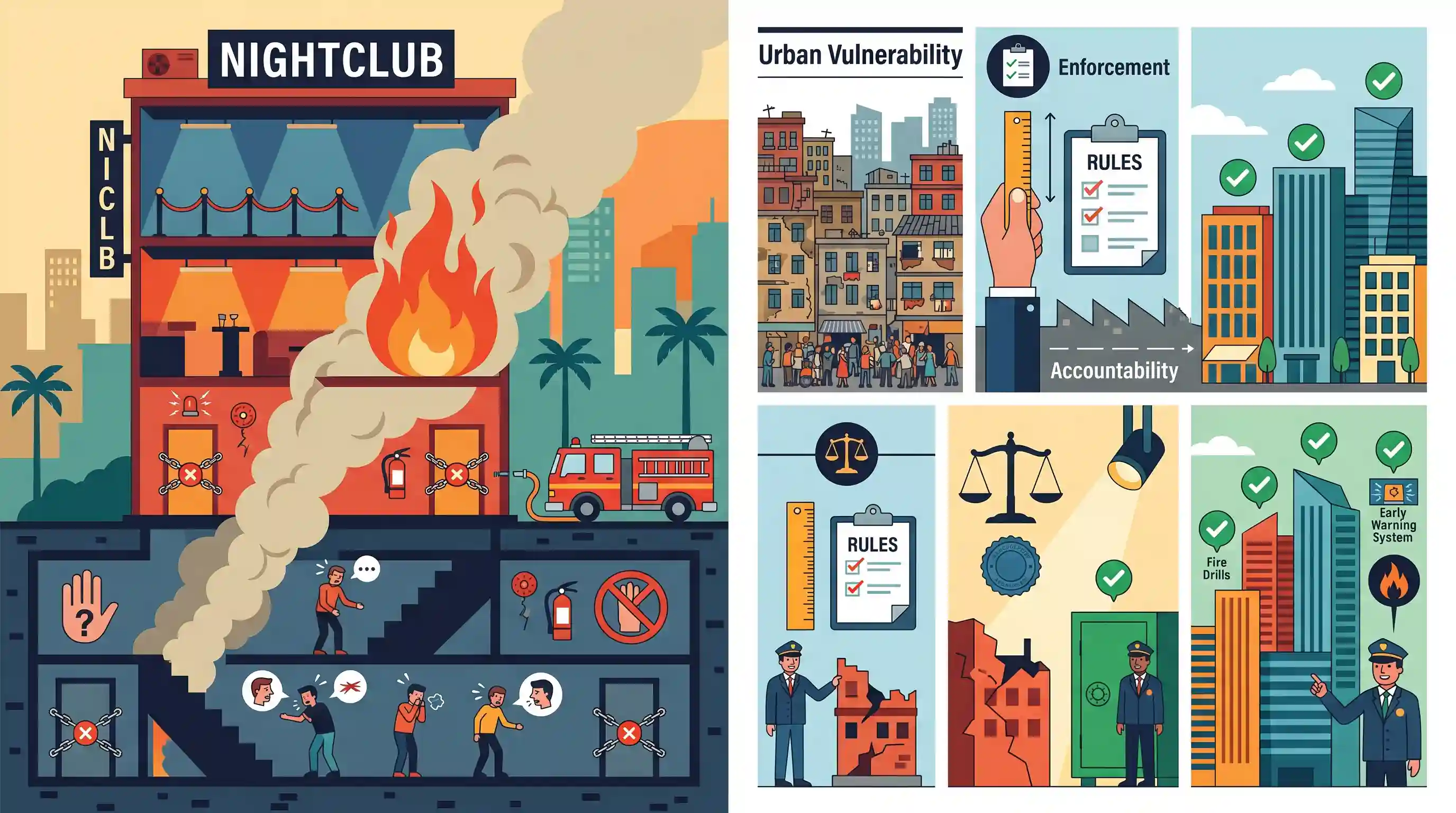
A tragic fire at a Goa nightclub claimed multiple lives due to suffocation after patrons were trapped in the basement with no escape route. The fire, which originated on the first floor, exposed glaring violations of building codes and inadequate fire safety measures. The incident underscores the vulnerabilities in urban infrastructure, highlighting the pressing need for strict enforcement of safety regulations and proactive disaster risk management in commercial spaces.
Key Points
- A fire at a Goa nightclub started on the first floor and trapped patrons in the basement, leading to multiple deaths by suffocation.
- The incident highlights severe violations of fire safety norms and the absence of adequate emergency evacuation routes in urban commercial establishments.
- It exposes the administrative negligence in enforcing building codes and regulating the safety of public spaces.
- The tragedy underscores the urgent need for comprehensive risk assessment, stringent safety audits, and disaster preparedness in urban centers.
Important Terms
National Building Code of India (NBC)

A comprehensive set of guidelines by the Bureau of Indian Standards (BIS) regulating building construction, structural integrity, and fire safety (Part 4). It serves as a model for state building regulations.
UPSC context
GS Paper 3: Infrastructure/Disaster Management. Tests knowledge of safety standards and regulatory frameworks for urban development.
Disaster Management Act, 2005
A 2005 legislation establishing a multi-tier institutional framework (NDMA, SDMA, DDMA) to manage disasters. It shifted India's approach from reactive relief to proactive mitigation, preparedness, and response.
UPSC context
GS Paper 3: Disaster Management. Tests understanding of the legal architecture for managing man-made and natural crises.
Urban Vulnerability
The susceptibility of urban areas to hazards due to high population density, unplanned growth, and inadequate infrastructure. It emphasizes the risk posed by non-compliant buildings and poor emergency access.
UPSC context
GS Paper 1: Urbanization; GS Paper 3: Disaster Management. Tests ability to analyze risks in rapidly growing Indian cities.
Fire and Emergency Services
A state-governed function under the 12th Schedule of the Constitution, responsible for fire prevention and emergency response. They enforce safety norms via the State Fire Services Act.
UPSC context
GS Paper 2: Governance/Local Bodies. Tests knowledge of the division of powers and state-level disaster response mechanisms.
Model Building Bye-laws, 2016
A set of guidelines issued by the Ministry of Housing and Urban Affairs (MoHUA) to help states modernize their local building regulations for safety and sustainability.
UPSC context
GS Paper 3: Infrastructure. Tests understanding of policy efforts to standardize urban safety and planning across India.
Fire Safety Audit
A systematic assessment of a building’s fire safety measures, including escape routes and equipment, to ensure compliance with the NBC. It is a vital tool for disaster prevention.
UPSC context
GS Paper 3: Disaster Management. Tests application of safety regulations and accountability in preventing man-made disasters.
Prelims Trap
The National Building Code 2016 is a legally binding statute strictly mandated across all states by the Union Government.
The NBC is purely recommendatory. It only becomes legally binding when States or Urban Local Bodies incorporate its guidelines into their local building bye-laws.
Static Concepts Connected
Under which Constitutional provision does the administration of 'Fire Services' fall in India?
- State Subject: Primarily falls under the jurisdiction of the State Governments (Entry 5, State List, 7th Schedule).
- 12th Schedule: Under Article 243W, state legislatures can devolve the function of 'Fire Services' to Municipalities or Urban Local Bodies.
What are the core components of proactive Urban Fire Risk Mitigation?
- Structural Audits: Transitioning from reactive firefighting to periodic pre-disaster structural and electrical safety audits of commercial buildings.
- Compliance and Retrofitting: Ensuring mandatory dual exits, automated smoke extraction systems, and retrofitting older buildings per municipal bye-laws.
- Capacity Building: Sensitizing building owners and training localized multi-hazard response units instead of relying solely on municipal fire tenders.
Cross-Topic Patterns
Administrative Ethics in Urban Governance
Nightclub and coaching centre fires frequently serve as GS4 case studies, highlighting the unethical nexus between ULB officials granting fake NOCs and commercial owners ignoring safety norms.
Federalism and ULB Capacity Constraints
The gap between NDMA guidelines and municipal enforcement exposes poor capacity building and financial starvation of Urban Local Bodies (ULBs) under India's fiscal federalism.

Expect a multi-statement Prelims question testing the legal enforceability of the National Building Code and ULB powers under Art 243W.
Linked PYQs · 3
Linked PYQs · 3
- 2019MainsGS3
Vulnerability is an essential element for defining disaster impacts and its threat to people. How and in what ways can vulnerability to disasters be characterized? Discuss different types of vulnerability with reference to disasters.
- 2013MainsGS3
How important are vulnerability and risk assessment for pre-disaster management ? As an administrator, what are key areas that you would focus on in a Disaster Management System.
- 2023MainsGS1
Does urbanization lead to more segregation and/or marginalization of the poor in Indian metropolises?
