Goa Ecological Crisis Demands Special Constitutional Safeguards
Source:Indian Express ↗
Why It Matters
It highlights the intersection of constitutional law and environmental protection. For UPSC aspirants, it provides a contemporary case study on how constitutional tools like Article 371 can be conceptually expanded beyond cultural/administrative preservation to address regional ecological and demographic crises.
Summary
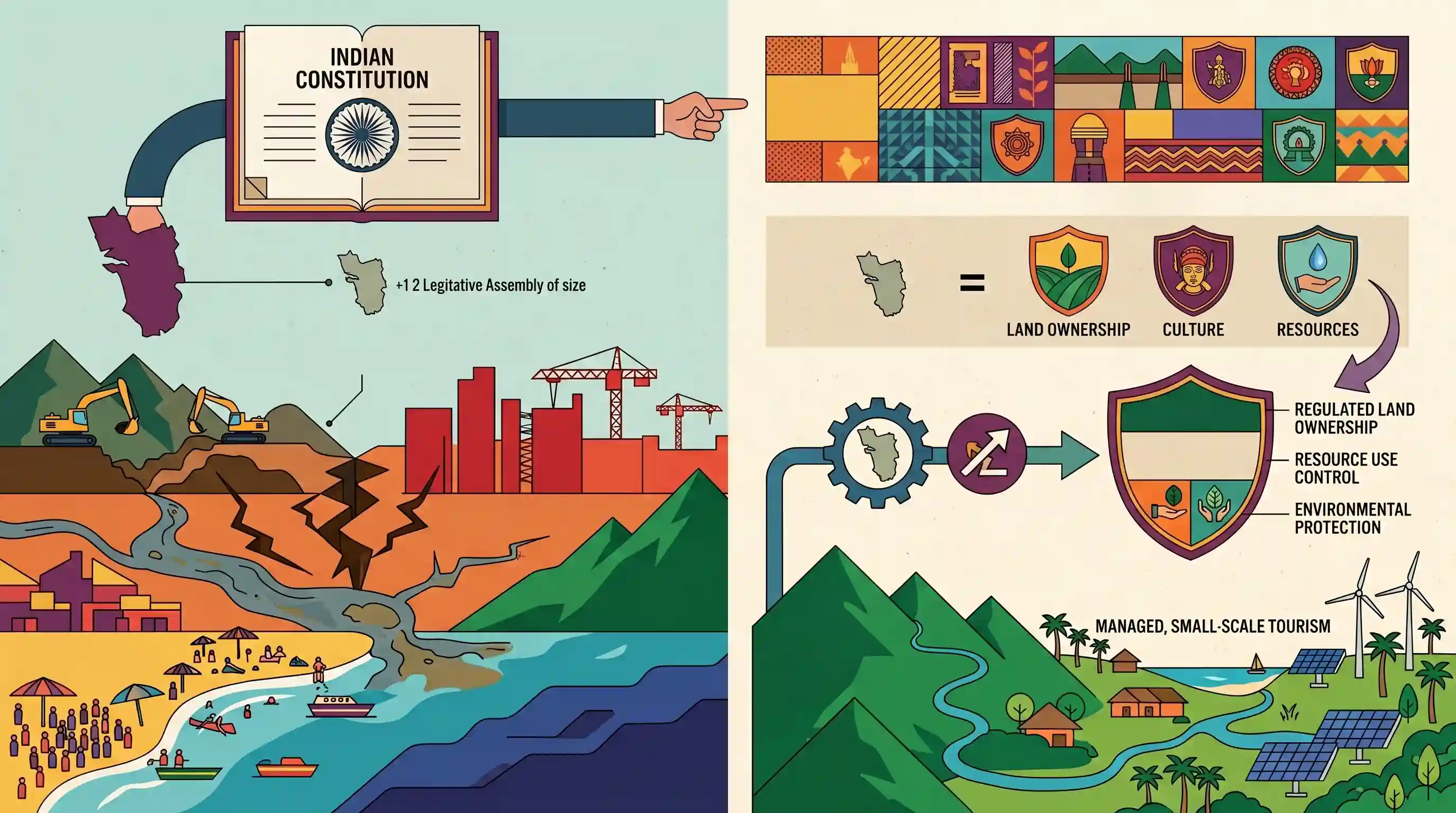
The article advocates for a special constitutional amendment for Goa under Article 371 to ensure its environmental survival. While Goa is currently covered by Article 371I, this provision only dictates the minimum size of its legislative assembly. Facing severe ecological threats from mining, unchecked real estate, and unregulated tourism along the coast and the Western Ghats, the author argues that Goa requires robust constitutional safeguards to regulate land ownership and resource utilization, akin to the protections granted to other ecologically and culturally sensitive Indian states.
Key Points
- Goa is facing severe ecological degradation stemming from unregulated tourism, mining activities, and unchecked real estate development.
- Currently, Article 371I provides special provisions for Goa, but it is strictly limited to mandating the minimum strength of its Legislative Assembly (30 members).
- The article argues for a new or expanded constitutional amendment under Article 371 to grant Goa specific protections over its land and resources.
- Such an amendment would parallel protections seen in other states (like Himachal Pradesh or northeastern states under Article 371A-G) to prevent the alienation of local land and preserve the fragile ecosystems of the Western Ghats and coastal zones.
Important Terms
Article 371

Part XXI provision granting 'special status' or specific protections to several Indian states to address regional disparities, cultural uniqueness, or administrative needs.
UPSC context
GS Paper II (Polity); tests understanding of Indian federalism and special constitutional provisions for regional governance.
Article 371I
A specific provision for Goa (added in 1987) that currently only mandates a minimum of 30 members for its Legislative Assembly.
UPSC context
GS Paper II; highlights state-specific constitutional mandates and the evolution of Goa's statehood.
Asymmetric Federalism
A federal model where constituent units have unequal powers or varied relationships with the Centre to accommodate regional, cultural, or geographical diversity.
UPSC context
GS Paper II; central theme for questions on Indian federal structure and regional autonomy.
Western Ghats
A UNESCO World Heritage site and global biodiversity hotspot stretching along India's west coast, including Goa, facing threats from mining and unregulated development.
UPSC context
GS Paper III (Environment); frequently tested for biodiversity conservation and environmental impact assessment.
Sustainable Development
Development that balances economic growth with environmental protection and social equity to preserve resources for future generations.
UPSC context
GS Paper III; core principle for environmental governance, climate change mitigation, and resource management.
Prelims Trap
"Article 371I provides Goa with special constitutional safeguards against the transfer of land to non-residents."
False. Article 371I only stipulates that the Goa Legislative Assembly must have at least 30 members. It provides zero constitutional safeguards regarding land ownership or resources.
Static Concepts Connected
Which Article 371 sub-clauses grant explicit protections over land ownership?
- Art 371A (Nagaland): Prevents Acts of Parliament regarding ownership and transfer of land from applying unless the State Assembly passes a resolution.
- Art 371G (Mizoram): Similar to Nagaland, it restricts parliamentary legislation on land ownership and transfer without state legislative consent.
- Art 371I (Goa): Offers no land or cultural protection. It solely dictates that the State Legislative Assembly must have a minimum of 30 members.
What are the key committee recommendations for Western Ghats conservation?
- Gadgil Committee (2011): Recommended classifying the entire Western Ghats as an Ecologically Sensitive Area (ESA) with varying degrees of strict protection, including broad mining bans.
- Kasturirangan Panel (2013): Proposed a diluted approach, classifying only ~37% of the Western Ghats (biologically rich areas) as ESA, attempting to balance conservation with development.
Cross-Topic Patterns
Federalism as a tool for ecological conservation
Demands for Article 371 protections are shifting from cultural autonomy to environmental survival, bridging GS2 (Polity/Special Provisions) directly with GS3 (Biodiversity and Sustainable Development).
CRZ Norms vs. Tourism Carrying Capacity
Goa's ecological crisis from unchecked coastal real estate highlights the failure of Coastal Regulation Zone (CRZ) enforcement and the urgent need to define the carrying capacity of tourist states.

Expect a Match-the-Following Prelims question on Article 371 (A-J), specifically testing the limited scope of 371I (Goa) vs 371A/G.
Linked PYQs · 5
Linked PYQs · 5
- 2025MainsGS2
Indian Constitution has conferred the amending power on the ordinary legislative institutions with a few procedural hurdles. In view of this statement, examine the procedural and substantive limitations on the amending power of the Parliament to change the Constitution.
- 2024PrelimsGS1
As per Article 368 of the Constitution of India, the Parliament may amend any provision of the Constitution by way of : 1. Addition 2. Variation 3. Repeal Select the correct answer using the code given below:
- 2025PrelimsGS1
Consider the following statements : I. The Constitution of India explicitly mentions that in certain spheres the Governor of a State acts in his/her own discretion. II. The President of India can, of his/her own, reserve a bill passed by a State Legislature for his/her consideration without it being forwarded by the Governor of the State concerned. Which of the statements given above is/are correct?
- 2025MainsGS3
Mineral resources are fundamental to the country's economy and these are exploited by mining. Why is mining considered an environmental hazard? Explain the remedial measures required to reduce the environmental hazard due to mining.
- 2019MainsGS3
Coastal sand mining, whether legal or illegal, poses one of the biggest threats to our environment. Analyze the impact of sand mining along the Indian coasts, citing specific examples.
