Goa Minister Acquittal Highlights Judicial Pendency in India
Source:Indian Express ↗
Why It Matters
The 27-year wait for a verdict in a high-profile political corruption case serves as a prime example of judicial inefficiency. It is highly relevant for UPSC aspirants examining the interplay between governance, anti-corruption frameworks (like the RPA), and the urgent need for reforms to ensure timely justice and maintain public trust.
Summary
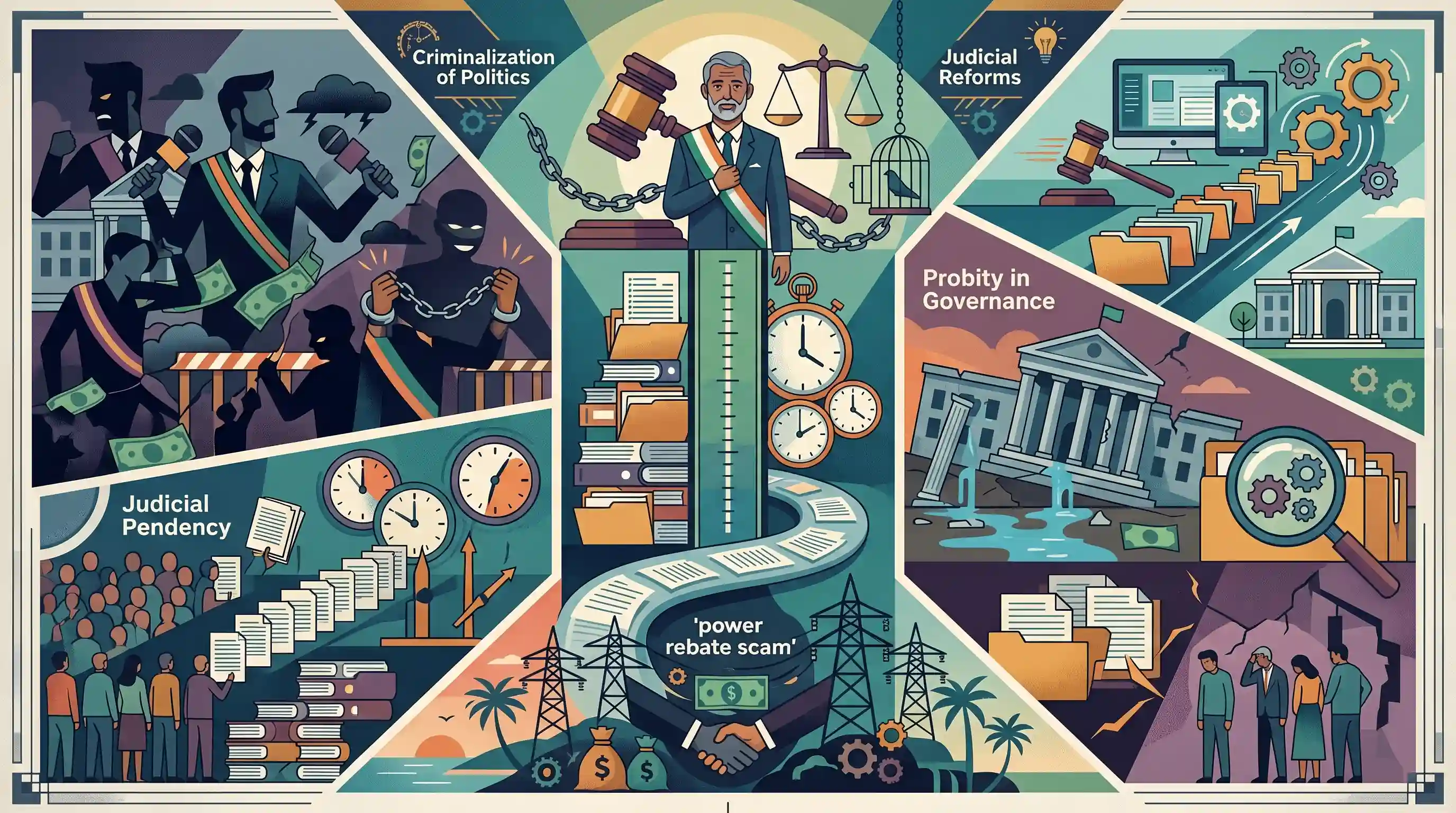
Goa Minister Mauvin Godinho has been acquitted in the longstanding 'power rebate scam' case, concluding a legal battle that stretched over 27 years. The staggering delay highlights the severe issue of judicial pendency in the Indian legal system. It brings to the forefront critical governance concerns including the effectiveness of anti-corruption mechanisms, the impact of delayed justice on democratic processes, and the imperative for comprehensive judicial reforms to ensure speedy trials, especially for cases involving public officials.
Key Points
- Goa Minister Mauvin Godinho was acquitted in the 'power rebate scam' after a prolonged trial lasting 27 years.
- The extensive timeline of the case brings sharp focus on extreme judicial pendency and the sluggish pace of trials in India.
- Such protracted delays in cases involving political figures and corruption highlight systemic issues regarding accountability, probity in public life, and the right to a speedy trial.
- The situation underscores the oft-quoted maxim "justice delayed is justice denied," indicating an urgent need for structural judicial reforms to expedite cases involving public servants.
Important Terms
Representation of the People Act, 1951

A comprehensive law governing Indian elections, covering candidate qualifications, disqualifications, and the conduct of polls. It mandates disqualification for representatives convicted of crimes with a sentence of two years or more.
UPSC context
GS Paper 2: Polity. Essential for understanding electoral integrity and the legal mechanisms to prevent criminals from entering legislatures.
Prevention of Corruption Act, 1988
The primary legislation aimed at combating corruption in the public sector. It defines offenses like bribery and criminal misconduct by public servants, establishing special courts for speedy trials.
UPSC context
GS Paper 2 & 4: Governance and Ethics. Tests knowledge on anti-corruption frameworks and accountability in public administration.
Judicial Pendency
The massive backlog of unresolved legal cases in the court system. In India, it exceeds 50 million cases, driven by judge vacancies, infrastructure deficits, and procedural delays.
UPSC context
GS Paper 2: Judiciary. Critical for analyzing "Justice delayed is justice denied" and its impact on the rule of law.
Probity in Governance
Strict adherence to moral principles like honesty, integrity, and transparency in public service. It goes beyond mere absence of corruption to include a proactive commitment to ethical conduct.
UPSC context
GS Paper 4: Ethics. A foundational concept for questions on civil service values and the philosophical basis of governance.
Criminalization of Politics
The increasing participation of individuals with criminal backgrounds in the electoral process. This phenomenon undermines democratic legitimacy and leads to the misuse of legislative power.
UPSC context
GS Paper 2: Polity. High-priority topic involving electoral reforms and the role of the Supreme Court in cleansing politics.
Judicial Reforms
Proposed changes to the legal system—such as AI integration, filling vacancies, and promoting Alternative Dispute Resolution—to ensure more efficient, transparent, and timely delivery of justice.
UPSC context
GS Paper 2: Judiciary. Focuses on institutional fixes for systemic delays and the evolution of the Indian justice system.
Article 21 (Right to Speedy Trial)
An implicit right derived from the "Right to Life" in the Indian Constitution. It ensures that criminal trials proceed without unreasonable delays that infringe upon personal liberty.
UPSC context
GS Paper 2: Fundamental Rights. Crucial for discussing prisoner rights and the constitutional obligation to prevent protracted trials.
Prelims Trap
The Right to a Speedy Trial is explicitly mentioned as a Fundamental Right in the Constitution.
The Right to a Speedy Trial is an implicit Fundamental Right under Article 21 (interpreted via Hussainara Khatoon case), not explicitly written in the constitutional text.
Static Concepts Connected
What are the grounds for disqualification of legislators under Section 8 of RPA, 1951?
- Conviction Threshold: Disqualification occurs upon conviction for specific offenses (e.g., promoting enmity, corruption) or any general offense resulting in a minimum two-year prison sentence.
- Immediate Effect: Following the Lily Thomas judgment (2013), disqualification is immediate upon conviction, striking down the 3-month appeal window previously available to sitting legislators.
- Duration: The disqualification lasts for the entire period of imprisonment plus a further six years from the date of the convict's release.
What mechanisms exist for fast-tracking criminal trials against politicians?
- Special Courts: The Supreme Court directed the establishment of Special MP/MLA Courts in 2017 to exclusively handle pending criminal cases against elected representatives.
- High Court Monitoring: High Courts are constitutionally mandated to monitor these special courts, ensuring that trials proceed on a day-to-day basis without unwarranted adjournments.
- Restriction on Stays: To prevent deliberate stalling, the Supreme Court has ruled that trial proceedings against lawmakers cannot be stayed without strong, exceptional reasons.
Cross-Topic Patterns
Judicial Pendency & Contract Enforcement
Protracted trials aren't just a political probity issue; GS3 economics links judicial delays directly to poor contract enforcement and dampened foreign direct investment.
Ethics: Erosion of Institutional Trust
A 27-year trial serves as a perfect GS4 example of how delayed justice normalizes administrative corruption and erodes public faith in democratic institutions.

Expect a Prelims question interlinking RPA Section 8 disqualifications, MP/MLA Special Courts, and Article 21's speedy trial right.
Linked PYQs · 4
Linked PYQs · 4
- 2025MainsGS2
Discuss the 'corrupt practices' for the purpose of the Representation of the People Act, 1951. Analyze whether the increase in the assets of the legislators and/or their associates, disproportionate to their known sources of income, would constitute 'undue influence' and consequently a corrupt practice.
- 2020MainsGS2
There is a need for simplification of procedure for disqualification of persons found guilty of corrupt practices under the Representation of Peoples Act". Comment.
- 2019MainsGS4
What do you understand by probity in governance ? Based on your understanding of the term, suggest measures for ensuring probity in government.
- 2022MainsGS4
Discuss the significance of 'Probity in public life' for effective governance.
