Goa Minister Dropped From Cabinet After Alleging Corruption
Source:Indian Express ↗
Why It Matters
This event acts as a live case study for GS2 (State Executive, Article 164, and collective responsibility) and GS4 (the ethical dilemma between maintaining government solidarity and exposing corruption).
Summary
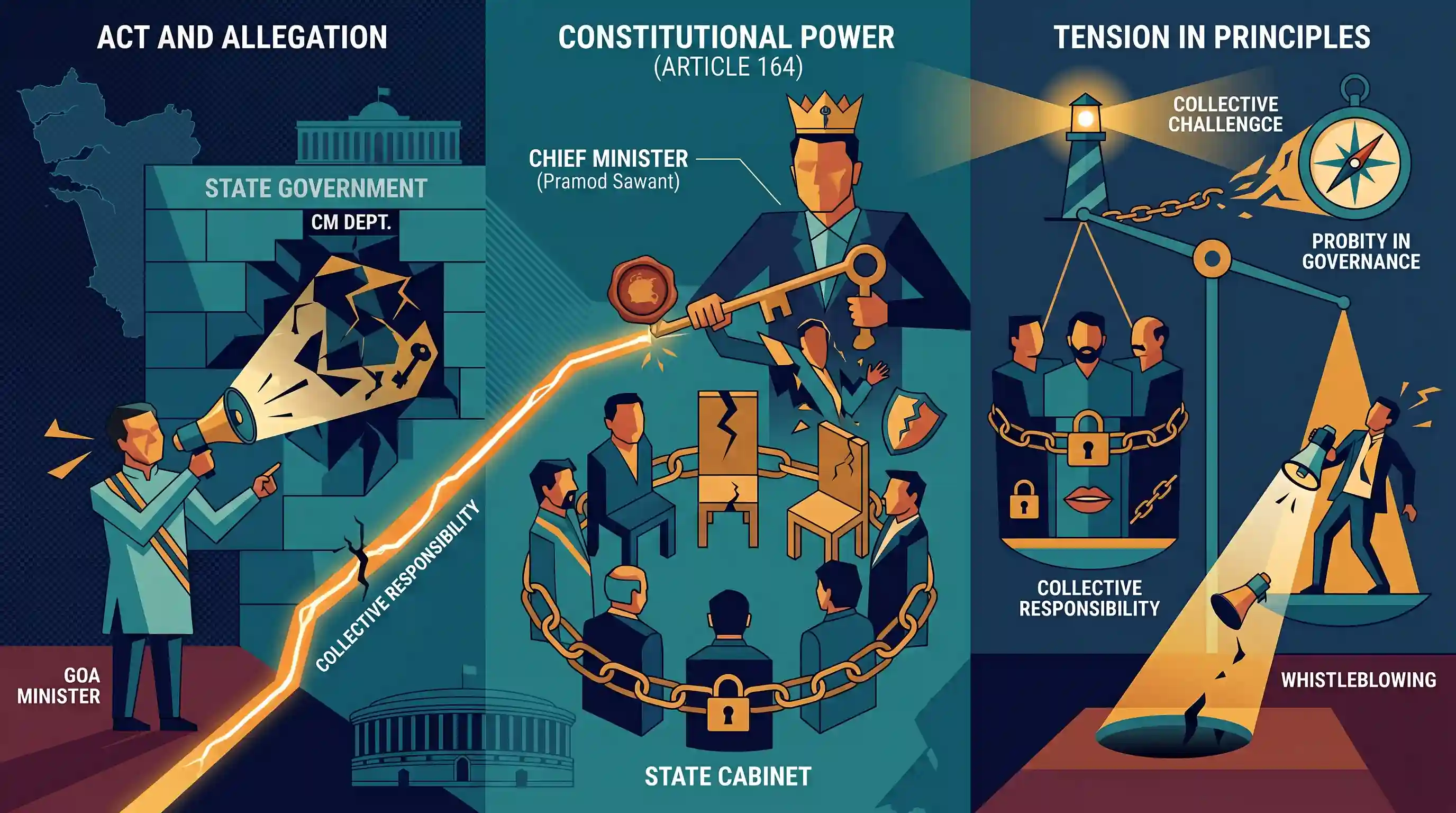
Goa Sports and Youth Affairs Minister Govind Gaude was dropped from the state cabinet after making public corruption allegations against a department held by Chief Minister Pramod Sawant. His removal highlights the constitutional power of the Chief Minister in determining the composition of the Council of Ministers (Article 164) and illustrates the inherent tension between the parliamentary principle of collective responsibility and the ethical obligation of whistleblowing in government.
Key Points
- Goa Minister Govind Gaude was removed from the state Cabinet by Chief Minister Pramod Sawant following public corruption allegations Gaude made against a department headed by the CM.
- Under Article 164 of the Constitution, state ministers are appointed and dismissed by the Governor on the advice of the Chief Minister, meaning they hold office at the CM's prerogative.
- The dismissal highlights the strict enforcement of the parliamentary principle of 'collective responsibility', where ministers are expected to present a unified front.
- The event serves as an ethical case study highlighting the tension between loyalty to the Council of Ministers and the moral obligation to expose corruption (probity and whistleblowing).
Important Terms
Article 164 of the Indian Constitution

A constitutional provision detailing the appointment of the Chief Minister by the Governor and other ministers on the CM's advice. It also outlines their tenure, salaries, and collective responsibility to the Assembly.
UPSC context
GS Paper II: State Executive. Tests knowledge of constitutional provisions governing the appointment and removal of state ministers.
Collective Responsibility
A parliamentary principle (Article 164(2)) where the Council of Ministers is jointly accountable to the Legislative Assembly. If a minister publicly disagrees with cabinet decisions, they must resign or be dismissed.
UPSC context
GS Paper II: Polity. Essential for understanding the "sink or swim together" rule in parliamentary democracies.
Pleasure of the Governor
A doctrine (Article 164(1)) stating ministers serve as long as the Governor desires. In practice, the Governor exercises this "pleasure" solely on the binding advice of the Chief Minister.
UPSC context
GS Paper II: Governance. Tests the legal boundary between the Governor's formal power and the CM's substantive executive authority.
Whistleblowing
The act of a person (often an insider) exposing information about illegal, unethical, or corrupt activities within an organization to protect the public interest, often facing significant professional or personal risks.
UPSC context
GS Paper IV: Ethics. Tests the dilemma between organizational loyalty and the moral duty to expose corruption in governance.
Probity in Governance
The adherence to the highest standards of integrity, transparency, and honesty in public life. It emphasizes ethical processes and the responsible use of public power to maintain institutional legitimacy.
UPSC context
GS Paper IV: Ethics and Governance. A core syllabus topic testing the philosophical and practical foundations of corruption-free administration.
Council of Ministers (State)
The real executive authority at the state level, headed by the Chief Minister. It consists of Cabinet Ministers, Ministers of State, and Deputy Ministers who aid and advise the Governor.
UPSC context
GS Paper II: State Executive. Fundamental for understanding the structure and functioning of the state-level decision-making body.
Prelims Trap
State Ministers hold office during the pleasure of the Chief Minister.
Under Article 164(1), ministers legally hold office during the pleasure of the Governor, not the CM, though the Governor acts on the CM's advice.
Static Concepts Connected
How does Collective Responsibility work under Article 164?
- Legislative Accountability: Article 164(2) explicitly mandates that the State Council of Ministers is collectively responsible to the State Legislative Assembly, not the Governor.
- Cabinet Solidarity: Ministers must publicly stand by all Cabinet decisions. Public dissent or criticism of the government requires resignation or invites dismissal by the CM.
How does whistleblowing conflict with Ministerial rules?
- Institutional Loyalty: Administrative rules and the Oath of Secrecy demand institutional loyalty, confidentiality, and strict adherence to established hierarchies and collective decisions.
- Public Interest: A Code of Ethics prioritizes transparency, probity, and exposing corruption in the wider public interest over blind political or institutional loyalty.
Cross-Topic Patterns
Collective Responsibility vs. Probity
GS4 case studies often test this exact dilemma: maintaining Cabinet solidarity (a GS2 constitutional mandate) versus acting as a whistleblower to expose intra-departmental corruption (GS4 probity).
Ministerial Dissent vs. Anti-Defection
While a minister can be sacked for public dissent, exposing corruption does not trigger disqualification under the Tenth Schedule (Anti-Defection Law) unless they voluntarily give up party membership.

Expect a GS4 case study in 2026 pitting the constitutional mandate of collective responsibility against the ethical duty of whistleblowing.
Linked PYQs · 4
Linked PYQs · 4
- 2022MainsGS2
Discuss the essential conditions for exercise of the legislative powers by the Governor. Discuss the legality of re-promulgation of ordinances by the Governor without placing them before the Legislature.
- 2024MainsGS4
“The 'Code of Conduct' and 'Code of Ethics' are the sources of guidance in public administration. There is code of conduct already in operation, whereas code of ethics is not yet put in place. Suggest a suitable model for code of ethics to maintain integrity, probity and transparency in governance.”
- 2019MainsGS4
What do you understand by probity in governance ? Based on your understanding of the term, suggest measures for ensuring probity in government.
- 2022PrelimsGS1
Consider the following statements: 1. The Constitution of India classifies the ministers into four ranks viz. Cabinet Minister, Minister of State with Independent Charge, Minister of State and Deputy Minister. 2. The total number of ministers in the Union Government, including the Prime Minister, shall not exceed 15 percent of the total number of members in the Lok Sabha. Which of the statements given above is/are correct?
