Goa Government Withdrawal of Anti Conversion Legislation
Source:Indian Express ↗
Why It Matters
This article sheds light on the legislative dynamics within state assemblies, intra-party dissent, and the contentious politics surrounding freedom of religion and anti-conversion bills in India.
Summary
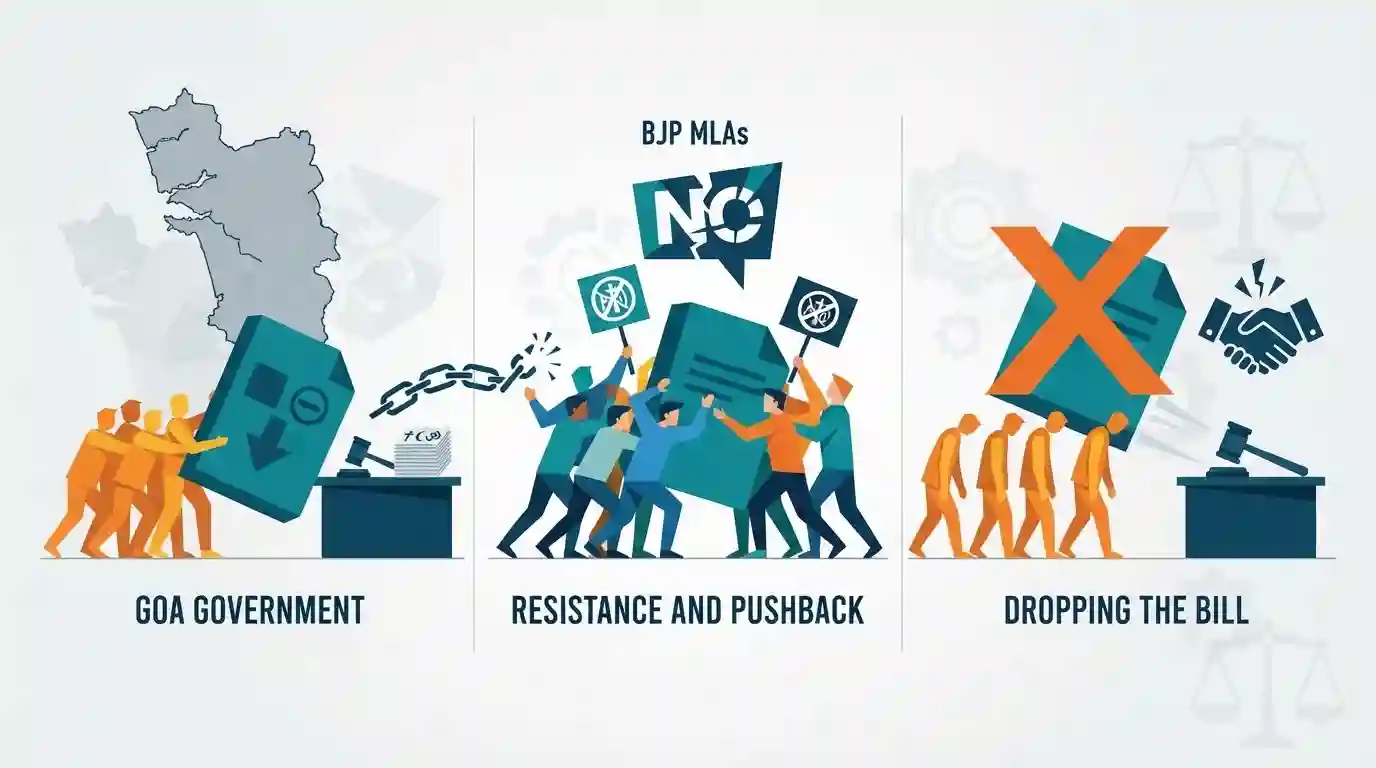
The Goa government has dropped the proposed Anti-Religious Conversion Bill, 2026 after facing resistance and pushback from BJP MLAs, highlighting political friction surrounding state-level conversion laws.
Key Points
- The Goa government decided to drop the proposed Anti-Religious Conversion Bill, 2026 following strong internal pushback from BJP MLAs and local political concerns.
- Chief Minister Pramod Sawant had previously floated the legislative measure, but concerns over community cohesion and political fallout led to its withdrawal.
- Anti-conversion laws have been a contentious debate across multiple Indian states, balancing freedom of religion, public order, and legislative overreach.
Important Terms
Anti-Religious Conversion Bill 2026

A proposed legislative measure aiming to penalize religious conversions carried out through force, fraud, undue influence, or marriage, which was dropped by the Goa government following internal resistance.
UPSC context
Relevant for GS Paper II (Indian Polity - Fundamental Rights, Secularism, and Federal/State legislation trends on religious freedom).
Goa Government
The executive body administering Goa, which faced intense political friction and subsequently withdrew its controversial conversion legislation due to internal pushback from legislators.
UPSC context
Relevant for GS Paper II (Functioning and Responsibilities of the Union and the States, state legislative procedures and executive decisions).
BJP
A major national political party in India that leads the ruling coalition in Goa, notable here for experiencing internal friction among its MLAs over social legislation.
UPSC context
Relevant for GS Paper II (Political Dynamics, party systems, and legislative policymaking processes in India).
Prelims Trap
The fundamental right to propagate religion under Article 25 includes the absolute right to convert any individual to one's own faith.
Aspirants often assume that 'propagate' under Article 25 includes the right to convert another person, confusing popular understanding with Supreme Court precedent.
Static Concepts Connected
What is the scope of the right to 'propagate' under Article 25 of the Constitution?
- Stainislaus Ruling: Supreme Court in Rev. Stainislaus v. State of Madhya Pradesh (1977) held that 'propagate' means to transmit or spread one's religion, not to convert another person.
- Constitutional Text: Article 25 guarantees freedom of conscience and the right freely to profess, practice, and propagate religion, subject to public order, morality, and health.
- State List Power: State anti-conversion laws derive legislative reference from 'public order', which falls under Entry 1 of the State List (List II) of the Seventh Schedule.
Cross-Topic Patterns
State Conversion Laws and Federal Legislative Competence
State legislation restricting religious conversion intersects with the Seventh Schedule's distribution of legislative powers under 'public order' (Entry 1, State List) versus the central criminal jurisdiction.
Article 25 Freedoms and Right to Privacy Linkages
Individual liberty regarding personal faith connects Article 25 freedoms with privacy rights under Article 21, as articulated in Puttaswamy.

Article 25 scope ('propagate' vs 'convert') and the limits of state legislative competence under 'public order' will feature in Prelims.
Linked PYQs · 3
Linked PYQs · 3
- 2024MainsGS2
Discuss India as a secular state and compare with the secular principles of the US constitution.
- 2019MainsGS2
What can France learn from the Indian Constitution's approach to secularism?
- 2025MainsGS2
Indian Constitution has conferred the amending power on the ordinary legislative institutions with a few procedural hurdles. In view of this statement, examine the procedural and substantive limitations on the amending power of the Parliament to change the Constitution.
