Goa Government Withdrawal of Anti Conversion Bill Amid Pushback
Source:Indian Express ↗
কেন এটি গুরুত্বপূর্ণ
The article touches upon important polity concepts relating to state-level legislation, freedom of religion, intra-party dissent, and the constitutional limits of regulating personal beliefs and civil liberties in India.
সারসংক্ষেপ
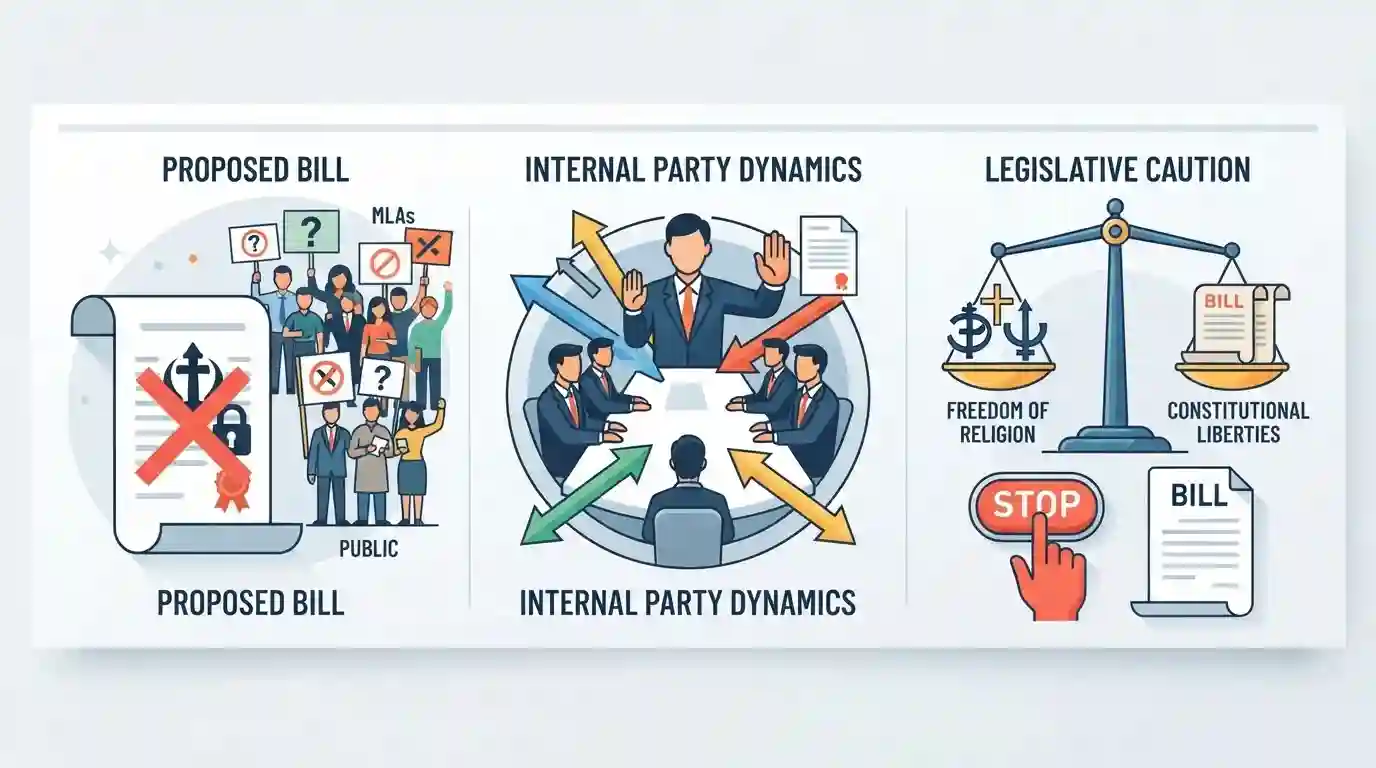
The Goa government decided to drop the proposed anti-religious conversion bill 2026 following strong pushback and reservations from BJP MLAs, highlighting internal party dynamics and legislative caution regarding laws governing religious freedom and personal liberties.
মূল বিষয়
- The Goa government dropped the proposed anti-religious conversion bill 2026 following internal pushback and reservations expressed by BJP MLAs.
- Chief Minister Pramod Sawant's administration decided to step back from the legislation amidst political deliberations within the ruling party.
- Anti-conversion laws have been a subject of intense debate in India concerning fundamental rights, freedom of religion (Article 25), and individual autonomy (Article 21).
গুরুত্বপূর্ণ শব্দ
Anti-Religious Conversion Bill 2026

A proposed state legislation intended to penalize unlawful religious conversions through force, fraud, or marriage, which was shelved by the Goa government following internal dissent.
UPSC context
Important for GS Paper II under Indian Polity - Freedom of Religion (Article 25) and state legislative dynamics.
Goa Government
The executive branch of the state of Goa, responsible for governance and introducing state-level bills in the legislative assembly.
UPSC context
Relevant for GS Paper II under State Legislature functioning, separation of powers, and executive decision-making.
প্রিলিমস ফাঁদ
India has enacted a comprehensive central anti-conversion law to regulate religious freedom uniformly across all states and Union Territories.
Aspirants often assume India has a uniform central law regulating religious conversions, similar to personal law reforms, whereas conversions are governed entirely by state-level enactments.
সংযুক্ত স্থির ধারণা
What are the constitutional dimensions and judicial rulings regarding the right to freedom of religion under Article 25?
- Article 25 Scope: Guarantees freedom of conscience and the right freely to profess, practise, and propagate religion, subject to public order, morality, and health.
- Stainislaus Ruling: Supreme Court held that the right to 'propagate' does not include a right to convert another person, as it would violate the freedom of conscience of others.
- Legislative Competence: States derive legislative competence to enact anti-conversion laws primarily from Entry 1 ('Public Order') or Entry 1 ('Public Order') and Entry 35 of the State List in the Seventh Schedule.
আন্তঃবিষয় প্যাটার্ন
Religious Freedom vs. State Public Order Power
Anti-conversion statutes enacted by states are regularly challenged under Articles 25 and 21, balancing police powers with individual privacy and autonomy.
Intra-party Dissent and Legislative Caution
State-level legislation on sensitive social issues often exposes internal party friction, testing the whip system and party discipline under the Tenth Schedule framework.

Expect questions pairing Article 25 scope ('propagate' vs 'convert') with state legislative competence under the Seventh Schedule.
সংযুক্ত PYQ · 3
সংযুক্ত PYQ · 3
- 2024MainsGS2
Discuss India as a secular state and compare with the secular principles of the US constitution.
- 2019MainsGS2
What can France learn from the Indian Constitution's approach to secularism?
- 2019PrelimsGS1
Which Article of the Constitution of India safeguards one's right to marry the person of one's choice?
