Great Nicobar Project Draft Relocation Plan Sparks Tribal Concerns
Source:The Hindu ↗
Why It Matters
The Great Nicobar mega-infrastructure project is a critical strategic and developmental initiative for India, yet it poses profound social and environmental challenges. It highlights the complex governance issues surrounding the displacement of particularly vulnerable tribal groups (PVTGs) and the implementation of crucial legislation like the Forest Rights Act and the Land Acquisition Act. Understanding this issue is vital for analyzing the balance between national infrastructure goals, tribal rights, and environmental conservation.
Summary
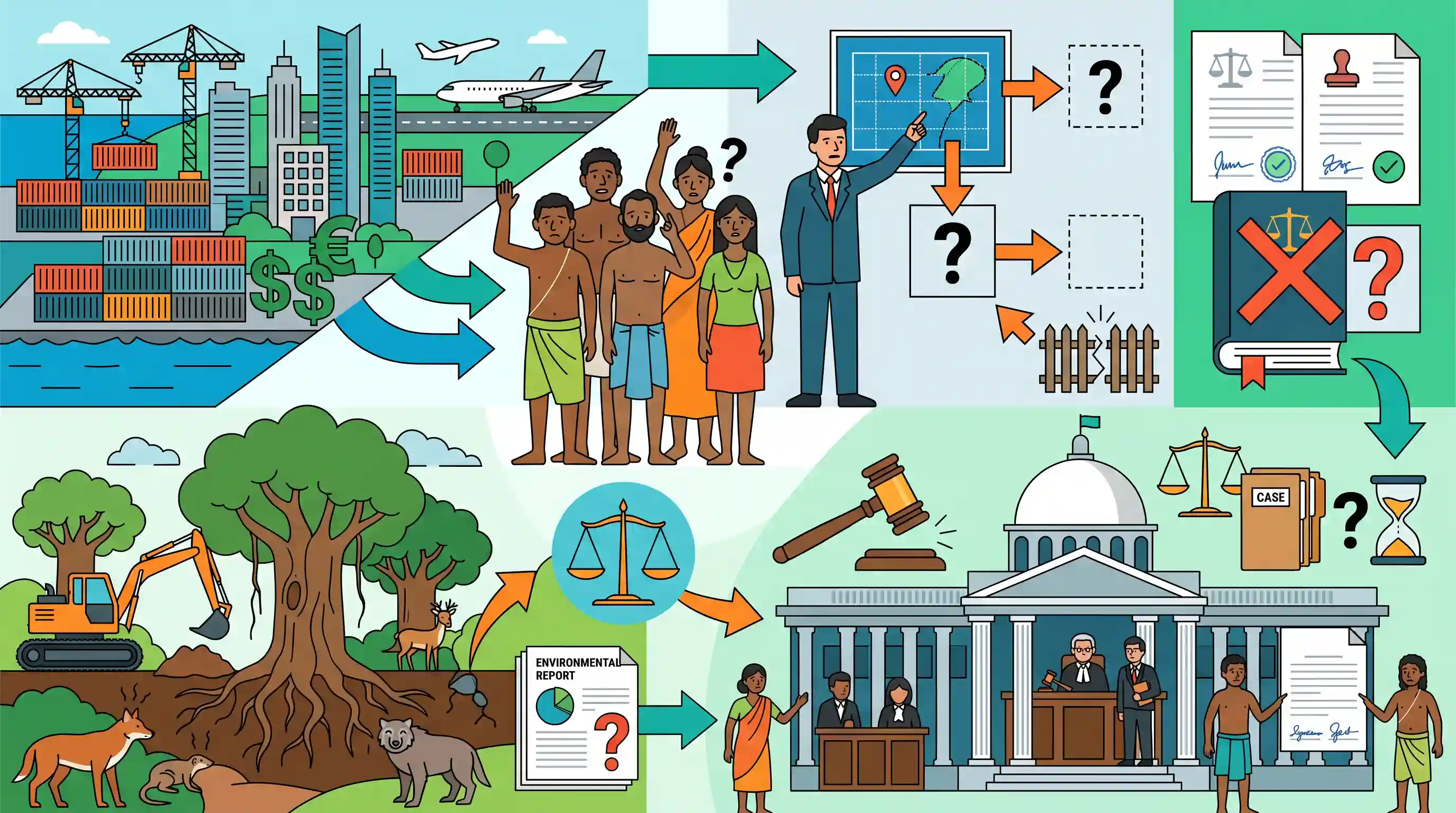
The Andaman and Nicobar Islands administration's draft "Comprehensive Tribal Welfare Plan" to relocate Nicobarese families affected by the Great Nicobar Island (GNI) mega-infrastructure project has generated confusion and apprehension among local tribal communities. The ₹42.52-crore plan, aimed at relocating families impacted by the project or displaced by the 2004 tsunami, lacks clarity on specific relocation sites and project boundaries. Heightening these concerns is the plan's omission of the 2006 Forest Rights Act (FRA), despite invoking other land and tribal protection laws. The Nicobarese and Shompen communities, who withdrew their consent for the ₹92,000-crore project in 2022, allege that their forest rights remain unsettled. The dispute is currently facing legal scrutiny in the Calcutta High Court over issues of tribal consent and displacement.
Key Points
- The Andaman and Nicobar Islands administration released a ₹42.52-crore draft Comprehensive Tribal Welfare Plan to relocate Nicobarese families affected by the ₹92,000-crore Great Nicobar Island (GNI) mega-infrastructure project and the 2004 tsunami.
- The draft plan has caused confusion among the Tribal Council due to ambiguities regarding exact relocation sites, the number of families, and project boundaries, exacerbating ongoing apprehensions.
- Tribal communities, including the Nicobarese and Shompen, previously withdrew their consent for the project in 2022, protesting that their ancestral forest lands were being encroached upon without proper rights settlement.
- While the plan cites the 2013 Land Acquisition Act and the 1956 Protection of Aboriginal Tribes Act, it entirely omits the 2006 Forest Rights Act (FRA), leading locals to allege that the administration falsely certified the settlement of their forest rights.
- The Union government recently asked the Calcutta High Court for 15 days to demonstrate that proper tribal consent had been obtained for the GNI project, amid legal challenges regarding consent procedures.
Important Terms
Comprehensive Tribal Welfare Plan

A ₹42.52-crore draft scheme by the Andaman administration proposing the relocation and rehabilitation of Nicobarese families affected by the Great Nicobar mega-project and the 2004 tsunami.
UPSC context
GS II: Government Policies/Welfare of Vulnerable Sections. Tests knowledge of tribal displacement, rehabilitation frameworks, and administrative planning in sensitive zones.
Right to Fair Compensation and Transparency in Land Acquisition, Rehabilitation and Resettlement Act
A 2013 central law governing land acquisition and rehabilitation in India. Its Social Impact Assessment (SIA) provisions are central to disputes over tribal displacement in Great Nicobar.
UPSC context
GS II: Governance/Statutory Acts. Crucial for understanding legal mandates for compensation and the "consent" clause in infrastructure projects.
Protection of Aboriginal Tribes Act, 1956
A 1956 regulation protecting indigenous tribes in Andaman and Nicobar. It allows the Administrator to manage tribal reserves but faces conflict with more recent forest rights laws.
UPSC context
GS II: Tribal Governance. Key for understanding the unique legal status of island tribes and the administrative powers of Union Territories.
Scheduled Tribes and Other Traditional Forest Dwellers (Recognition of Forest Rights) Act, 2006
A landmark law recognizing the rights of forest-dwelling tribes to land and resources. It requires Gram Sabha consent before any forest land can be diverted for projects.
UPSC context
GS II & III: Statutory Bodies/Environment. A core UPSC topic testing the "Gram Sabha" power and procedural justice for indigenous groups.
Tribal Council of Great and Little Nicobar
The primary representative body for the Nicobarese tribes. It withdrew project consent in 2022, alleging the administration misrepresented the status of their forest rights.
UPSC context
GS II: Social Sector/Social Justice. Represents local governance structures and the role of tribal self-representation in environmental clearances.
Calcutta High Court
The High Court with jurisdiction over the Andaman and Nicobar Islands. It is currently adjudicating the legality of the Great Nicobar project’s environmental and tribal clearances.
UPSC context
GS II: Judiciary. Tests the role of High Courts in environmental litigation and protecting constitutional rights in Union Territories.
Particularly Vulnerable Tribal Groups (PVTGs)
A government category for tribal groups with declining populations, low literacy, and pre-agricultural technology. The Shompen of Great Nicobar are a designated PVTG.
UPSC context
GS II: Welfare Schemes for Vulnerable Sections. A frequent Prelims/Mains topic regarding the unique protection needs of India's most isolated tribes.
Prelims Trap
The Forest Rights Act, 2006 is not applicable to the Andaman and Nicobar Islands due to the 1956 PAT Regulation.
The FRA 2006 applies across India. The existence of the special 1956 Protection of Aboriginal Tribes Regulation does not exempt the UT from mandatory FRA compliance and Gram Sabha consent.
Static Concepts Connected
What are the rights specific to PVTGs under the Forest Rights Act, 2006?
- Habitat Rights: Section 3(1)(e) specifically recognizes community tenures of habitat and habitations for Particularly Vulnerable Tribal Groups (PVTGs) and pre-agricultural communities.
- Definition: Habitat includes the area comprising customary habitat and such other habitats in reserved forests and protected forests.
- Protection from Eviction: Diversion of forest land or relocation requires the free, prior, and informed consent (FPIC) of the Gram Sabha, protecting them from arbitrary eviction.
What are the main components of the Great Nicobar Island (GNI) Project?
- Transshipment Terminal: A mega International Container Transshipment Terminal (ICTT) located at Galathea Bay.
- Supporting Infrastructure: A greenfield international airport, a gas and solar-based power plant, and a planned coastal township.
- Ecological Overlap: The project overlaps with the Galathea National Park, affecting the Shompen PVTG and the nesting sites of the Giant Leatherback Turtle.
Cross-Topic Patterns
High Court jurisdictions + UT administration
The Calcutta High Court holds territorial jurisdiction over the Andaman and Nicobar Islands. Legal scrutiny of UT administrative actions frequently bridges Polity (Article 241) and Environment (project clearances).
Strategic Infrastructure vs. PVTG Rights
The tension between strategic maritime infrastructure (GNI transshipment terminal) and constitutional safeguards for isolated tribes (Shompen) is a recurring theme, mirroring developmental debates in Lakshadweep.

Expect a multi-statement question on the Shompen tribe in 2026, combining their PVTG status, the geography of Great Nicobar, and habitat rights under FRA 2006.
Linked PYQs · 2
Linked PYQs · 2
- 2016MainsGS3
Rehabilitation of human settlements is one of the important environmental impacts which always attracts controversy while planning major projects. Discuss the measures to be adopted to mitigate the impact of the recent incidents of cloudbursts in many places of Uttarakhand.
- 2021PrelimsGS1
At the national level, which ministry is the nodal agency to ensure effective implementation of the Scheduled Tribes and Other Traditional Forest Dwellers (Recognition of Forest Rights) Act, 2006?
