Uttarakhand to install early warning systems at high-risk lakes
Source:hindustantimes ↗
Why It Matters
Crucial for understanding climate change adaptation, glacial dynamics, and disaster mitigation strategies in the fragile Himalayan ecosystem of Uttarakhand.
Summary
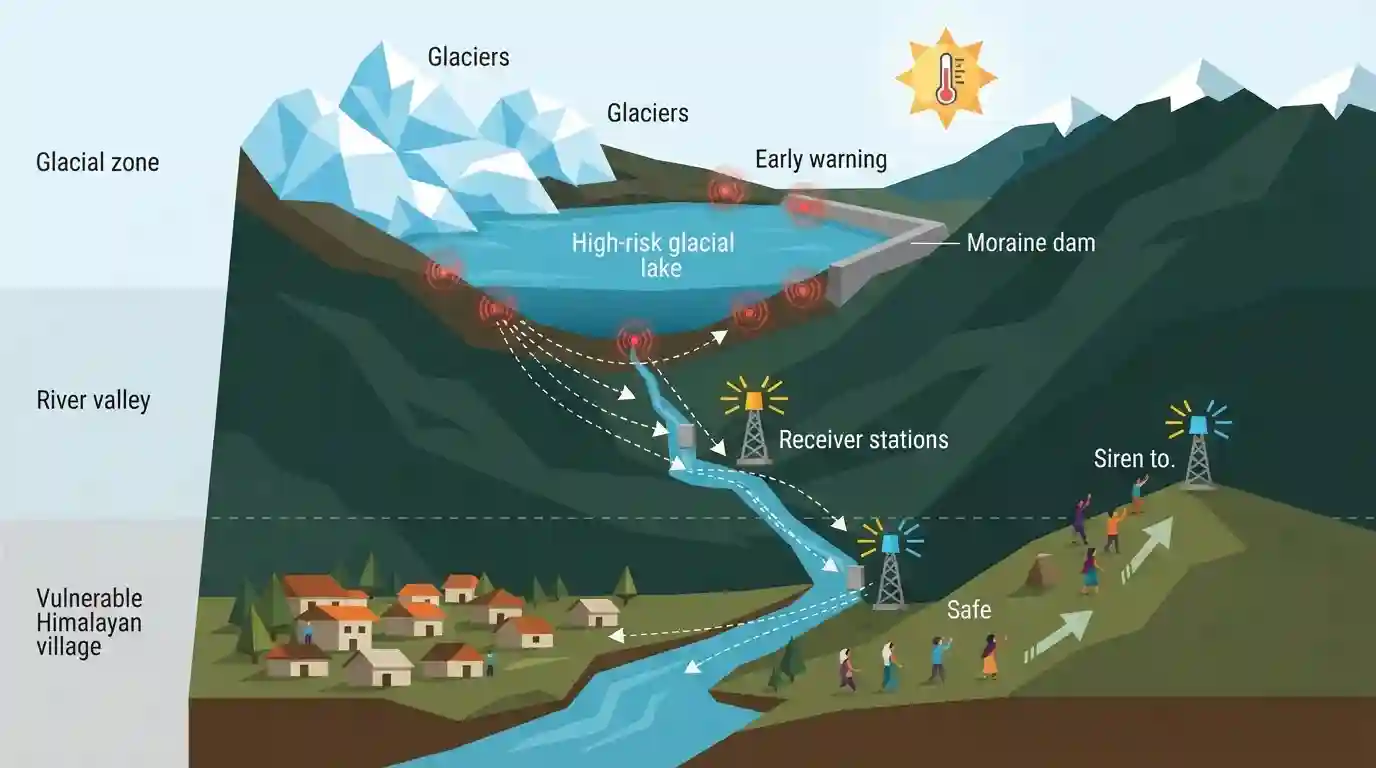
In response to escalating climate-induced threats, the Uttarakhand government is installing early warning systems at 13 high-risk glacial lakes to protect downstream populations from Glacial Lake Outburst Floods (GLOFs).
Key Points
- The Uttarakhand government is set to install early warning systems (EWS) at 13 high-risk glacial lakes prone to Glacial Lake Outburst Floods (GLOF).
- This initiative aims to enhance disaster preparedness and mitigate risks to downstream habitations and infrastructure in the fragile Himalayan region.
- GLOFs pose an increasing threat due to climate change-induced melting of glaciers and the formation of unstable moraine-dammed lakes.
Important Terms
Glacial Lake Outburst Floods (GLOFs)

Sudden and catastrophic release of a large volume of water contained by a glacial lake or moraine dam, often triggered by melting glaciers, avalanches, or earthquakes in high-altitude mountain regions.
UPSC context
Important for GS Paper III (Disaster Management, Climate Change) and UKPSC syllabus focusing on Himalayan hazards and mitigation strategies.
State Disaster Management Authority
State-level apex statutory body established under the Disaster Management Act, 2005, responsible for formulating policies, coordinating disaster response, and implementing mitigation plans within the state.
UPSC context
Crucial for GS Paper III (Disaster Management) and UKPSC questions on institutional frameworks for disaster risk reduction in Uttarakhand.
Prelims Trap
All glacial lakes in Uttarakhand have been categorized by the NDMA as high-risk and equipped with early warning systems.
Aspirants often assume all glacial lakes in Uttarakhand are categorized as high-risk, confusing total lake count with the NDMA-identified dangerous subset.
Static Concepts Connected
What is a Glacial Lake Outburst Flood (GLOF) and how are moraine dams formed?
- Moraine Dams: Moraine accumulation consists of debris, boulders, and soil pushed forward or left behind by retreating glaciers, forming unstable natural dams.
- Trigger Event: GLOF is a sudden release of a colossal volume of water from a glacial lake due to the breach of its moraine barrier.
- Key Triggers: Primary triggers include seismic activity, ice avalanches, rapid melting, and hydrostatic pressure exceeding the dam's structural integrity.
Cross-Topic Patterns
Climate Change + Himalayan Ecology
Rising global temperatures accelerate glacier melt in Uttarakhand, creating unstable moraine-dammed lakes that threaten sensitive Himalayan ecosystems and downstream hydro-infrastructure.
Disaster Management + Uttarakhand Governance
Uttarakhand's fragile topography requires robust disaster management frameworks, combining NDMA guidelines, state early warning networks, and climate adaptation financing.

GLOF risk mitigation + NDMA risk categorization + moraine-dammed lake mechanics is a high-yield UKPSC Prelims match-list or statement question.
Linked PYQs · 3
Linked PYQs · 3
- 2025UKPSC_PRELIMSGS1
Consider the following statements and select the correct answer from the options given below : Statement 1 : Uttarakhand is highly vulnerable to climate change. Statement 2 : Climate change is causing water stress and depleting biodiversity in Uttarakhand.
- 2024UKPSC_PRELIMSGS1
'Untadhura Pass' is situated near which one of the following glaciers of Uttarakhand ?
- 2012UKPSC_PRELIMSGS1
Which are called 'Duns' in Uttarakhand?
