Globalisation Resilience and India Strategic Autonomy
Source:The Hindu ↗
কেন এটি গুরুত্বপূর্ণ
This article is important for understanding India's evolving economic diplomacy and trade strategy in a fragmented global order marked by rising protectionism, supply chain disruptions, and the push for self-reliance.
সারসংক্ষেপ
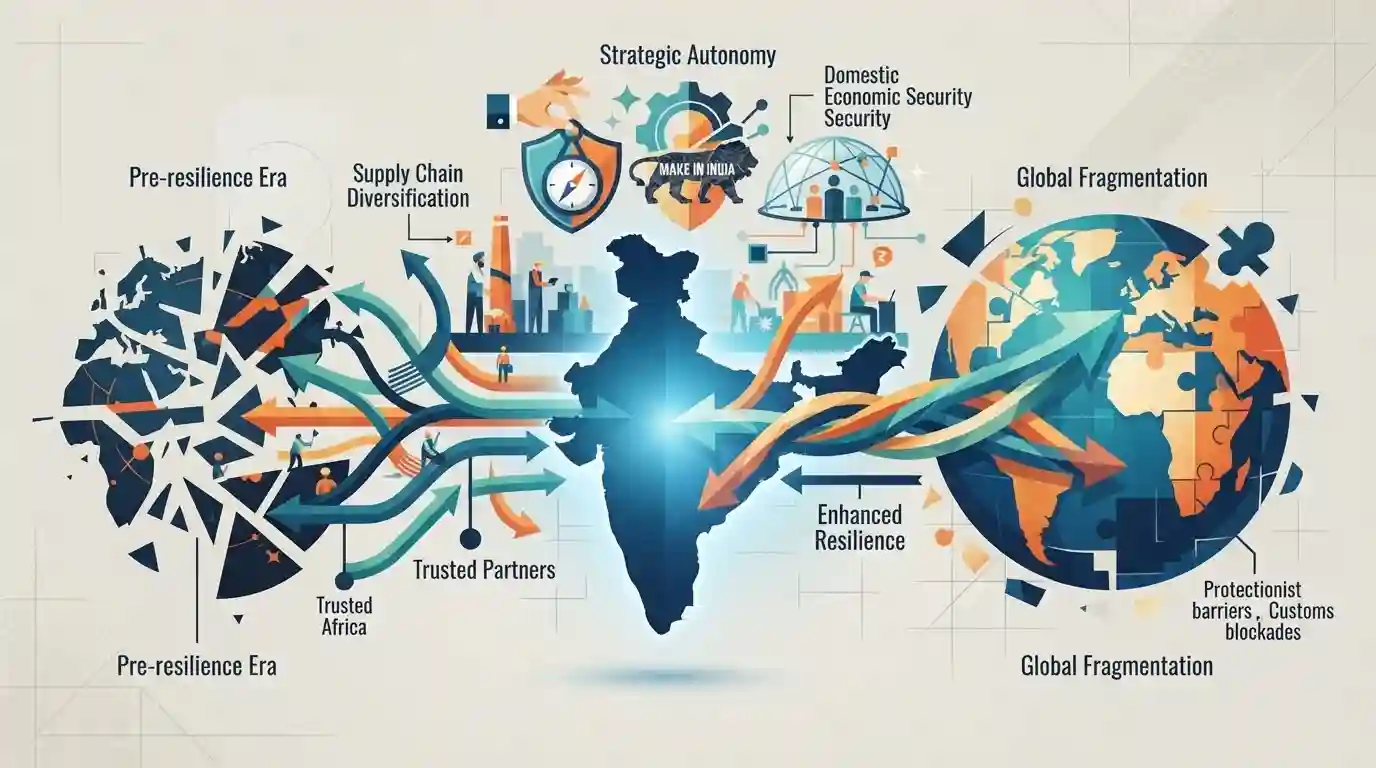
External Affairs Minister S. Jaishankar remarked that while globalisation cannot be reversed, it must be approached with enhanced resilience, focusing on supply chain diversification, strategic autonomy, and domestic economic security amidst growing global fragmentation and protectionism.
মূল বিষয়
- External Affairs Minister S. Jaishankar stated that globalisation cannot be reversed but must be navigated with greater resilience.
- Emphasized the need for strategic autonomy, diversification of supply chains, and robust domestic manufacturing capabilities in the face of global economic uncertainties.
- Highlighted that contemporary challenges require nations to balance openness with economic security and self-reliance (Atmanirbhar Bharat).
প্রিলিমস ফাঁদ
Globalisation is being completely reversed through absolute economic decoupling and total protectionist isolationism.
Aspirants often confuse economic 'de-risking' advocated by middle powers with complete economic 'decoupling' or the total reversal of globalization.
সংযুক্ত স্থির ধারণা
What are the core pillars and objectives of India's Atmanirbhar Bharat Abhiyan?
- Structural Focus: Economy revitalization through targeted structural reforms rather than protectionist isolation.
- Self-Reliance: Domestic capacity building in critical manufacturing, defense, and technology sectors to reduce import dependency.
- Global Integration: Supply chain integration making India a reliable, competitive node in global value chains.
আন্তঃবিষয় প্যাটার্ন
Supply Chain Resilience vs. WTO Obligations
India's push for Atmanirbhar Bharat balances global economic integration under WTO norms with domestic production subsidies, testing the limits of multilateral trade rules.
Strategic Autonomy and Economic De-risking
Strategic autonomy enables middle powers to hedge against great power competition, linking economic security directly to independent foreign policy choices.

Globalisation vs. de-risking vs. strategic autonomy is a prime candidate for a Mains GS-3 analytical question on supply chains.
সংযুক্ত PYQ · 2
সংযুক্ত PYQ · 2
- 2025MainsGS3
What are the challenges before the Indian economy when the world is moving away from free trade and multilateralism to protectionism and bilateralism? How can these challenges be met?
- 2018MainsGS3
How would the recent phenomena of protectionism and currency manipulations in world trade affect macroeconomic stability of India?
