Climate change and pollution impact natural coloration in wildlife
Source:The Hindu ↗
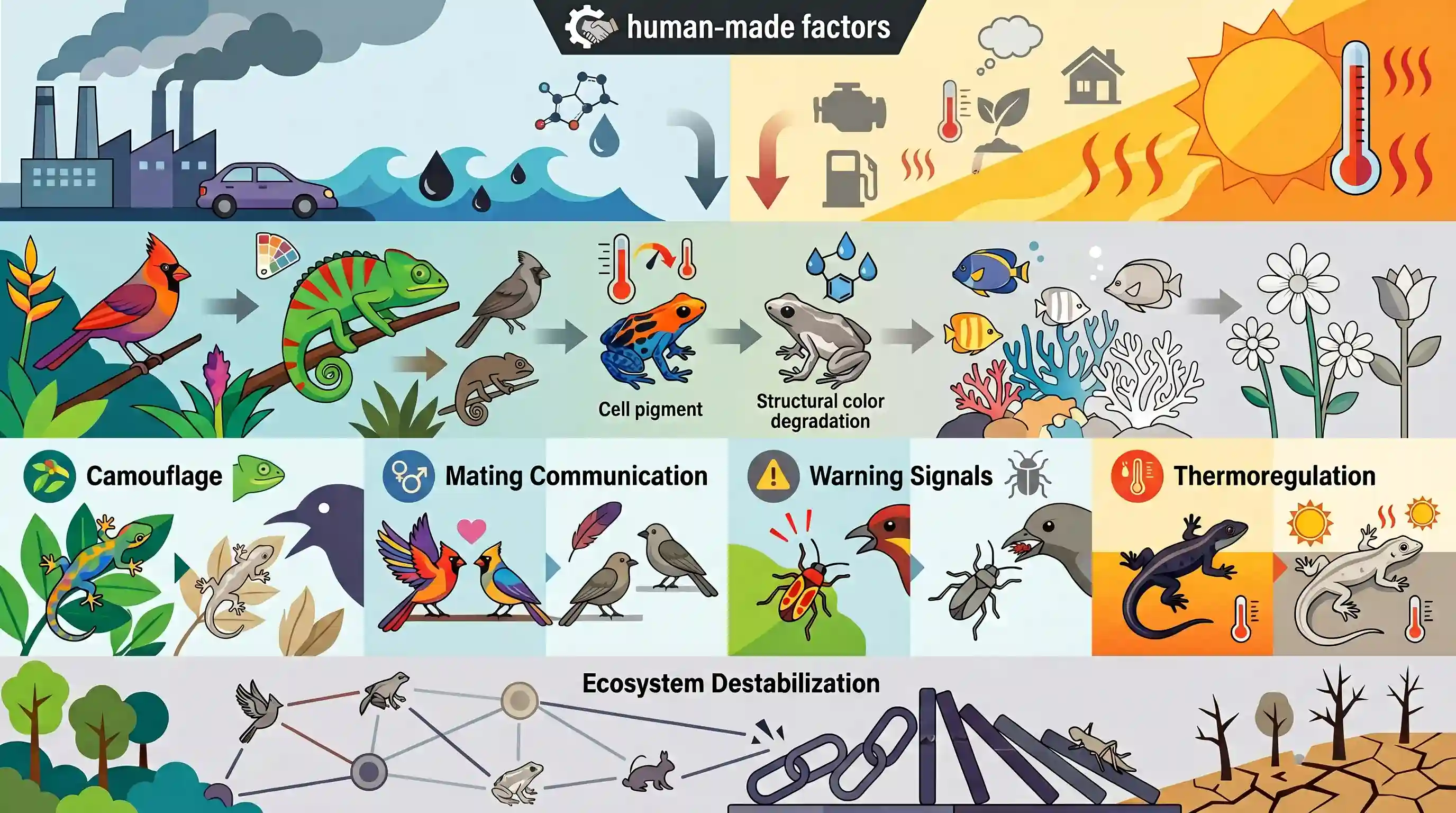
Why It Matters
Provides a unique, scientific dimension to the impacts of climate change and pollution (phenotypic and physiological changes in wildlife). It serves as a powerful, specific example for Mains GS3 answers on environmental degradation, moving beyond generic points like habitat loss to illustrate the deep evolutionary threats posed by anthropogenic activities.
Summary
The article highlights the profound and subtle impacts of anthropogenic environmental stressors—specifically global warming and pollution—on biodiversity. It details how these factors are stripping flora and fauna of their vibrant natural colours. Temperature variations from climate change disrupt biological pigment production, while pollutants degrade structural colours. This loss of colour is not merely aesthetic; it severely impacts species survival by impairing critical evolutionary functions such as camouflage, mating communication, warning signals, and thermoregulation, thereby destabilising ecosystems.
Key Points
- Global warming and pollution act as major environmental stressors, inducing physiological and phenotypic changes in flora and fauna, notably the loss of vibrant natural coloration.
- Temperature fluctuations associated with climate change disrupt the biological synthesis of pigments in plants and animals.
- Various forms of pollution (such as air and water pollutants) degrade structural colours and chemically alter natural pigments.
- The dulling of colours is an ecological threat, as it impairs vital species functions such as mating displays, aposematism (warning signals), camouflage, and thermoregulation.
- This phenomenon highlights the subtle but profound ways anthropogenic activities undermine evolutionary adaptations, ultimately threatening biodiversity and ecosystem resilience.
Prelims Trap
"Structural colours in birds and butterflies are produced by biological pigments that degrade under heat."
Trap! Structural colours rely on physical nanoscale structures that scatter light, not chemical pigments. Air pollution physically degrades these structures, whereas climate change (heat) disrupts biological pigment synthesis.
Static Concepts Connected
What are the key evolutionary defence mechanisms related to animal coloration?
- Aposematism: Warning coloration used by toxic or unpalatable prey to deter predators (e.g., Poison Dart Frog).
- Crypsis: The ability of an animal to avoid detection by blending into its environment (camouflage).
- Batesian Mimicry: When a harmless species mimics the warning signals of a harmful, aposematic species to avoid predation.
What is a Bioindicator in ecological monitoring?
- Definition: Living organisms used to assess the health of a natural ecosystem (e.g., lichens indicating SO2 air pollution).
- Morphological Indicators: Physical changes, such as the environment-induced fading of natural colours, acting as early signs of physiological stress.
- Significance: They provide an early warning system for pollution accumulation and climate shifts before broader ecosystem destabilisation occurs.
Cross-Topic Patterns
Phenotypic Plasticity & Adaptation limits
The rapid pace of climate change outpacing 'phenotypic plasticity' (the ability of an organism to change its physical traits) directly links micro-evolution limits to GS-3 climate change vulnerabilities.
Parallels with Coral Bleaching
The fading of terrestrial fauna colors conceptually mirrors marine coral bleaching, where environmental stress causes pigment-producing zooxanthellae expulsion, creating early-warning indicators of ecosystem collapse.

Expect a match-the-following in 2026 Prelims pairing ecological terms like Aposematism, Crypsis, and Phenotypic Plasticity with definitions.
Linked PYQs · 2
Linked PYQs · 2
- 2017MainsGS3
'Climate change' is a global problem. How India will be affected by climate change? How Himalayan and coastal states of India will be affected by climate change?
- 2023MainsGS3
What is oil pollution? What are its impacts on the marine ecosystem? In what way is oil pollution particularly harmful for a country like India?
