Climate Change and Pollution Drive Loss of Color in Natural Ecosystems
Source:The Hindu ↗
Why It Matters
Highlights the cascading, visible ecological impacts of climate change and pollution beyond standard metrics (like temperature rise or ice melt). It is highly relevant for GS3 Environment and Ecology, especially for questions focusing on bio-indicators, subtle evolutionary effects of global warming, and phenotypic adaptation.
Summary
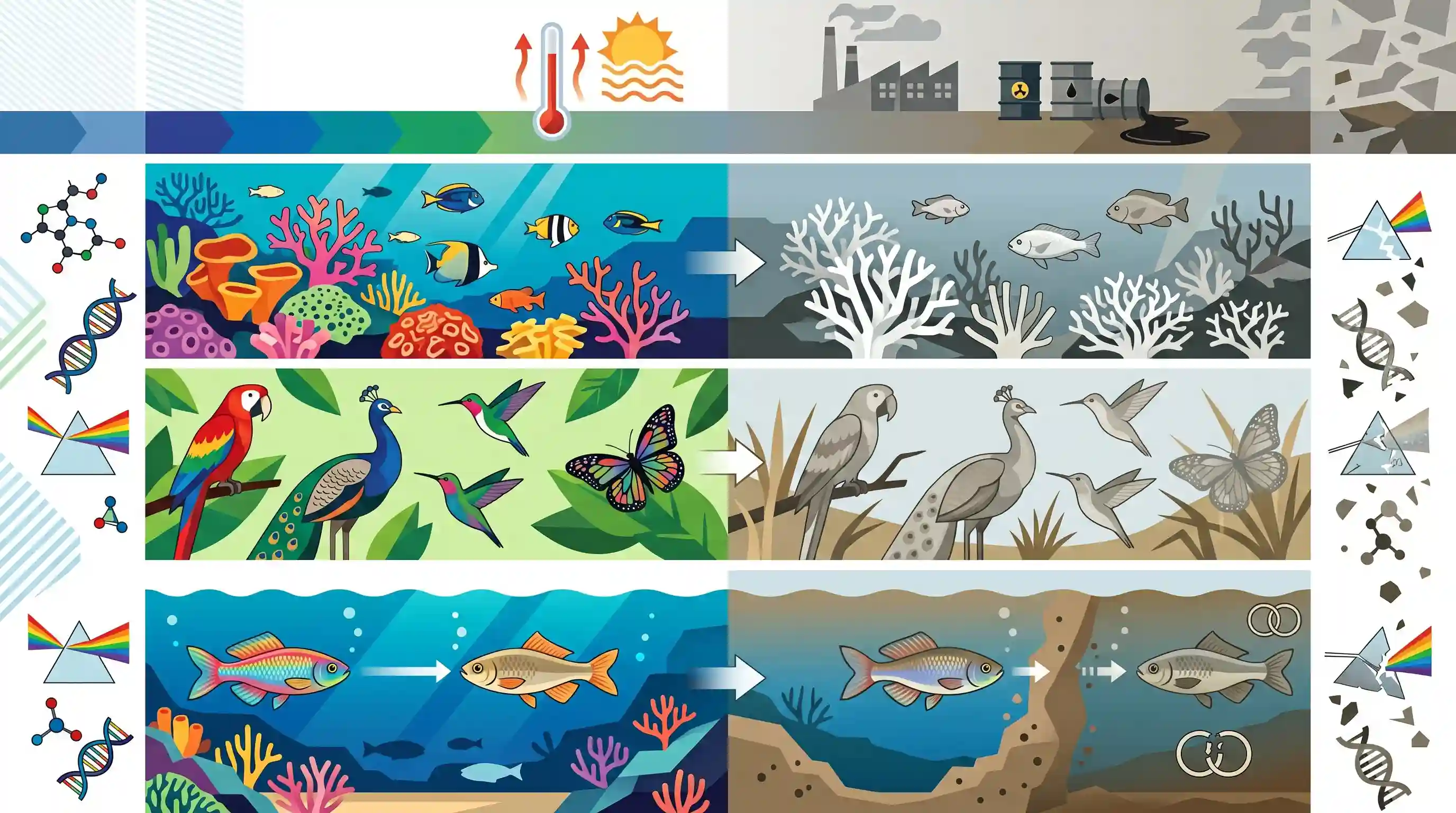
Global warming and pollution are triggering a silent but visible crisis in the natural world: the loss of vibrant biological coloration. From bleached coral reefs to dull-plumaged birds and faded insects, environmental stressors are disrupting both chemical pigment synthesis and the formation of microscopic structural colors. Furthermore, aquatic pollution and murky waters obscure visual mating signals, leading to reproductive failures in various species. This widespread 'fading' of nature serves as a stark bio-indicator of severe ecological distress, highlighting how climate change alters evolutionary biology, species interaction, and phenotypic plasticity.
Key Points
- Climate change and environmental pollution are causing widespread loss of vibrant coloration across ecosystems, acting as a visible bio-indicator of ecological distress.
- Biological coloration is derived from either chemical pigments (like carotenoids or melanin) or structural colors (nanostructures refracting light); both are highly sensitive to environmental stressors.
- Global warming induces coral bleaching by disrupting the symbiotic relationship between corals and their colorful zooxanthellae algae, stripping reefs of their hues.
- Rising temperatures, nutritional stress, and habitat degradation disrupt pigment synthesis, resulting in duller plumage in birds and faded wing scales in insects.
- Aquatic pollution and increased water turbidity obscure visual signaling in marine and freshwater species, severely disrupting mating behaviors, sexual selection, and species recognition.
Prelims Trap
The fading of colors in insects is a permanent genetic mutation driven by global warming.
Color loss due to environmental stress reflects altered 'phenotypic plasticity' (changes in physical expression due to environment), not necessarily a permanent alteration of the underlying DNA.
Static Concepts Connected
What is Phenotypic Plasticity in evolutionary biology?
- Definition: The ability of a single genotype to produce multiple observable traits (phenotypes) in response to varying environmental conditions.
- Contrast with mutation: Unlike evolutionary adaptation through genetic mutations, plasticity allows rapid, sometimes reversible, physical adjustments to environmental stressors like temperature or nutrition.
How does coral bleaching occur physiologically?
- Symbiosis: Corals host photosynthetic zooxanthellae algae, which provide up to 90% of their energy and their vibrant colors.
- Expulsion: Under thermal or pollution stress, corals expel these algae. They turn white (bleach) and lose their main food source, though they do not die immediately.
Cross-Topic Patterns
Structural colors vs. Pigmentation in Science
UPSC often tests the physics behind biological coloration, contrasting structural coloration (nanoscale light refraction, e.g., peacock feathers) with chemical pigmentation (light absorption via melanin/carotenoids).
Bio-indicators across ecosystems
The concept of nature 'fading' expands the standard list of bio-indicators. It links with past UPSC themes testing lichens (SO2 pollution) and diatoms (water quality) as markers of environmental health.

Expect a hybrid question linking 'phenotypic plasticity' (Science) with 'bio-indicators' (Environment) and climate stress in 2026.
Linked PYQs · 3
Linked PYQs · 3
- 2018PrelimsGS1
The term "sixth mass extinction/sixth extinction" is often mentioned in the news in the context of the discussion of
- 2012PrelimsGS1
Which of the following can be threats to the biodiversity of a geographical area? 1. Global warming 2. Fragmentation of habitat 3. Invasion of alien species 4. Promotion of vegetarianism Select the correct answer using the codes given below:
- 2022MainsGS3
Discuss global warming and mention its effects on the global climate. Explain the control measures to bring down the level of greenhouse gases which cause global warming, in the light of the Kyoto Protocol, 1997.
