Global Climate Report Warns Rapid Depletion of Remaining Carbon Budget
Source:Indian Express ↗
Why It Matters
The concept of a 'carbon budget' is central to global climate negotiations. Understanding the tension between rapid renewable energy scaling and the continued rise in aggregate emissions is critical for answering Mains questions on climate mitigation, green hydrogen, and India's energy transition.
Summary
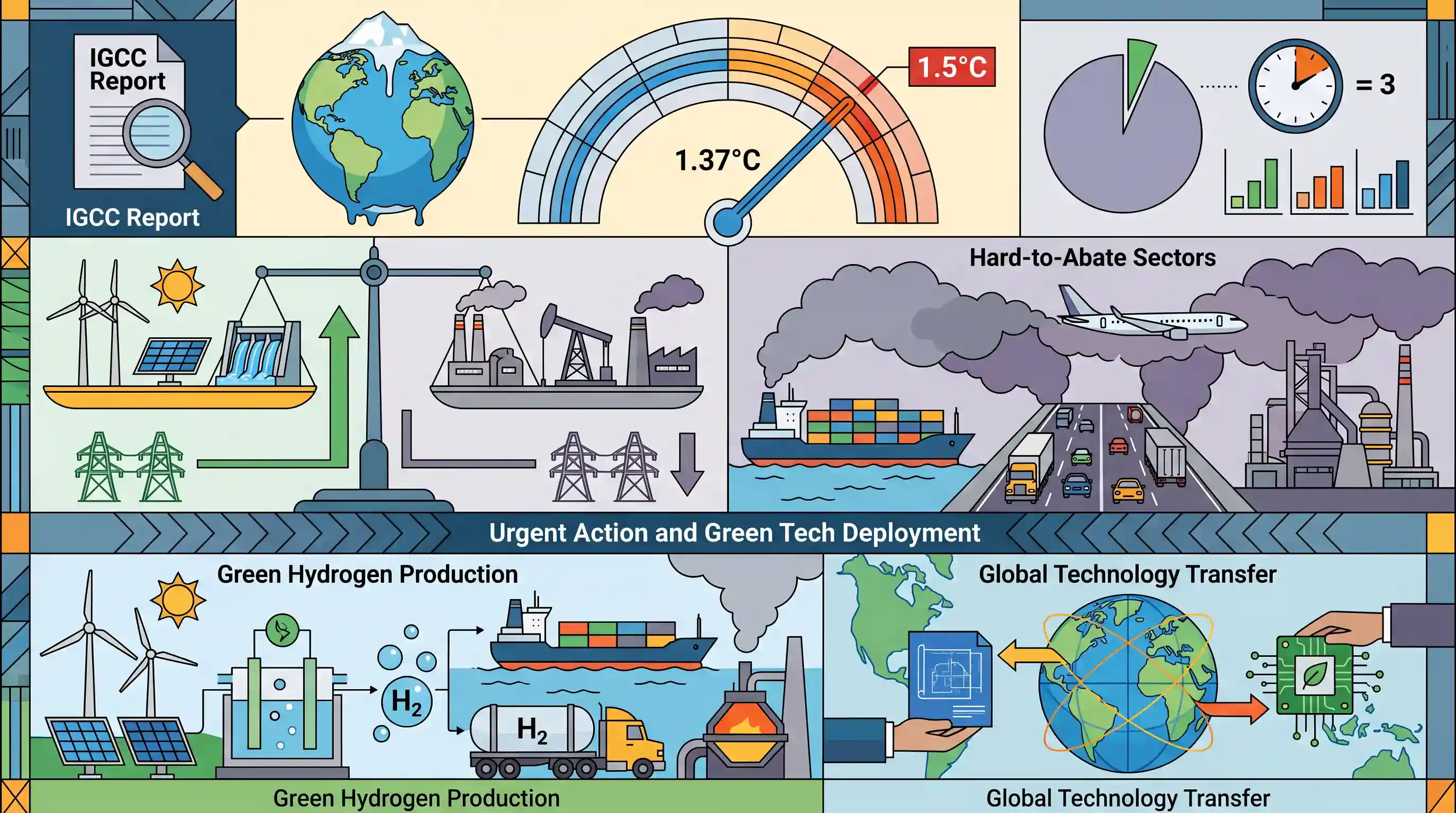
A recent report by the Indicators of Global Climate Change (IGCC) highlights that global warming has reached 1.37°C, shrinking the remaining carbon budget for the 1.5°C target to just three years at current emission rates. While renewable energy generation has grown to rival fossil fuels, hard-to-abate sectors like industry and transport are keeping overall emissions high, necessitating urgent deployment of green technologies like green hydrogen and enhanced global technology transfer.
Key Points
- The Indicators of Global Climate Change (IGCC) report warns that global warming has reached 1.37°C, bringing the world dangerously close to the Paris Agreement's 1.5°C threshold.
- Despite significant progress in scaling up renewable energy sources like solar, wind, and hydro, overall global greenhouse gas emissions continue to rise, driven by industry and transport.
- The world's remaining carbon budget for limiting warming to 1.5°C is estimated at 200 gigatons, which could be entirely depleted within three years at the current emission pace.
- Urgent decarbonization of hard-to-abate sectors is required, demanding a shift toward green hydrogen, recycled materials like aluminium, and robust international technology transfer.
Important Terms
Paris Agreement

A legally binding 2015 international treaty aiming to limit global warming to well below 2°C, preferably 1.5°C, compared to pre-industrial levels.
UPSC context
GS Paper 3: Environment/Global Governance; tests understanding of international climate frameworks and India's NDCs.
Indicators of Global Climate Change (IGCC)
An annual scientific initiative providing data-driven updates on climate indicators (e.g., warming rates, emissions) to bridge the gap between decadal IPCC reports.
UPSC context
GS Paper 3: Science & Environment; relevant for current data on warming trajectories and report-based questions.
Carbon Budget
The estimated cumulative amount of CO2 humanity can emit while maintaining a likely chance of staying below a specific temperature threshold (e.g., 1.5°C).
UPSC context
GS Paper 3: Environmental Pollution; essential for analyzing climate equity and remaining 'carbon space' for developing nations.
Hard-to-abate sectors
Industrial sectors (e.g., steel, cement, aviation, shipping) where decarbonization is technically difficult or expensive due to high-heat requirements and chemical process emissions.
UPSC context
GS Paper 3: Infrastructure/Economy; focuses on industrial decarbonization challenges and the role of new technologies like CCUS.
Green Hydrogen
Hydrogen produced via electrolysis of water using renewable electricity, serving as a clean fuel for industries that cannot be easily electrified.
UPSC context
GS Paper 3: Energy/Science & Tech; central to India's National Green Hydrogen Mission and industrial transition.
Net Zero
A state where greenhouse gas emissions released into the atmosphere are balanced by an equal amount removed, typically targeted by 2050 or 2070.
UPSC context
GS Paper 3: Environment; tests knowledge of long-term climate targets like India’s 'Panchamrit' pledge for 2070.
Prelims Trap
The IGCC (Indicators of Global Climate Change) is an official mechanism established under the UNFCCC.
The IGCC is actually an independent, scientist-led initiative designed to provide annual updates between the lengthy IPCC report cycles, not a UN body.
Static Concepts Connected
What exactly is the 'Global Carbon Budget'?
- Definition: The maximum amount of cumulative net global anthropogenic CO2 emissions permitted to limit global warming to a specific threshold (e.g., 1.5°C).
- Baseline & Scope: It is calculated from the pre-industrial period and factors in the warming caused by non-CO2 greenhouse gases like methane and nitrous oxide.
Why is Green Hydrogen crucial for 'hard-to-abate' sectors?
- High-grade heat: It provides the intense heat required for cement and steel manufacturing, which cannot be efficiently achieved through direct electrification (batteries).
- Chemical feedstock: It acts as a vital zero-carbon reducing agent in steelmaking and serves as a clean raw material for producing ammonia/fertilizers.
Cross-Topic Patterns
Green H2 + National Missions
Decarbonizing heavy industries directly tests knowledge of India’s National Green Hydrogen Mission and industrial energy efficiency schemes like PAT (Perform, Achieve and Trade).
Carbon Space & Climate Justice
The rapid depletion of the global carbon budget by industrialized nations forms the core argument for CBDR and scaled-up climate finance demands by the Global South.

Expect a 2026 Prelims question pairing 'hard-to-abate' sectors (steel, cement) with Green Hydrogen and Carbon Budget definitions.
Linked PYQs · 4
Linked PYQs · 4
- 2016PrelimsGS1
With reference to the Agreement at the UNFCCC Meeting in Paris in 2015, which of the following statements is/are correct? 1. The Agreement was signed by all the member countries of the UN and it will go into effect in 2017. 2. The Agreement aims to limit the greenhouse gas emissions so that the rise in average global temperature by the end of this century does not exceed 2°C or even 1.5°C above pre-industrial levels. 3. Developed countries acknowledged their historical responsibility in global warming and committed to donate $ 1000 billion a year from 2020 to help developing countries to cope with climate change. Select the correct answer using the code given below.
- 2022MainsGS3
Do you think India will meet 50 percent of its energy needs from renewable energy by 2030 ? Justify your answer. How will the shift of subsidies from fossil fuels to renewables help achieve the above objective ? Explain.
- 2023PrelimsGS1
With reference to green hydrogen, consider the following statements: 1. It can be used directly as a fuel for internal combustion. 2. It can be blended with natural gas and used as fuel for heat or power generation. 3. It can be used in the hydrogen fuel cell to run vehicles. How many of the above statements are correct?
- 2023PrelimsGS1
Consider the following heavy industries: 1. Fertilizer plants 2. Oil refineries 3. Steel plants Green hydrogen is expected to play a significant role in decarbonizing how many of the above industries?
