Uttarkashi Flash Floods and Anthropogenic Ecological Vulnerability
Source:Indian Express ↗
Why It Matters
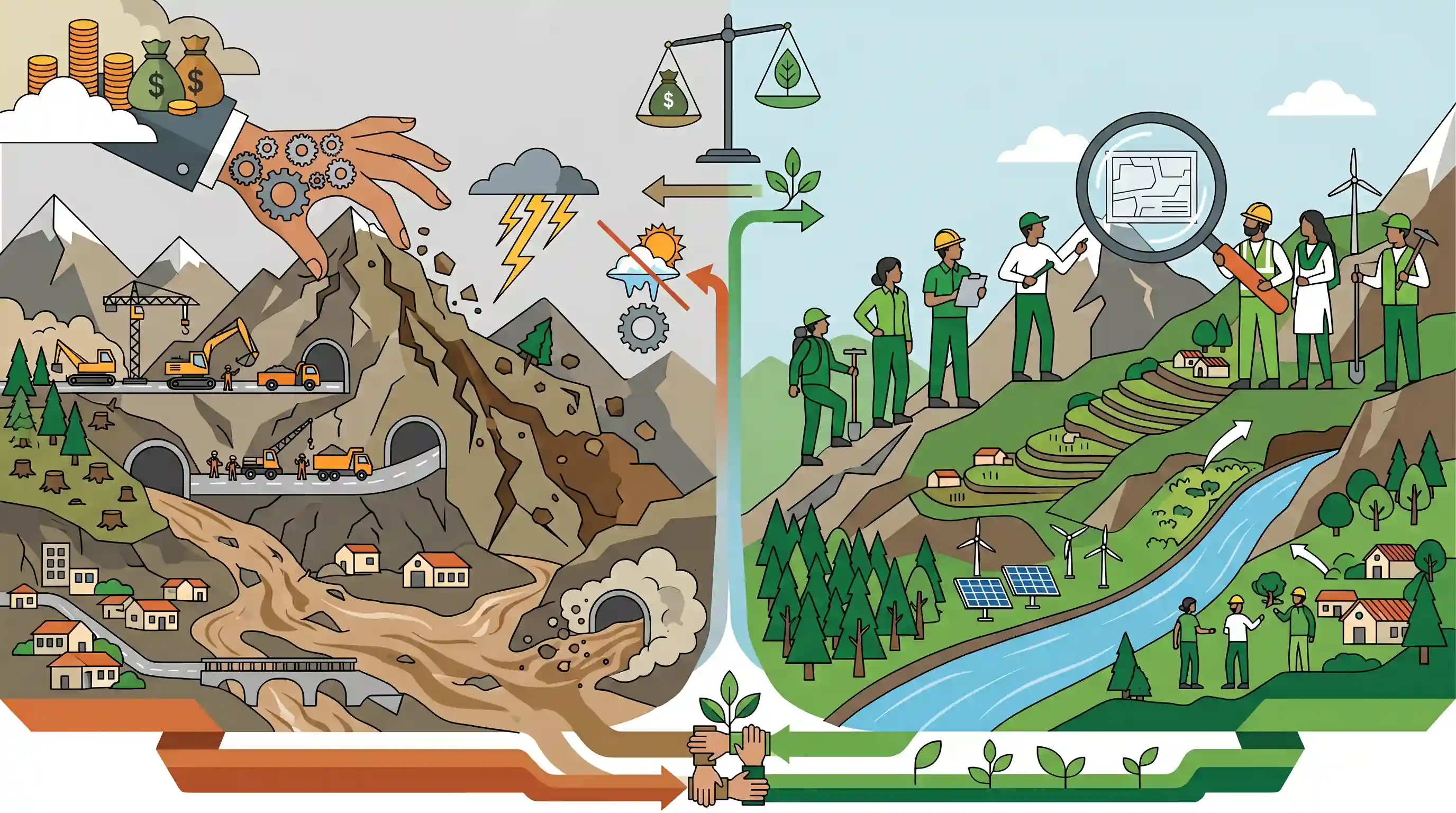
The Himalayan region's vulnerability to disasters is a recurring UPSC theme across GS1 (Geography) and GS3 (Environment and Disaster Management). This article provides a critical perspective for Mains, contrasting the convenient scapegoat of climate change with the more controllable anthropogenic drivers of disaster, such as infrastructure projects and carrying capacity violations.
Summary
The article argues that the recurring flash floods, landslides, and tunnel incidents in Uttarkashi and the broader Himalayan region cannot be entirely blamed on global warming. Instead, it attributes these disasters to anthropogenic factors—specifically, unbridled human greed manifesting as unregulated infrastructure development, large-scale deforestation, and massive construction projects like the Char Dham highway. By ignoring the fragile ecology and carrying capacity of the mountains, such projects exacerbate disaster vulnerability. The piece calls for an urgent prioritization of ecological sustainability and rigorous Environmental Impact Assessments over reckless economic expansion.
Key Points
- Highlights that the recent flash floods and ecological disasters in Uttarkashi are primarily driven by human greed and unregulated infrastructure development, rather than just climate change.
- Points out that large-scale construction, drilling, blasting, and deforestation are severely destabilizing the inherently fragile Himalayan ecosystem.
- Emphasizes the critical need to respect the carrying capacity of the region and strictly enforce Environmental Impact Assessments (EIA) for mega-projects.
- Advocates for a shift from unchecked economic expansion and mass tourism toward sustainable development models suitable for mountainous terrains.
Important Terms
Char Dham Pariyojana

A ~900-km highway project in Uttarakhand connecting the shrines of Badrinath, Kedarnath, Gangotri, and Yamunotri. It aims to boost tourism and strategic military connectivity near the Indo-China border.
UPSC context
GS Paper 3: Infrastructure and Environment; tests the trade-off between national security, economic development, and ecological preservation in fragile regions.
Carrying Capacity
The maximum population size and level of human activity an ecosystem can sustainably support without causing significant degradation or depletion of its natural resources.
UPSC context
GS Paper 3: Sustainable Development; relevant for understanding resource limits and judicial efforts to regulate urbanization in the Himalayas.
Environmental Impact Assessment (EIA)
A statutory process under the Environment (Protection) Act, 1986, used to identify and evaluate the potential environmental, social, and economic impacts of proposed infrastructure or industrial projects.
UPSC context
GS Paper 3: Environment; tests knowledge of regulatory frameworks and the consequences of bypassing safeguards in ecologically sensitive zones.
Himalayan Ecology
The unique and sensitive biological and physical systems of the young, tectonically active Himalayan mountains, characterized by steep slopes, glaciers, and high susceptibility to landslides and floods.
UPSC context
GS Paper 1: Geography and GS Paper 3: Disaster Management; examines the relationship between physical topography and regional disaster vulnerability.
Anthropogenic Factors
Environmental changes or disasters caused or exacerbated by human activity, such as unscientific road construction, deforestation, and blasting, rather than purely natural processes.
UPSC context
GS Paper 3: Environment and Disaster Management; tests the ability to analyze how human interventions intensify natural hazards into full-scale disasters.
Prelims Trap
"All continuous mega-infrastructure projects in fragile regions like the Himalayas require mandatory and unified Environmental Impact Assessments."
Proponents often bypass EIA norms by segmenting continuous highways into smaller stretches (under 100km) or utilizing exemptions designed for strategic border roads.
Static Concepts Connected
What is the "carrying capacity" of an ecosystem?
- Definition: The maximum population size, infrastructure, or tourism load that an environment can sustainably support without undergoing degradation.
- UPSC Application: Applied heavily in NDMA guidelines for hill stations to limit unregulated construction, vehicular influx, and mass tourism.
- Ecological Footprint: It determines the delicate balance between anthropogenic resource consumption and the ecosystem's natural regenerative capacity.
What are the key pillars of the National Landslide Risk Management Strategy?
- Hazard Mapping: Creation of macro and micro-level Landslide Hazard Zonation (LHZ) maps to restrict construction in highly vulnerable shear zones.
- Early Warning Systems: Deployment of site-specific systems using rainfall thresholds and geological sensors to predict slope failures.
- Mountain Regulations: Strict enforcement of specialized town planning, building codes, and slope modification rules specific to hilly terrains.
Cross-Topic Patterns
Strategic needs vs. Himalayan ecology
The Char Dham project's strategic necessity for border mobility frequently clashes with NDMA guidelines for fragile ecosystems, presenting a classic GS3 internal security versus environment dilemma.
Judicial oversight via HPCs and NGT
The Supreme Court's formation of a High Powered Committee (HPC) for the Char Dham highway highlights judicial oversight when executive bodies bypass EIAs through project segmentation.

Expect a 2026 GS3 Mains question contrasting Himalayan "carrying capacity" with border security and strategic infrastructure needs.
Linked PYQs · 5
Linked PYQs · 5
- 2016MainsGS3
Rehabilitation of human settlements is one of the important environmental impacts which always attracts controversy while planning major projects. Discuss the measures to be adopted to mitigate the impact of the recent incidents of cloudbursts in many places of Uttarakhand.
- 2019MainsGS3
Define the concept of carrying capacity of an ecosystem as relevant to an environment. Explain how understanding this concept is vital while planning for sustainable development of a region.
- 2021MainsGS3
Describe the various causes and the effects of landslides. Mention the important components of the National Landslide Risk Management Strategy.
- 2016MainsGS1
The Himalayas are highly prone to landslides. Discuss the causes and suggest suitable measures of mitigation.
- 2021MainsGS1
Differentiate the causes of landslides in the Himalayan region and Western Ghats.
