ILO Report Highlights Persistent Informal Labor and Quality Deficit
Source:The Hindu ↗
Why It Matters
The findings draw a clear distinction between the quantity and quality of jobs, an important theme for GS3 Economy. It highlights the growing concern of the 'working poor' and informalization of labor, reminding policymakers that low unemployment numbers can mask deep structural issues like extreme poverty and gender disparity in the workforce.
Summary
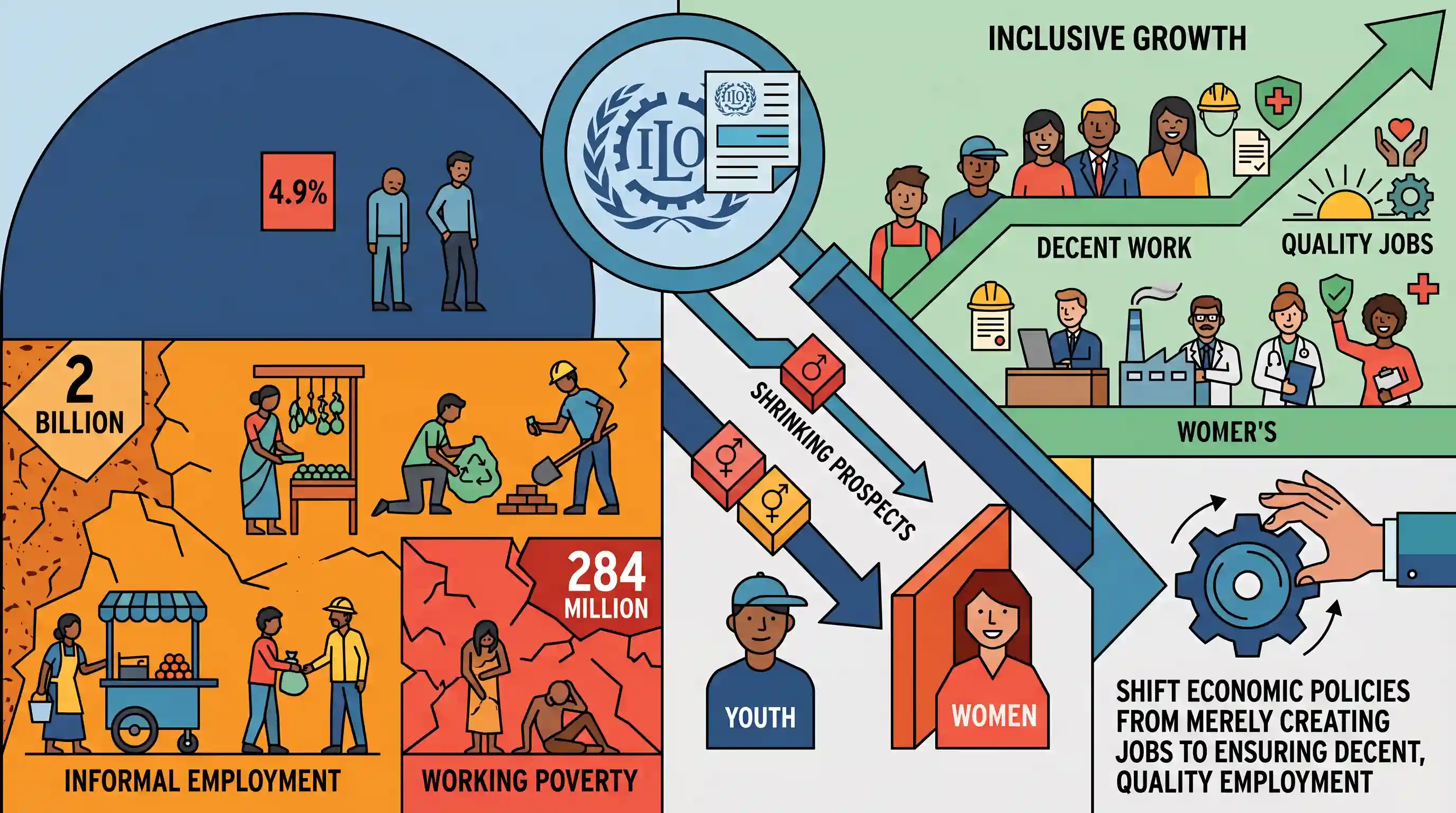
The International Labour Organization's (ILO) Employment and Social Trends 2026 report highlights a paradox in the global labor market: while the overall unemployment rate remains at a historic low of 4.9%, job quality is severely lacking. Over two billion people remain trapped in informal employment, and 284 million workers live in extreme poverty. Furthermore, the report warns of shrinking job prospects for youth and women, underscoring that global economic policies must shift focus from merely creating jobs to ensuring decent, quality employment.
Key Points
- The global unemployment rate for 2026 is projected to remain at a historically low level of 4.9%, representing roughly 186 million people.
- The ILO report warns of decreasing job opportunities specifically for youth and women across the globe.
- Poor job quality remains a massive structural issue, with over 2 billion workers globally engaged in informal employment.
- The pace of poverty reduction has drastically slowed down; the share of workers in extreme poverty (earning less than $3 a day) declined by only 3.1 percentage points between 2015 and 2025, leaving 284 million workers in extreme poverty.
Important Terms
International Labour Organization (ILO)

A specialized United Nations agency established in 1919 to set international labor standards and promote social justice through its unique tripartite structure involving governments, employers, and workers.
UPSC context
Relevant for GS Paper II (International Institutions) and GS Paper III (Employment and Economy).
Employment and Social Trends 2026 report
An annual ILO publication (part of the World Employment and Social Outlook series) that analyzes global labor market trends, unemployment rates, job quality, and socio-economic inequalities.
UPSC context
Crucial for GS Paper III (Indian Economy and Issues Relating to Planning, Mobilization of Resources, and Employment).
Informal Employment
Jobs or businesses operating without legal protection, social security, or formal registration, where workers lack benefits like pensions, paid leave, and job security.
UPSC context
Key concept for GS Paper III (Inclusive Growth and Issues arising from it).
Working Poverty
A situation where employed individuals live in households with a per capita income below the international poverty line, indicating that employment alone does not guarantee an adequate standard of living.
UPSC context
Important for GS Paper III (Economy and Poverty-related issues) and GS Paper II (Social Justice).
Decent Work Agenda
An ILO framework focused on four pillars: creating jobs, guaranteeing rights at work, extending social protection, and promoting social dialogue, formally integrated into UN SDG 8.
UPSC context
Relevant for GS Paper III (Labor Reforms and Sustainable Development Goals).
Labour Force Participation Rate (LFPR)
The percentage of the working-age population (typically 15 years and older) that is either employed or actively seeking employment.
UPSC context
A core metric for GS Paper III (Employment trends and gender-based economic disparities).
Prelims Trap
A historically low global unemployment rate indicates a proportional decrease in working poverty and informal employment.
The ILO report explicitly highlights a global paradox: unemployment is historically low, yet poor job quality, informality, and working poverty remain massive structural issues.
Static Concepts Connected
What are the key Labour Market Indicators tracked by India's PLFS?
- LFPR (Labour Force): The percentage of persons in the labour force (i.e., working or actively seeking work) in the population.
- WPR (Worker Ratio): The percentage of employed persons in the overall population.
- Unemployment Rate (UR): The percentage of persons unemployed strictly among those in the labour force, not the entire population.
What distinguishes 'informal employment' in India according to the NCEUS definition?
- Social Security Absence: Workers lack statutory social security benefits like provident fund (EPF), health insurance (ESIC), and pension.
- Enterprise Size: Typically involves unincorporated private enterprises owned by individuals or households employing less than 10 workers.
- Contractual Nature: Includes formal sector workers who do not have formal employment contracts or legal protections.
Cross-Topic Patterns
India's PLFS vs ILO Global Trends
While ILO warns of shrinking global female/youth opportunities, India's recent PLFS shows rising FLFPR. However, this is largely driven by unpaid family labor in agriculture, mirroring ILO's 'poor job quality' concerns.
E-Shram portal & Informal Worker Mapping
The ILO's focus on 2 billion informal workers underscores the urgency of India's e-Shram portal and the Code on Social Security to map and protect gig and unorganized workers.

Expect a 2026 Prelims question pairing ILO report publishers with the conceptual paradox of falling unemployment but rising 'working poor'.
Linked PYQs · 3
Linked PYQs · 3
- 2018PrelimsGS1
International Labour Organization's Conventions 138 and 182 are related to
- 2023MainsGS3
Most of the unemployment in India is structural in nature. Examine the methodology adopted to compute unemployment in the country and suggest improvements.
- 2016MainsGS3
How globalization has led to the reduction of employment in the formal sector of the Indian economy? Is increased informalization detrimental to the development of the country?
