US tariff policies and their implications for global trade order
Source:Indian Express ↗
Why It Matters
The shift from globalization to protectionism is a central theme in recent UPSC exams. Understanding how US tariff policies and potential trade wars impact the WTO's relevance and India's macroeconomic stability is crucial for GS Paper 2 (International Relations) and GS Paper 3 (Economy).
Summary
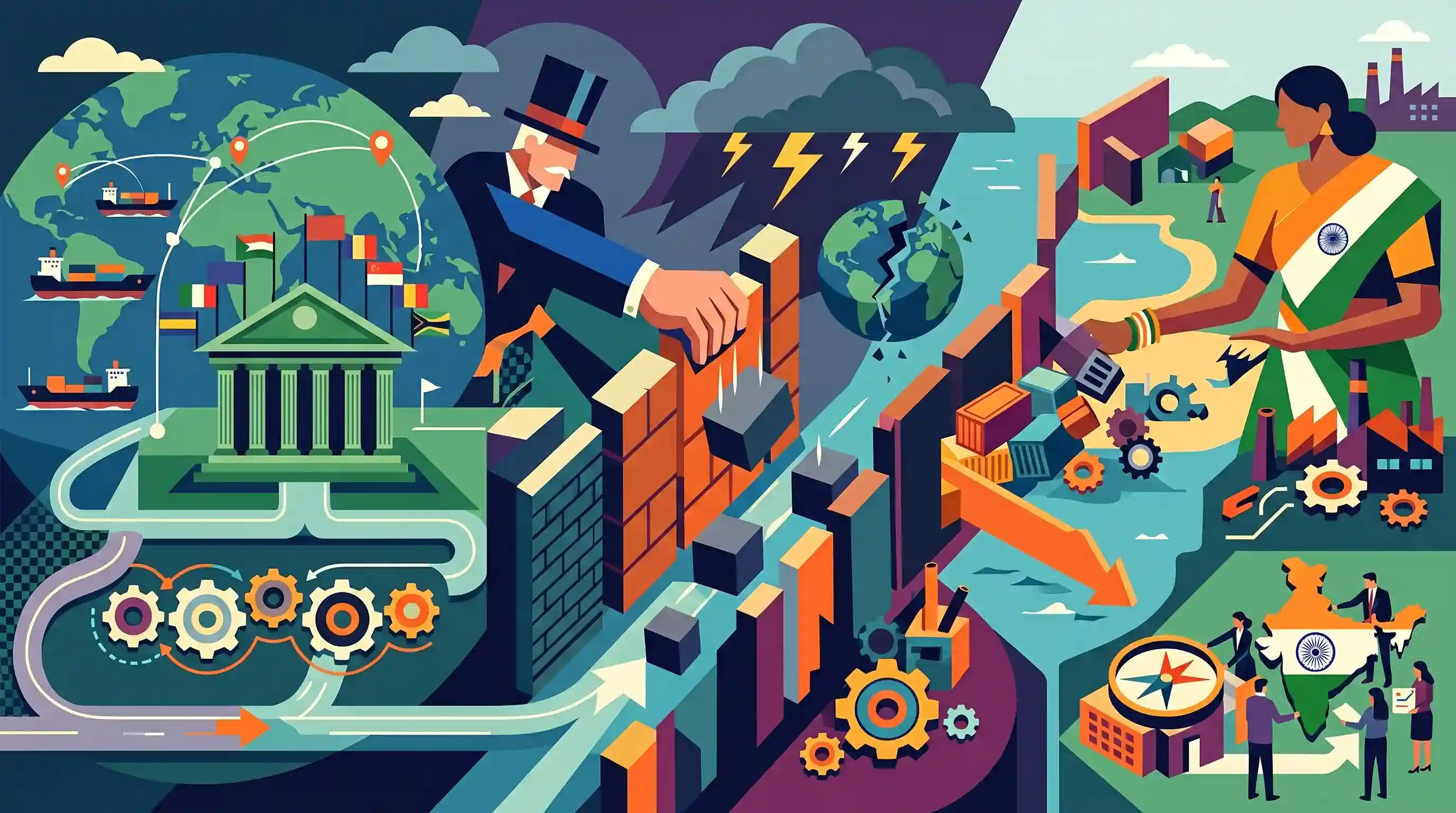
The article discusses the fundamental shift in global trade dynamics driven by rising US protectionism, particularly Donald Trump's proposed universal tariffs. This shift marks a departure from the long-standing 'business-as-usual' era of multilateralism and free trade under the WTO. The transition towards high tariffs and bilateral trade wars poses severe challenges for the global economy, threatening to disrupt supply chains and shrink export opportunities for developing nations like India. Navigating this deglobalization trend requires countries to recalibrate their economic strategies to mitigate external shocks.
Key Points
- The global trade environment is shifting from an era of free trade and multilateralism to rising protectionism and bilateralism.
- Donald Trump's proposed universal tariffs and aggressive trade policies threaten to severely disrupt established global supply chains and trade norms.
- Such protectionist policies undermine the World Trade Organization (WTO) framework, creating the potential for an escalated global 'Trade War'.
- Developing economies like India face significant challenges from shrinking export markets, necessitating strategic realignments and a focus on self-reliance or regional partnerships.
Important Terms
World Trade Organization (WTO)

An intergovernmental organization (est. 1995) that regulates global trade rules. It operates on a consensus-based system to ensure trade flows smoothly, predictably, and freely.
UPSC context
GS Paper 2/3: Focuses on rules-based trade, the Dispute Settlement Body, and MFN principles affecting India's trade policy.
Deglobalization
The process of reducing economic interdependence and integration between nations, often marked by reshoring supply chains and increasing trade barriers.
UPSC context
GS Paper 3: Examines shifts in global value chains and the impact of economic nationalism on India's growth.
Protectionism
An economic policy that restricts imports through tariffs, quotas, or subsidies to shield domestic industries and employment from foreign competition.
UPSC context
GS Paper 3: Relevant for trade war analysis, industrial policy, and the balance between free trade and self-reliance (Aatmanirbhar Bharat).
Multilateralism
The process of organizing international relations among three or more states based on common principles, typically through international institutions like the WTO.
UPSC context
GS Paper 2: Tests the efficacy of global governance and the shift toward bilateral or minilateral trade arrangements.
Tariffs
A tax or duty imposed by a government on imported goods. "Universal tariffs" are broad, uniform duties applied across all trading partners.
UPSC context
GS Paper 3: Crucial for understanding trade barriers, revenue generation, and their direct impact on the competitiveness of Indian exports.
Bilateralism
Trade or diplomatic coordination conducted between two states. It often results in faster negotiations compared to multilateral agreements.
UPSC context
GS Paper 2: Central to analyzing India's recent Free Trade Agreements (FTAs) with partners like the UAE and Australia.
Prelims Trap
"Under WTO rules, unilateral tariff hikes by a member country are strictly prohibited under all circumstances."
The WTO permits tariff hikes up to a country's 'bound rates' and allows exceptions like trade remedies or the National Security Exception (GATT Article XXI).
Static Concepts Connected
What are the WTO-compliant trade remedy measures against unfair trade?
- Anti-dumping duties: Levied when an exporting country sells products below fair market value, causing material injury to the domestic industry.
- Countervailing duties: Imposed to neutralize the negative effects of specific trade-distorting subsidies provided by the exporting country's government.
- Safeguard measures: Temporary import restrictions applied when a sudden, unforeseen surge in imports threatens serious injury to domestic producers.
What is the Supply Chain Resilience Initiative (SCRI)?
- Trilateral partnership: Launched by India, Japan, and Australia in 2021 to reduce supply chain vulnerability and over-dependence on a single nation (China).
- Core objectives: Aims to ensure continuity of supply networks, attract FDI, and build complementary manufacturing capacities across the Indo-Pacific.
Cross-Topic Patterns
Protectionism + Currency Wars
US tariffs often trigger competitive devaluations by exporting nations (like China) to maintain price competitiveness, indirectly impacting India's exchange rate (REER) and trade balance.
Self-reliance vs Import Substitution
UPSC frequently asks candidates to differentiate modern 'Atmanirbhar Bharat' (building capacity for global value chains) from pre-1991 import substitution (hiding behind high tariff walls).

Expect a 2026 Mains question linking WTO dispute mechanism paralysis with the global surge in unilateral protectionism and minilateral FTAs.
Linked PYQs · 3
Linked PYQs · 3
- 2025MainsGS3
What are the challenges before the Indian economy when the world is moving away from free trade and multilateralism to protectionism and bilateralism? How can these challenges be met?
- 2018MainsGS2
What are the key areas of reform if the WTO has to survive in the present context of "Trade War', especially keeping in mind the interest of India?
- 2016MainsGS2
The broader aims and objectives of WTO are to manage and promote international trade in the era of globalization. But the Doha round of negotiations seem doomed due to differences between the developed and the developing countries." Discuss in the Indian perspective.
