Strategic Vulnerabilities of Strait of Malacca Trade Chokepoint
Source:Indian Express ↗
Why It Matters
India heavily relies on these maritime chokepoints for its energy imports and international trade. Understanding the geopolitical dynamics, vulnerabilities (like piracy and narrow straits), and regional security arrangements in the Strait of Malacca is essential for analyzing India's strategic interests in the Indo-Pacific and its broader economic stability.
Summary
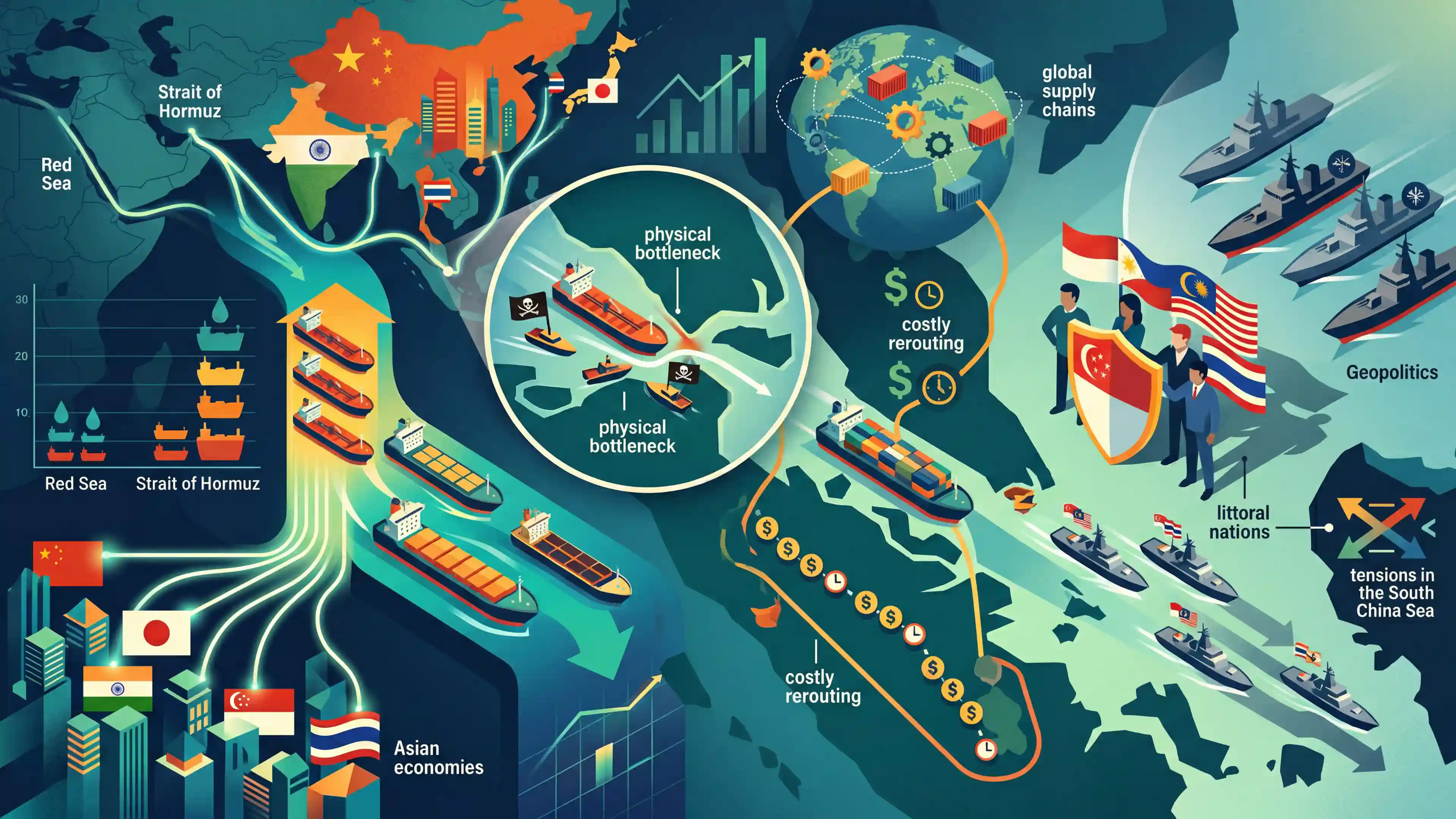
While recent geopolitical focus has centered on disruptions in the Red Sea and the Strait of Hormuz, the Strait of Malacca remains the most vital and vulnerable chokepoint in global maritime trade. Connecting the Indian Ocean to the Pacific, it facilitates a larger volume of daily oil shipments than Hormuz and is crucial for the energy security of major Asian economies like China, Japan, and India. The strait faces unique challenges, including a severe physical bottleneck at the Phillips Channel and a recent resurgence in piracy. A blockade or major disruption would force costly rerouting, threatening global supply chains. In response, littoral nations (Indonesia, Malaysia, Singapore, and Thailand) are enhancing coordinated security patrols to protect the route and avoid giving major global powers a pretext for intervention, which could exacerbate existing tensions in the South China Sea.
Key Points
- The Strait of Malacca transports over 21 million barrels of oil daily, surpassing the Strait of Hormuz as the world's most critical maritime energy chokepoint.
- The strait's physical narrowness (only 2.7 km at the Phillips Channel) makes it highly susceptible to bottlenecks, where a single accident could severely disrupt global trade.
- Rising piracy incidents in the strait pose significant security threats to commercial shipping and global supply chains.
- Any disruption forcing ships to reroute via the Sunda or Lombok Straits would drastically increase shipping costs, transit times, and potentially fuel global inflation.
- Littoral states—Indonesia, Malaysia, Singapore, and Thailand—have ramped up coordinated patrols to ensure maritime security and prevent major external powers from intervening under the pretext of securing trade routes.
Important Terms
ReCAAP (Regional Cooperation Agreement on Combating Piracy)

First regional government-to-government agreement to combat piracy and armed robbery at sea in Asia. Established in 2006, it involves 21 countries, including India, which is represented by the Indian Coast Guard.
UPSC context
GS Paper 2 (International Relations) and GS Paper 3 (Maritime Security); tests knowledge of regional security architectures and India's role.
ReCAAP Information Sharing Centre (ISC)
The Singapore-based hub for ReCAAP that facilitates real-time information exchange, issues alerts, and publishes periodic reports on maritime security incidents to enhance situational awareness for member nations and the shipping industry.
UPSC context
GS Paper 3 (Internal Security); relevant for questions on institutional mechanisms for information-led maritime policing in the Indo-Pacific.
SUMED Pipeline
A 200-mile oil pipeline in Egypt connecting the Red Sea (Ain Sokhna) to the Mediterranean (Sidi Kerir). It serves as a vital strategic bypass for tankers too large for the Suez Canal.
UPSC context
GS Paper 1 (World Geography) and GS Paper 3 (Energy Security); tests understanding of global energy infrastructure and maritime chokepoints.
Phillips Channel
A critical 2.7 km-wide bottleneck within the Singapore Strait, representing the narrowest point for ships navigating the Malacca-Singapore transit route and posing significant collision and grounding risks for large vessels.
UPSC context
GS Paper 1 (World Geography); specific geographical feature critical to global trade and maritime navigation.
Malacca Straits Patrol (MSP)
A four-nation security initiative (Indonesia, Malaysia, Singapore, Thailand) launched in 2004 to secure the Strait of Malacca via coordinated sea/air patrols and intelligence sharing while maintaining the sovereignty of littoral states.
UPSC context
GS Paper 2 (International Relations); important for India's 'Act East' policy and its quest for inclusion in regional security frameworks.
US Energy Information Administration (EIA)
The primary U.S. government authority for energy statistics and analysis. It tracks global oil transit chokepoints, providing data crucial for assessing energy security and global trade vulnerabilities.
UPSC context
GS Paper 3 (Economic Development); cited as a standard source for energy security data and trade flow analysis.
Centre for Strategic and International Studies (CSIS)
A prominent US-based think tank that provides bipartisan policy analysis on international security, trade, and geopolitics, frequently cited for its "China Power" and "Asia Maritime Transparency Initiative" data.
UPSC context
GS Paper 2 (International Relations); source of strategic research used in analyzing global power dynamics and Indo-Pacific security.
Prelims Trap
The Strait of Hormuz is the world's largest maritime oil transit chokepoint by volume.
Despite the geopolitical noise around the Middle East, the Strait of Malacca actually handles more daily oil volume than the Strait of Hormuz.
Static Concepts Connected
What are the key alternative straits to Malacca in the Indo-Pacific?
- Sunda Strait: Connects the Indian Ocean to the Java Sea, lying between the Indonesian islands of Sumatra and Java.
- Lombok Strait: Located between Bali and Lombok; it is much deeper than Malacca, making it the required route for massive 'Malaccamax' vessels.
- Makassar Strait: A common continuation from the Lombok Strait, connecting the Celebes and Java seas.
What regional frameworks govern maritime security around the Malacca Strait?
- Malacca Straits Patrol: A coordinated maritime security framework involving the littoral states of Indonesia, Malaysia, Singapore, and Thailand to curb piracy.
- ReCAAP: The first government-to-government agreement in Asia (ReCAAP) aimed at promoting cooperation against piracy and armed robbery against ships.
Cross-Topic Patterns
China's Malacca Dilemma and CPEC
China's reliance on the Strait for 80% of its oil directly drives its investments in Gwadar Port and CPEC, seeking alternative overland energy routes avoiding maritime chokepoints.
A&N Islands as a Chokepoint Sentinel
India's massive infrastructure push in the Andaman and Nicobar Islands leverages their proximity to Malacca's western approach, serving as a strategic sentinel over this vital trade route.

Expect a map-based Prelims question pairing Southeast Asian straits (Sunda, Lombok, Malacca) with their connecting water bodies in 2026.
Linked PYQs · 5
Linked PYQs · 5
- 2008PrelimsGS1
Which one of the following straits is nearest to the International Date Line?
- 2024MainsGS2
Discuss the geopolitical and geostrategic importance of Maldives for India with a focus on global trade and energy flows. Further also discuss how this relationship affects India's maritime security and regional stability amidst international competition ?
- 2014MainsGS2
With respect to the South China sea, maritime territorial disputes and rising tension affirm the need for safeguarding maritime security to ensure freedom of navigation and over flight throughout the region. In this context, discuss the bilateral issues between India and China.
- 2025MainsGS3
Why is maritime security vital to protect India's sea trade? Discuss maritime and coastal security challenges and the way forward.
- 2022MainsGS3
What are the maritime security challenges in India ? Discuss the organisational, technical and procedural initiatives taken to improve the maritime security.
