Semiconductor Supply Chains and Global Hardware Price Hikes from AI
Source:Indian Express ↗
Why It Matters
Provides a practical example of how emerging technologies (like AI) impact global manufacturing dynamics and supply chains. It is highly relevant for GS3 topics on Technology, indigenization of technology, and India's efforts to establish a robust semiconductor manufacturing ecosystem (India Semiconductor Mission).
Summary
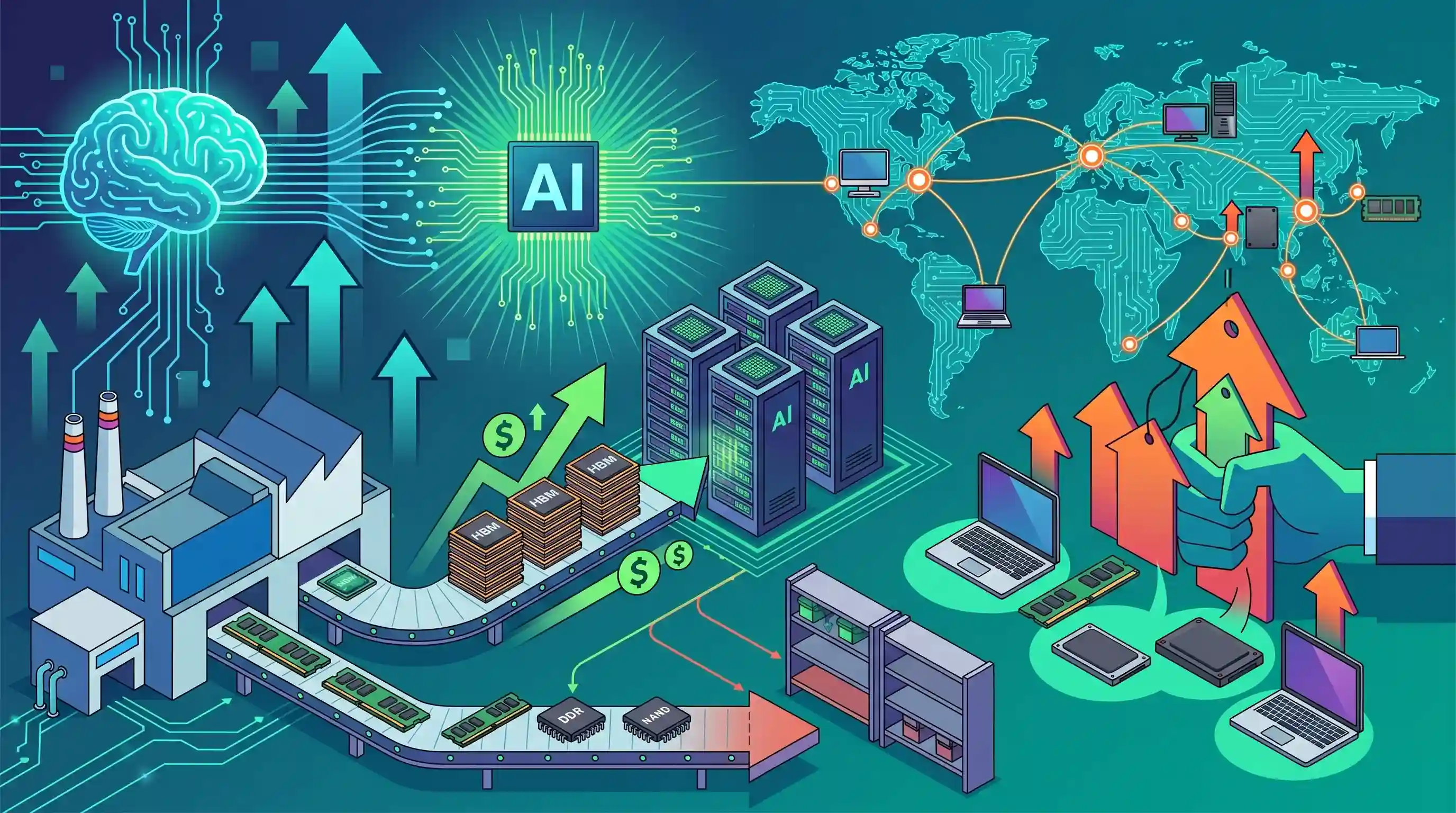
A surge in global demand for Artificial Intelligence computing has triggered up to a 50% price hike for traditional computer memory (RAM) and solid-state drives (SSDs). Major semiconductor manufacturers, including Samsung and SK Hynix, are reallocating their production lines to prioritize High Bandwidth Memory (HBM) chips required for AI servers, as these yield higher profit margins. Consequently, the production of standard DDR memory and NAND flash has slowed down, causing widespread supply constraints. This shift underscores the immense hardware infrastructure required to sustain the AI revolution and highlights vulnerabilities within the highly concentrated global semiconductor supply chain.
Key Points
- The global AI boom has generated enormous demand for High Bandwidth Memory (HBM) chips, which are essential for AI computing servers to handle massive data loads.
- Dominant semiconductor manufacturers like Samsung and SK Hynix are diverting production capacities towards high-margin HBM chips to capitalize on the AI trend.
- This pivot has led to a significant supply crunch for standard DDR4 and DDR5 RAM, as well as NAND flash memory, driving up global prices of standard RAM and SSDs by up to 50%.
- The component shortage is expected to increase the final retail prices of consumer electronics such as PCs and smartphones, showcasing the vulnerability of the global electronics supply chain to specialized tech booms.
Important Terms
Semiconductor Industry

A strategic sector involving the design and fabrication of chips. It is the backbone of modern electronics, AI, and national security, characterized by high capital intensity and complex global supply chains.
UPSC context
GS Paper 3: Science & Tech, Industrial Policy. Tests understanding of critical technologies and India's 'Atmanirbhar Bharat' manufacturing goals.
High Bandwidth Memory (HBM)
A high-performance 3D-stacked DRAM (Dynamic Random Access Memory) technology that provides ultra-high data transfer speeds. It is essential for AI accelerators and GPUs to handle massive datasets with low latency.
UPSC context
GS Paper 3: Science & Tech. Tests knowledge of emerging hardware innovations driving the global AI revolution.
NAND Flash
A type of non-volatile storage technology that retains data without power. It is the primary component in Solid State Drives (SSDs), USB drives, and smartphones for long-term data storage.
UPSC context
GS Paper 3: Science & Tech. Useful for comparing volatile vs. non-volatile memory in digital infrastructure questions.
India Semiconductor Mission (ISM)
A comprehensive policy framework launched in 2021 with a ₹76,000 crore outlay to build a vibrant semiconductor and display ecosystem in India through fiscal support and global partnerships.
UPSC context
GS Paper 3: Economy/Industry. A flagship scheme central to India's digital sovereignty and electronics manufacturing exports.
Samsung & SK Hynix
Two South Korean giants that dominate the global memory market. Samsung is the world's largest chipmaker, while SK Hynix is a pioneer and market leader in High Bandwidth Memory (HBM).
UPSC context
GS Paper 3: Global Economy. Illustrates the high concentration of critical technology manufacturing in specific geopolitical regions like East Asia.
Supply Chain Resilience
The ability of a supply chain to anticipate, resist, and recover from disruptions. The semiconductor shortage highlights the need for diversifying production away from single-source dependencies (e.g., China or Taiwan).
UPSC context
GS Paper 2/3: IR & Economy. Crucial for discussing global trade stability and India's role as an 'alternative' manufacturing hub.
Prelims Trap
"NAND flash memory used in SSDs is a volatile memory that requires continuous power supply to retain data."
NAND Flash is non-volatile memory, retaining data without power. Standard RAM is volatile. UPSC frequently swaps these exact properties in S&T statements.
Static Concepts Connected
How do volatile and non-volatile computer memory fundamentally differ?
- Volatile (RAM): Requires continuous power to hold data; provides high-speed access for active CPU tasks (e.g., standard DDR4/DDR5).
- Non-volatile (NAND): Retains data even when powered off; it is the foundational technology for SSDs and long-term storage.
- HBM (High Bandwidth): Advanced vertically stacked RAM offering exceptionally fast data transfer, crucial for massive AI matrix calculations.
How is India addressing global semiconductor supply chain concentration?
- Fiscal Support: The India Semiconductor Mission (ISM) offers up to 50% project cost support for establishing local fabrication facilities.
- DLI Scheme: The Design Linked Incentive (DLI) scheme provides financial support for domestic chip design and deployment.
- Strategic Autonomy: Aims to reduce critical tech import reliance and vulnerability to supply shocks from hubs like Taiwan/South Korea.
Cross-Topic Patterns
AI infrastructure vs. e-waste policies
Rapid obsolescence of standard memory and the pivot to high-end AI servers will accelerate e-waste generation globally, heavily testing India's updated E-Waste (Management) Rules.
Semiconductor supply shocks & imported inflation
Component shortages drive up consumer electronics prices, creating supply-side tech inflation that central banks struggle to manage via traditional monetary policy tools.

Expect a 2026 Prelims question differentiating volatile vs non-volatile memory, paired with the hardware requirements of AI processing.
Linked PYQs · 2
Linked PYQs · 2
- 2025MainsGS3
India aims to become a semiconductor manufacturing hub. What are the challenges faced by the semiconductor industry in India? Mention the salient features of the India Semiconductor Mission.
- 2023MainsGS3
Introduce the concept of Artificial Intelligence (AI). How does Al help clinical diagnosis? Do you perceive any threat to privacy of the individual in the use of Al in healthcare?
