Indigenous Drone Manufacturing and Defence Technology Indigenisation
Source:Indian Express ↗
Why It Matters
The push for indigenous drone manufacturing addresses critical vulnerabilities in India's defence supply chain and aligns with the broader goal of Aatmanirbharta (self-reliance). Understanding the integration of drones, AI, and startups in defence is crucial for GS3 topics covering security challenges, technological indigenization, and border management.
Summary
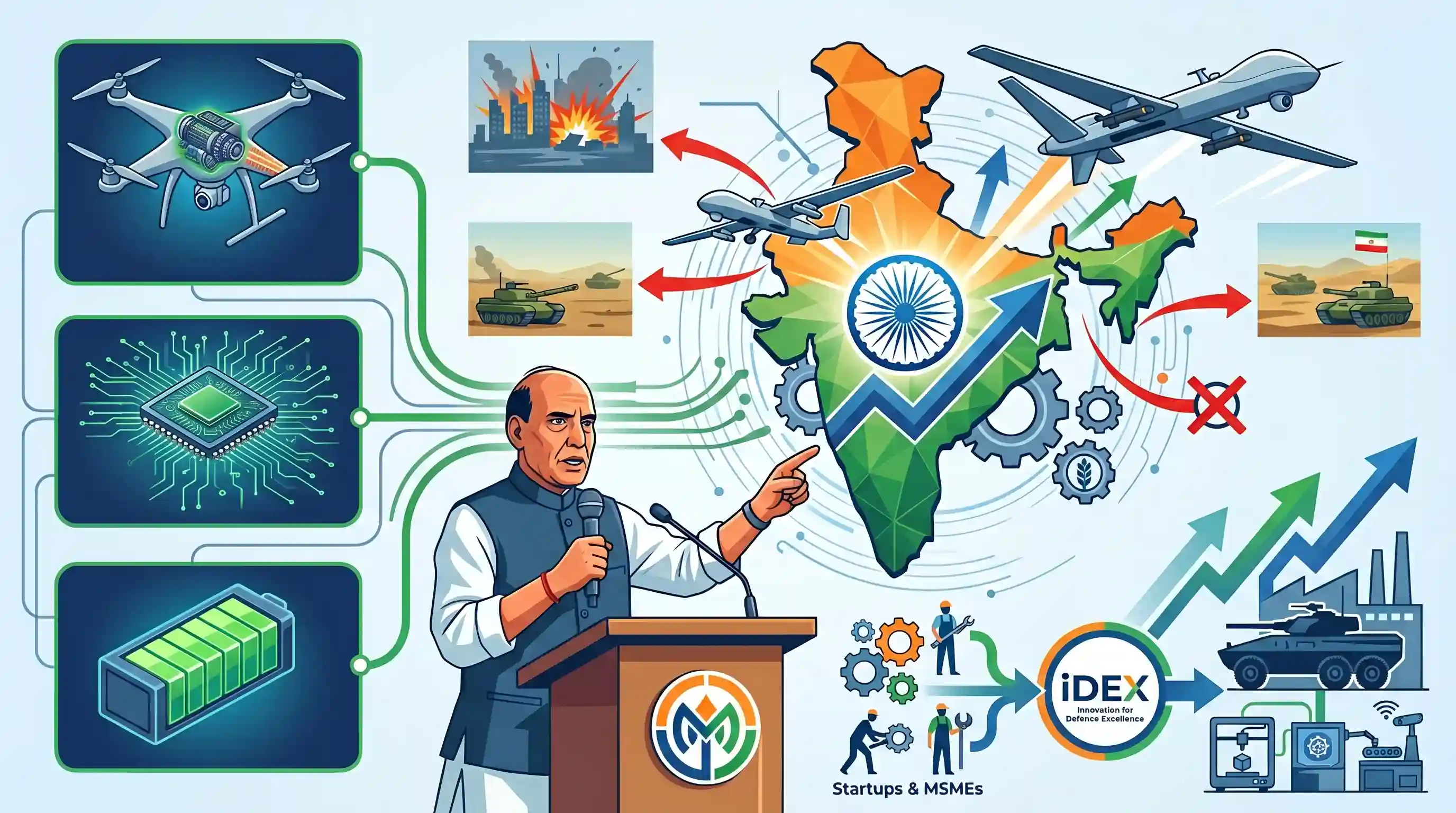
Defence Minister Rajnath Singh has emphasized the urgent need to make India a global hub for indigenous drone manufacturing on a mission mode. Speaking at the National Defence Industries Conclave, he highlighted that achieving true strategic autonomy requires indigenization not just of final products, but of critical components like software, engines, and batteries, which are currently imported. Referencing recent conflicts like Russia-Ukraine and Iran-Israel, he underscored the growing centrality of drones and Advanced Manufacturing Technologies (AMT) in modern warfare. He also praised the iDEX initiative for successfully bringing startups and MSMEs into defence innovation.
Key Points
- Defence Minister Rajnath Singh urged for the development of India as a global drone manufacturing hub on a 'mission mode' to secure strategic autonomy.
- He stressed the need for component-level self-reliance, noting that critical parts like drone software, engines, batteries, and molds are currently heavily imported.
- The role of drones and counter-drone technologies in modern warfare was highlighted using the examples of the ongoing Russia-Ukraine and Iran-Israel conflicts.
- Advanced Manufacturing Technologies (AMT)—including artificial intelligence, robotics, smart materials, and additive manufacturing—are fundamentally reshaping the defence sector.
- The iDEX initiative (launched in 2018) has been successful in integrating startups and MSMEs into the defence sector, resulting in 548 signed contracts and boosting indigenous innovation.
Important Terms
iDEX (Innovations for Defence Excellence)

Launched in 2018, iDEX fosters innovation in defense and aerospace by engaging startups, MSMEs, and individual innovators through funding and R&D support to achieve self-reliance in military technology.
UPSC context
GS Paper III (Security/Innovation); tests private sector participation in defense and technology indigenization.
Aatmanirbhar Bharat
A policy framework ('Self-Reliant India') launched in 2020 to reduce import dependency and boost local manufacturing across sectors like defense, aiming to strengthen India’s global supply chain role.
UPSC context
GS Paper III (Economy/Security); fundamental for essays and questions on economic resilience and strategic self-sufficiency.
Indigenization of Technology
The process of developing and manufacturing critical components and final products within India using domestic R&D to eliminate reliance on foreign suppliers and ensure control over intellectual property.
UPSC context
GS Paper III (Science & Tech/Security); tests understanding of technical sovereignty and indigenous defense industrial bases.
Strategic Autonomy
A nation’s capability to pursue its foreign policy and security interests independently, free from external coercion or dependence on foreign-made critical military hardware during geopolitical crises.
UPSC context
GS Paper II (International Relations); key concept in Indian foreign policy and national security strategy.
Make in India
A 2014 flagship initiative to transform India into a global manufacturing hub by incentivizing domestic production and facilitating investment to reduce the trade deficit and create jobs.
UPSC context
GS Paper III (Economy/Industry); central to discussions on manufacturing-led growth and the defense-industrial complex.
Mission Mode
A high-priority, time-bound execution strategy for government projects characterized by dedicated resources, clear targets, and streamlined decision-making to achieve specific national objectives efficiently.
UPSC context
GS Paper II (Governance); tests knowledge of administrative efficiency and project management in public policy implementation.
Prelims Trap
"iDEX is a defence innovation initiative launched and managed directly by DRDO."
iDEX is actually funded and managed by the Defence Innovation Organisation (DIO), a not-for-profit company formed by HAL and BEL, not DRDO.
Static Concepts Connected
What is the institutional framework of the iDEX initiative?
- Nodal Agency: Funded and managed by the Defence Innovation Organisation (DIO), a Section 8 company formed by HAL and BEL under the Department of Defence Production.
- Core Objective: Fosters aerospace and defence R&D by engaging MSMEs, startups, individual innovators, and academic institutions.
- Funding Mechanism: Provides financial grants and support through Partner Incubators to develop technologies for the Indian military.
How do Advanced Manufacturing Technologies (AMT) enhance modern defence production?
- Additive Manufacturing: 3D printing allows rapid, decentralized prototyping of UAV components and complex geometries, significantly reducing payload weight.
- Smart Materials: Utilizing shape-memory alloys and piezoelectric materials that adapt to stress and environmental changes in aerospace applications.
- AI & Robotics: Enables autonomous navigation, swarm drone coordination, and predictive maintenance for combat platforms without human intervention.
Cross-Topic Patterns
UAV Indigenization vs Critical Minerals
India's drone manufacturing relies heavily on imported batteries, linking defence autonomy directly to securing critical mineral supply chains like Lithium and Cobalt from South America and Australia.
Dual-Use Tech & Wassenaar Arrangement
Advanced drone software and engines are dual-use technologies. India's membership in the Wassenaar Arrangement is critical for navigating global export controls for these sub-components.

Expect a multi-statement question mixing iDEX's nodal agency (DIO vs DRDO) with India's import dependencies for UAV sub-components.
Linked PYQs · 2
Linked PYQs · 2
- 2023MainsGS3
The use of unmanned aerial vehicles (UAVs) by our adversaries across the borders to ferry arms/ammunitions, drugs, etc., is a serious threat to the internal security. Comment on the measures being taken to tackle this threat.
- 2025PrelimsGS1
With reference to Unmanned Aerial Vehicles (UAVs), consider the following statements : I. All types of UAVs can do vertical landing. II. All types of UAVs can do automated hovering. III. All types of UAVs can use battery only as a source of power supply. How many of the statements given above are correct?
