Urban Housing Unaffordability and Real Estate Financialization
Source:Indian Express ↗
Why It Matters
Provides critical data and sociological perspectives on how market-driven urbanization and real estate financialization are marginalizing the urban poor. Highly relevant for Mains questions on the socio-economic impacts of urbanization, distributive justice in smart cities, and the limits of market economies in providing basic needs.
Summary
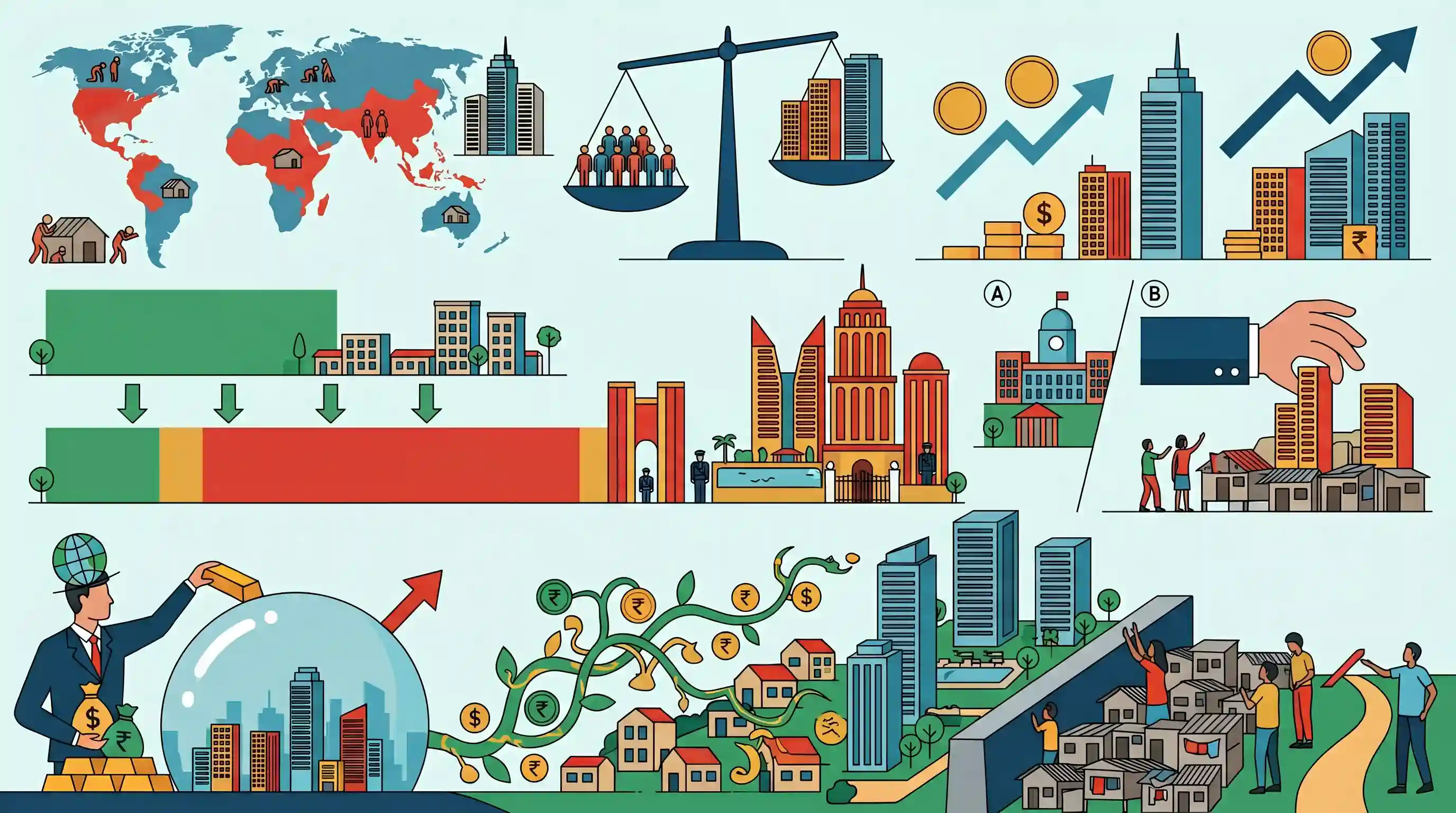
The UN World Cities Report 2026 underscores a severe global housing crisis, highlighting that 3.4 billion people lack adequate housing while the financialization of real estate drives prices beyond the reach of average incomes. In India, the problem is acute; the affordable housing share in new launches plummeted from over 50% in 2018 to under 20% in 2025 as developers pivoted to luxury units. The crisis stems from a historical retreat by governments from public housing in favor of a private-sector 'enabling approach,' which failed the urban poor. Furthermore, speculative buying by investors and NRIs has acted as a 'slow poison,' heavily inflating urban property markets and exacerbating spatial segregation and inequality.
Key Points
- UN-Habitat’s World Cities Report 2026 highlights a global housing shortage, with over 3.4 billion people lacking adequate shelter and escalating price-to-income ratios in South Asia.
- A structural shift away from state-led public housing toward a private sector-led market approach has disproportionately excluded the urban poor from formal housing.
- In India, public housing efforts have struggled; agencies like the DDA have missed construction targets and often placed low-income housing in remote areas lacking connectivity and livelihood access.
- The 'financialization of housing'—treating homes primarily as financial assets and investment vehicles—has severely decoupled property prices from real incomes.
- Speculative investments by high-net-worth individuals and NRIs have accelerated price inflation, shrinking the affordable housing share in new Indian real estate projects from over 50% in 2018 to under 20% in 2025.
Important Terms
UN-Habitat

A UN agency established in 1978 to promote socially and environmentally sustainable human settlements and the goal of providing adequate shelter for all.
UPSC context
GS Paper 2: International Organizations; GS Paper 1: Urbanization. Key for Sustainable Development Goal 11.
Financialization of Housing
Treating housing as a financial asset or commodity for profit and speculation rather than as a social good for shelter and a human right.
UPSC context
GS Paper 1: Social Issues (Urbanization); GS Paper 3: Economy. Explains structural causes of housing unaffordability.
UN World Cities Report 2026
The 2026 flagship UN-Habitat report titled 'The Global Housing Crisis: Pathways to Action,' highlighting that 3.4 billion people lack adequate housing globally.
UPSC context
GS Paper 1: Urbanization and its remedies; GS Paper 2: Social Justice. Provides critical data for urban policy analysis.
Delhi Development Authority (DDA)
A statutory body established in 1957 responsible for the planned development of Delhi, including land acquisition, housing, and the creation of Master Plans.
UPSC context
GS Paper 2: Governance and Statutory Bodies. A case study for urban development and public housing challenges.
Spatial Segregation
The spatial separation of social groups (by class, caste, or religion) within urban areas, often leading to unequal access to basic services and infrastructure.
UPSC context
GS Paper 1: Social Empowerment; GS Paper 3: Inclusive Growth. Addresses urban inequality and marginalization.
Inclusive Growth
Economic growth that creates equitable opportunities for all sections of society, ensuring participation and fair distribution of benefits like affordable housing.
UPSC context
GS Paper 3: Economy (Growth & Development). Core objective for Indian policy-making and PMAY missions.
Prelims Trap
"Financialization of housing refers to increasing formal credit and mortgage access for the urban poor."
Financialization actually means treating homes as speculative financial assets and investment vehicles, which inflates prices, decouples them from real incomes, and actively excludes the poor.
Static Concepts Connected
What is UN-Habitat and its core mandate?
- Core Mandate: Promotes socially and environmentally sustainable human settlements and the achievement of adequate shelter for all.
- Headquarters: Headquartered in Nairobi, Kenya. It acts as the UN system's focal point for sustainable urbanization.
- Key Publications: It publishes the flagship World Cities Report, tracking global urbanization trends and housing crises.
How does India officially define and support 'Affordable Housing'?
- Infrastructure Status: Granted to affordable housing in 2017, allowing developers to access cheaper institutional credit and longer repayment tenures.
- Size & Price Caps: Defined by specific carpet area limits (e.g., 60 sq m in metros, 90 sq m in non-metros) and property price caps to target lower-income buyers.
- Affordable Housing Fund: Created under the National Housing Bank (NHB) using priority sector lending shortfalls to refinance housing finance companies.
Cross-Topic Patterns
Real estate speculation and spatial inequality
Speculative investments and the parking of wealth in luxury real estate distort urban land markets, directly aggravating slum proliferation, spatial inequality, and pushing the urban poor to disconnected peripheries.
PMAY-U limits vs. market failures
The crisis highlights the limits of the 'enabling approach' in schemes like PMAY-U, as developer profit margins strongly favor luxury units, rendering credit-linked subsidies ineffective against structural market failures.

The 'financialization of housing' and its impact on urban inequality (GS1/GS3) is a highly probable analytical question for Mains 2026.
Linked PYQs · 5
Linked PYQs · 5
- 2023MainsGS1
Does urbanization lead to more segregation and/or marginalization of the poor in Indian metropolises?
- 2025MainsGS1
How does smart city in India, address the issues of urban poverty and distributive justice?
- 2013MainsGS1
Discuss the various social problems which originated out of the speedy process of urbanization in India.
- 2025MainsGS2
Inequality in the ownership pattern of resources is one of the major causes of poverty. Discuss in the context of 'paradox of poverty'.
- 2022MainsGS3
Is inclusive growth possible under market economy ? State the significance of financial inclusion in achieving economic growth in India.
