US Dollar Devaluation Impact on Global Gold Prices and Trade
Source:The Hindu ↗
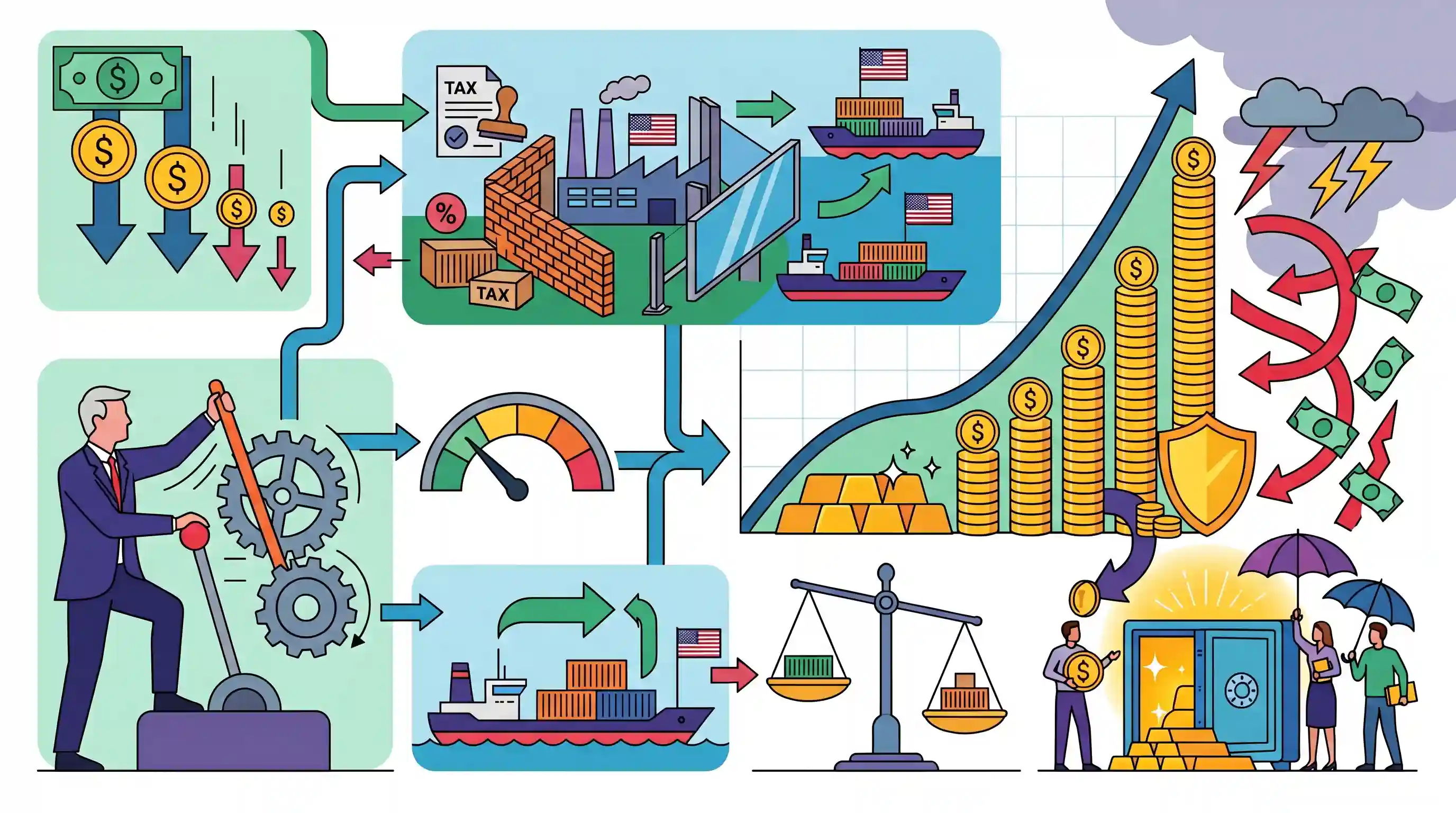
Why It Matters
Understanding currency dynamics (like devaluation and depreciation) and protectionism is crucial for the UPSC Economics syllabus. The direct correlation between a weakening reserve currency (US Dollar) and rising prices of safe-haven assets (gold) tests a candidate's grasp of open-economy macroeconomics and global trade vulnerabilities, which are frequently asked in both Prelims and Mains.
Summary
The article analyzes the potential impact of a deliberate devaluation of the US Dollar, a policy considered by the incoming US administration to boost American exports and reduce its trade deficit. This macroeconomic shift could lead to a significant surge in international spot gold prices, potentially doubling to $7,000 an ounce by 2030. Even without an active devaluation policy, a combination of proposed tariffs, trade controls, and lower interest rates aimed at transitioning the US from a "consumer of last resort" to a net producer would likely weaken the dollar. Consequently, this enhances the appeal of gold as an inflation hedge and a global safe-haven asset.
Key Points
- The incoming US administration has proposed devaluing the US dollar to increase export competitiveness and reduce trade deficits.
- A weaker dollar typically shares an inverse relationship with gold; thus, international spot gold prices are projected to rise significantly, potentially reaching $7,000 an ounce by 2030.
- Even without active currency devaluation, proposed protectionist measures such as tariffs and trade controls could lead to a weaker dollar and higher inflation.
- The US aims to shift its macroeconomic model from being the world's 'consumer of last resort' to a net producer, which necessitates a cheaper currency and smaller capital inflows.
- Gold is expected to remain a critical inflation hedge and safe-haven asset in the face of currency manipulation and protectionist policies in global trade.
Important Terms
Currency Devaluation

A deliberate downward adjustment of a country's currency value relative to another currency or standard, often used to boost exports by making them cheaper abroad.
UPSC context
Relevant for GS Paper III (Economy) regarding the external sector, exchange rate management, and trade competitiveness.
Safe-Haven Asset
An investment expected to retain or increase in value during periods of market turbulence, economic downturns, or geopolitical instability, such as gold.
UPSC context
Significant for GS Paper III (Economy) under investment models and global financial stability.
Protectionism
The economic policy of restricting imports from other countries through methods such as tariffs, quotas, or subsidies to protect domestic industries from foreign competition.
UPSC context
Key topic in GS Paper III (Economy) concerning international trade and global value chains.
Trade Deficit
An economic condition where a country's cost of imports exceeds the value of its exports, indicating a net outflow of domestic currency to foreign markets.
UPSC context
Vital for GS Paper III (Economy) under Balance of Payments (BoP) and trade policy.
Inflation Hedge
An investment intended to protect the investor against the declining purchasing power of money that typically results from rising price levels in an economy.
UPSC context
Tested in GS Paper III (Economy) regarding inflation management and investment strategies.
Spot Price
The current market price at which a particular asset—such as a security, commodity, or currency—can be bought or sold for immediate delivery.
UPSC context
General economic concept relevant for Prelims and GS Paper III (Economy) market dynamics.
Kotak Securities
A prominent Indian stockbroking and financial services firm, part of Kotak Mahindra Bank, frequently cited for market analysis on commodities and currencies.
UPSC context
Relevant for Prelims regarding domestic financial institutions and their role in economic forecasting.
Prelims Trap
"A depreciating US Dollar directly causes international spot gold prices to fall."
They share an inverse relationship. A weaker dollar makes dollar-denominated gold cheaper for non-US buyers, increasing global demand and pushing the spot price UP, not down.
Static Concepts Connected
How does currency devaluation affect a nation's trade balance?
- Export Competitiveness: Domestic goods become cheaper for foreign buyers, boosting export volumes.
- Import Contraction: Foreign goods become more expensive in domestic currency terms, discouraging imports.
- J-Curve Effect: The trade deficit may initially worsen due to inelastic short-term contracts before eventually improving.
Why is gold considered an inflation hedge and safe-haven asset?
- Intrinsic Value: It is priced in dollars; when fiat currencies lose purchasing power due to inflation, gold retains its intrinsic value.
- Crisis Liquidity: During geopolitical tensions or economic crises, investors shift capital from volatile equities/currencies into universally accepted physical assets.
- Limited Supply: Unlike fiat money, gold cannot be printed by central banks, protecting it from expansionary monetary policies.
Cross-Topic Patterns
Surging Gold Prices & India's CAD
India is a massive net importer of gold. A global price spike to $7,000/oz would severely widen India's Current Account Deficit (CAD) and exert depreciating pressure on the Rupee.
Competitive Devaluation & Trade Wars
Deliberate US dollar devaluation to boost exports could trigger retaliatory 'beggar-thy-neighbour' currency wars, testing IMF and WTO frameworks on currency manipulation and trade imbalances.

Expect a multi-statement prelims question interlinking US Fed policies, the dollar index, and India's CAD via gold imports.
Linked PYQs · 5
Linked PYQs · 5
- 2021PrelimsGS1
Consider the following statements : The effect of devaluation of a currency is that it necessarily 1. improves the competitiveness of the domestic exports in the foreign markets 2. increases the foreign value of domestic currency 3. improves the trade balance Which of the above statements is/are correct?
- 2022PrelimsGS1
Consider the following statements: 1. Tight monetary policy of US Federal Reserve could lead to capital flight. 2. Capital flight may increase the interest cost of firms with existing External Commercial Borrowings (ECBs). 3. Devaluation of domestic currency decreases the currency risk associated with ECBs. Which of the statements given above are correct?
- 2011PrelimsGS1
Consider the following actions which the Government can take: 1. Devaluing the domestic currency. 2. Reduction in the export subsidy. 3. Adopting suitable policies which attract greater FDI and more funds from FIIs. Which of the above action/actions can help in reducing the current account deficit?
- 2022PrelimsGS1
With reference to the Indian economy, consider the following statements: 1. If the inflation is too high, Reserve Bank of India (RBI) is likely to buy government securities. 2. If the rupee is rapidly depreciating, RBI is likely to sell dollars in the market. 3. If interest rates in the USA or European Union were to fall, that is likely to induce RBI to buy dollars. Which of the statements given above are correct?
- 2018MainsGS3
How would the recent phenomena of protectionism and currency manipulations in world trade affect macroeconomic stability of India?
