Global economy faces tug of war between energy shock and AI
Source:The Hindu ↗
Why It Matters
This article provides a comprehensive overview of the contemporary macroeconomic challenges and opportunities shaping the global order. It is highly relevant for GS3 (Indian Economy, Energy Security, and Science & Technology), as it links geopolitical chokepoints (Strait of Hormuz) to domestic inflation, central bank policies, and global supply chains. Furthermore, it touches upon the economic impact of emerging technologies (AI), making it useful for both Mains essay arguments and GS3 answers regarding India's growth trajectory ('Viksit Bharat') amidst global fragmentation.
Summary
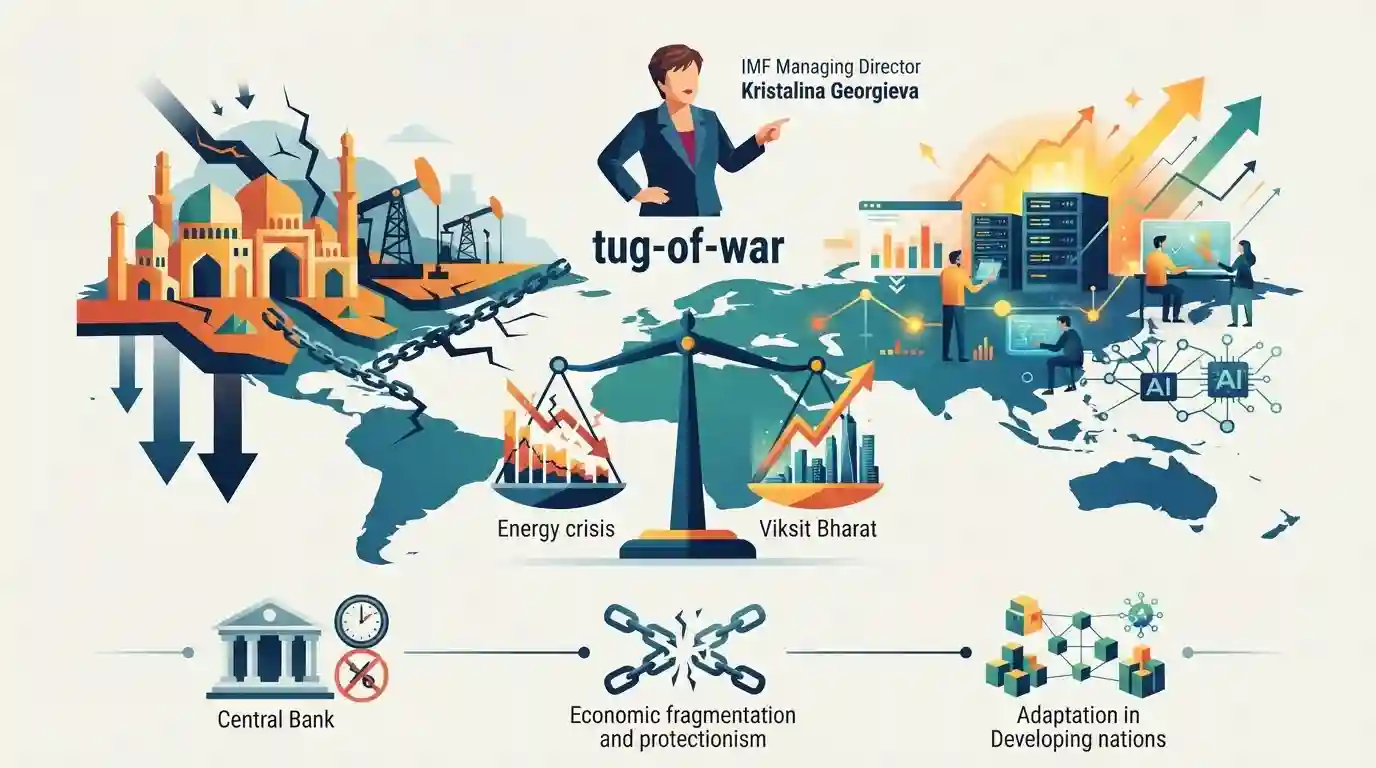
IMF Managing Director Kristalina Georgieva has highlighted that the global economy is caught in a 'tug-of-war' between two major forces: the potential for a severe negative supply shock due to geopolitical tensions in the Middle East, specifically the risk of the Strait of Hormuz closing, and a positive demand shock driven by an AI investment boom. While AI could significantly boost global growth over the next 15 years, an energy crisis would trigger inflation, delay central bank rate cuts, and disproportionately harm low-income developing nations through higher debt servicing costs and food insecurity. The IMF also warns against growing global economic fragmentation and protectionism, emphasizing that developing nations like India must adapt to technological shifts to achieve long-term developmental goals like 'Viksit Bharat'.
Key Points
- The global economy faces opposing forces: a positive demand shock from an AI investment boom and a negative supply shock risk from potential disruptions in the Strait of Hormuz.
- Closure of the Strait of Hormuz could lead to severe oil and natural gas shortfalls, resulting in inflation, delayed interest rate cuts, and lower global growth.
- Low-income and developing nations are particularly vulnerable to these energy shocks, facing risks of higher borrowing costs, food insecurity, and increased debt burdens.
- AI investments, particularly in data centres, present a significant growth opportunity, potentially boosting global growth by up to 0.8% annually over the next 15 years.
- The IMF cautions against global economic fragmentation and protectionism, highlighting the need for developing nations like India to leverage AI for goals like 'Viksit Bharat'.
Important Terms
Viksit Bharat @ 2047

The Government of India's comprehensive developmental roadmap aiming to transform India into a fully developed nation by 2047, coinciding with the centenary of its independence.
UPSC context
Essential for GS Paper 2 (Governance), GS Paper 3 (Economic Development), and Essay themes on India's growth.
Geo-economic Fragmentation
A policy-driven reversal of global economic integration. It occurs when geopolitical tensions prompt nations to impose trade restrictions, limit capital flows, and divide into rival economic blocs.
UPSC context
Crucial for GS Paper 2 (International Relations) and GS Paper 3 (Economy) concerning globalization and trade policies.
Strait of Hormuz
A strategically vital maritime chokepoint connecting the Persian Gulf to the Gulf of Oman. It handles roughly 20% of global oil trade, making it crucial for energy security.
UPSC context
Highly relevant for Prelims Map-based geography questions and GS Paper 2 (International Relations and Energy Security).
International Monetary Fund (IMF)
An international financial institution that promotes global macroeconomic stability, facilitates international trade, and provides policy advice and financial assistance to member countries facing balance of payments difficulties.
UPSC context
Frequently tested in Prelims (Economy) and GS Paper 2 (Important International Institutions, their mandates and reports).
Supply Shock
An unexpected event that suddenly changes the availability of a critical product or commodity, causing a rapid shift in its price—such as geopolitical tensions disrupting global oil flows.
UPSC context
Important for GS Paper 3 (Macroeconomics), specifically for understanding inflation dynamics, market volatility, and central bank policies.
Prelims Trap
"The Strait of Hormuz is a maritime chokepoint bordered by Iran and the United Arab Emirates."
Aspirants often miss that the southern shore of the strait is actually the Musandam Peninsula, an exclave of Oman, not the UAE.
Static Concepts Connected
How do macroeconomic supply and demand shocks impact inflation differently?
- Supply shock: Reduces output while raising prices (e.g., oil crisis). This creates stagflation, making it highly difficult for central banks to cut interest rates without worsening inflation.
- Demand shock: Increases both output and prices simultaneously. This is typically driven by surges in investment (like the current AI infrastructure boom) or broad consumer spending.
What are the exact geographic boundaries of the Strait of Hormuz?
- Northern shore: The entire northern coastline of the strait is controlled by Iran.
- Southern shore: Controlled by Oman via the Musandam Peninsula, an exclave geographically separated from Oman's mainland by the UAE.
- Strategic linkage: It is the sole maritime route connecting the landlocked Persian Gulf to the Gulf of Oman and the Arabian Sea.
Cross-Topic Patterns
Middle East mapping + Fertilizer security
Beyond oil and LNG, the Strait of Hormuz handles ~30% of globally traded chemical fertilizers. Its closure directly impacts India's food security and agricultural subsidy burden.
Core inflation + Sovereign debt distress
Persistent energy inflation delays Western central bank rate cuts, strengthening the US Dollar, triggering capital flight, and inflating foreign-denominated debt servicing costs for developing nations.

Expect a multi-statement question mapping Middle East chokepoints against specific trade commodities (LNG, fertilizers) and border nations.
Linked PYQs · 3
Linked PYQs · 3
- 2026PrelimsGS1
Ships from which of the following countries have to cross the Strait of Hormuz to reach out to the Indian Ocean ? 1. Bahrain 2. Syria 3. Qatar 4. Egypt Select the answer using the code given below :
- 2015MainsGS3
What are the areas of prohibitive labour that can be sustainably managed by robots ? Discuss the initiatives that can propel research in premier research institutes for substantive and gainful innovation.
- 2025MainsGS3
Why is maritime security vital to protect India's sea trade? Discuss maritime and coastal security challenges and the way forward.
