RBI Bulletin Warns of Fragile Global Economy and Inflation
Source:The Hindu ↗
Why It Matters
This article covers crucial macroeconomic indicators (CPI, WPI, core sector growth) and connects them to global geopolitical events (West Asia conflict, oil prices). It provides necessary analytical fodder for GS3 questions on inflation management, energy security, and the resilience of the Indian economy amidst global volatility.
Summary
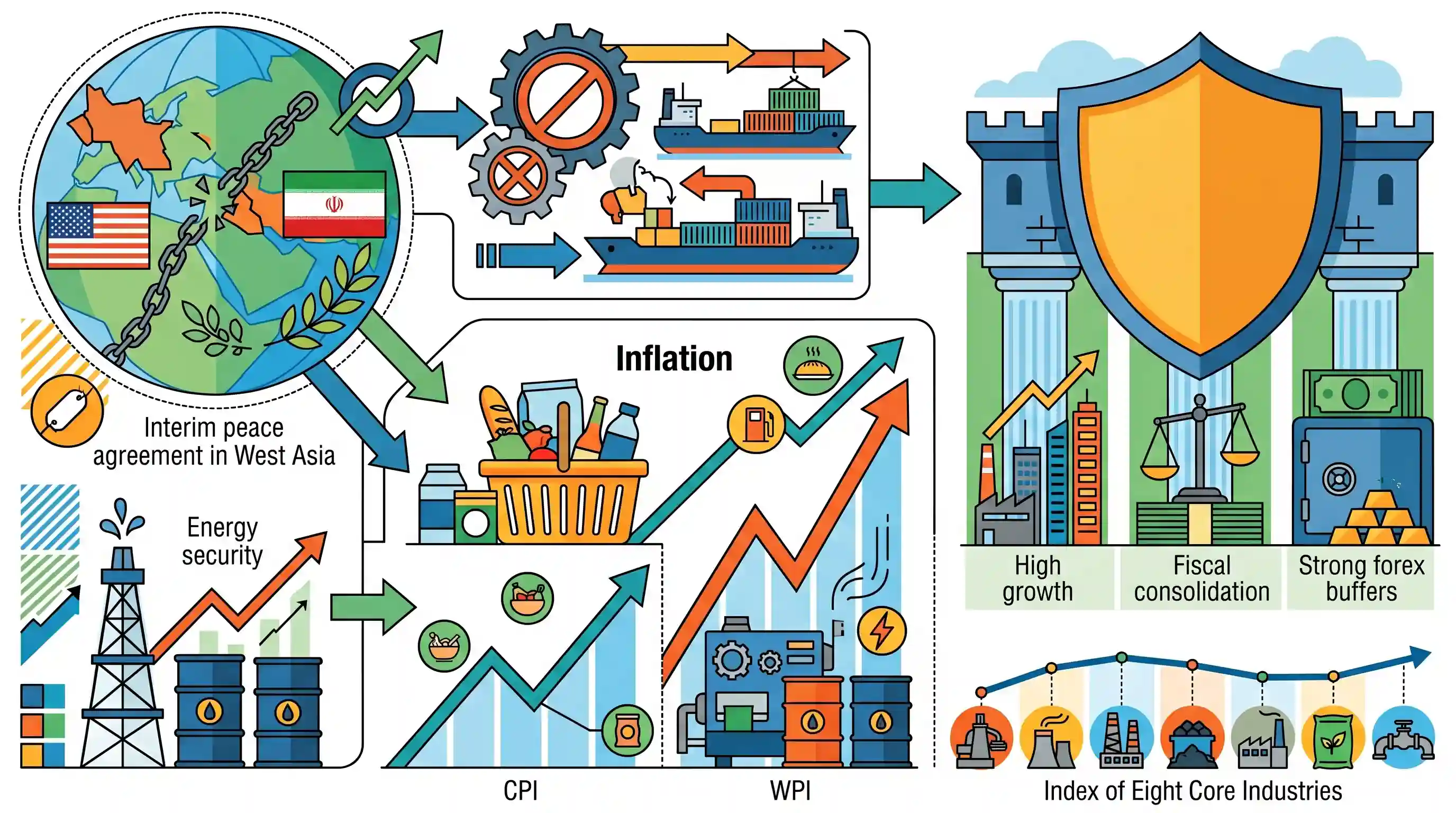
The Reserve Bank of India's June 2026 Bulletin highlights that while the global economic landscape remains fragile due to recent geopolitical tensions in West Asia, India's macroeconomic fundamentals are resilient. Despite an interim US-Iran peace agreement, global supply chain disruptions and elevated crude oil prices have exerted upward pressure on inflation. India's headline CPI inflation rose to 3.9% in May 2026, accompanied by a sharp spike in WPI inflation to 9.7%, largely driven by food and fuel cost pressures. The RBI noted that while core sector growth has slowed, India's underlying strength—characterized by high growth, fiscal consolidation, and strong forex buffers—provides a buffer against international economic turbulence.
Key Points
- The RBI's June 2026 Bulletin notes that the global economic landscape remains fragile, impacted by the recent West Asia conflict and ensuing supply chain disruptions, despite an interim US-Iran peace agreement.
- India's headline CPI inflation increased to 3.9% in May 2026, alongside a sharp rise in WPI inflation to 9.7%, driven by broad-based cost pressures in food, fuel, and core components.
- Global crude oil prices remained elevated due to energy supply chain disruptions, leaving domestic Oil Marketing Companies (OMCs) to absorb under-recoveries.
- Despite these external headwinds, the RBI emphasized India's resilient macroeconomic fundamentals, citing robust growth, fiscal consolidation, manageable current account deficit (CAD), and strong forex buffers.
- Growth in the Index of Eight Core Industries decelerated to 0.5% in May, and the central bank warned that an adverse south-west monsoon could present upside risks to the domestic growth-inflation outlook.
Important Terms
Reserve Bank of India (RBI)

India's central bank (est. 1935) responsible for regulating the monetary system, issuing currency, and managing the country's foreign exchange and credit systems.
UPSC context
GS Paper III: Economy. Tests understanding of monetary policy, inflation control, and financial sector stability.
Consumer Price Index (CPI)
A measure of change in the retail prices of a representative basket of goods and services; the RBI's primary benchmark for inflation targeting.
UPSC context
GS Paper III: Economy. Crucial for understanding retail inflation, purchasing power, and monetary policy frameworks.
Wholesale Price Index (WPI)
An index tracking average price changes at the wholesale level (producer side) for goods traded in bulk; excludes services.
UPSC context
GS Paper III: Economy. Tests ability to distinguish between producer and consumer inflation pressures.
Index of Eight Core Industries
A production index tracking eight vital infrastructure sectors (Refinery Products, Electricity, Steel, Coal, Crude Oil, Natural Gas, Cement, and Fertilizers) representing ~40.27% of IIP.
UPSC context
GS Paper III: Economy/Infrastructure. A high-frequency indicator used to gauge industrial and infrastructure growth.
Fiscal Consolidation
The process of improving a government's fiscal health by reducing the fiscal deficit and debt-to-GDP ratio through revenue enhancement and expenditure rationalization.
UPSC context
GS Paper III: Economy. Vital for questions on budgetary discipline and the FRBM Act.
Oil Marketing Companies (OMCs)
Entities (like IOCL, BPCL, and HPCL) responsible for downstream activities including refining, distributing, and retailing petroleum products like petrol, diesel, and LPG.
UPSC context
GS Paper III: Economy/Energy. Important for understanding fuel pricing mechanisms and subsidy management.
Foreign Exchange (Forex) Reserves
External assets held by the RBI (Foreign Currency Assets, Gold, SDRs) that act as a buffer against balance-of-payment crises and currency volatility.
UPSC context
GS Paper III: Economy. Key to external sector stability and maintaining investor confidence.
Prelims Trap
"Food articles drove the massive spike in WPI, as food holds the highest weightage in the Wholesale Price Index."
Food has a much higher weight in CPI (~46%) than WPI (~24%). Manufactured goods hold the highest weight (64%) in WPI, not food.
Static Concepts Connected
What drives the structural divergence between CPI and WPI in India?
- Coverage & Services: CPI tracks prices at the retail level (including services), while WPI tracks bulk wholesale transactions (excluding services).
- Food Weightage: Food constitutes roughly 45.9% of CPI, but only about 24.4% of the WPI basket, making CPI more sensitive to monsoon shocks.
- Imported Inflation: WPI is far more sensitive to global commodity and crude price shocks due to the high weight of manufactured goods and fuel.
What is the composition of the Index of Eight Core Industries (ICI)?
- Overall Weight: The eight core sectors collectively constitute 40.27% of the total weight in the broader Index of Industrial Production (IIP).
- Top Weight: Petroleum Refinery Products hold the highest weight (approx. 28% of ICI), making the index highly sensitive to global crude supply chains.
- Lowest Weight: Fertilizers hold the lowest weight among the eight core sectors.
Cross-Topic Patterns
Geopolitics & Fiscal Subsidies
West Asia conflicts directly impact India's fiscal consolidation path through increased fertilizer subsidy bills and state-owned OMC under-recoveries.
Monsoons & Monetary Policy
RBI's inflation-targeting mandate is heavily constrained by supply-side climate shocks, tying IMD's monsoon spatial distribution directly to repo rate decisions.

Expect a 2026 prelims statement testing the descending order of weights in the Core Industries index alongside a WPI-CPI divergence clause.
Linked PYQs · 5
Linked PYQs · 5
- 2020PrelimsGS1
Consider the following statements: 1. The weightage of food in Consumer Price Index (CPI) is higher than that in Wholesale Price Index (WPI). 2. The WPI does not capture changes in the prices of services, which CPI does. 3. Reserve Bank of India has now adopted WPI as its key measure of inflation and to decide on changing the key policy rates. Which of the statements given above is/are correct?
- 2022PrelimsGS1
In India, which one of the following is responsible for maintaining price stability by controlling inflation?
- 2024MainsGS3
What are the causes of persistent high food inflation in India? Comment on the effectiveness of the monetary policy of the RBI to control this type of inflation.
- 2018MainsGS3
How would the recent phenomena of protectionism and currency manipulations in world trade affect macroeconomic stability of India?
- 2017MainsGS2
The question of India's Energy Security constitutes the most important part of India's economic progress. Analyze India's energy policy cooperation with West Asian countries.
