Internationalisation of Higher Education under NEP 2020
Source:The Hindu ↗
Why It Matters
The internationalisation of higher education is a pivotal component of NEP 2020. Understanding the regulatory mechanisms, benefits, and challenges of foreign universities entering India is crucial for GS Paper 2 questions on education policy, human resource development, and governance.
Summary
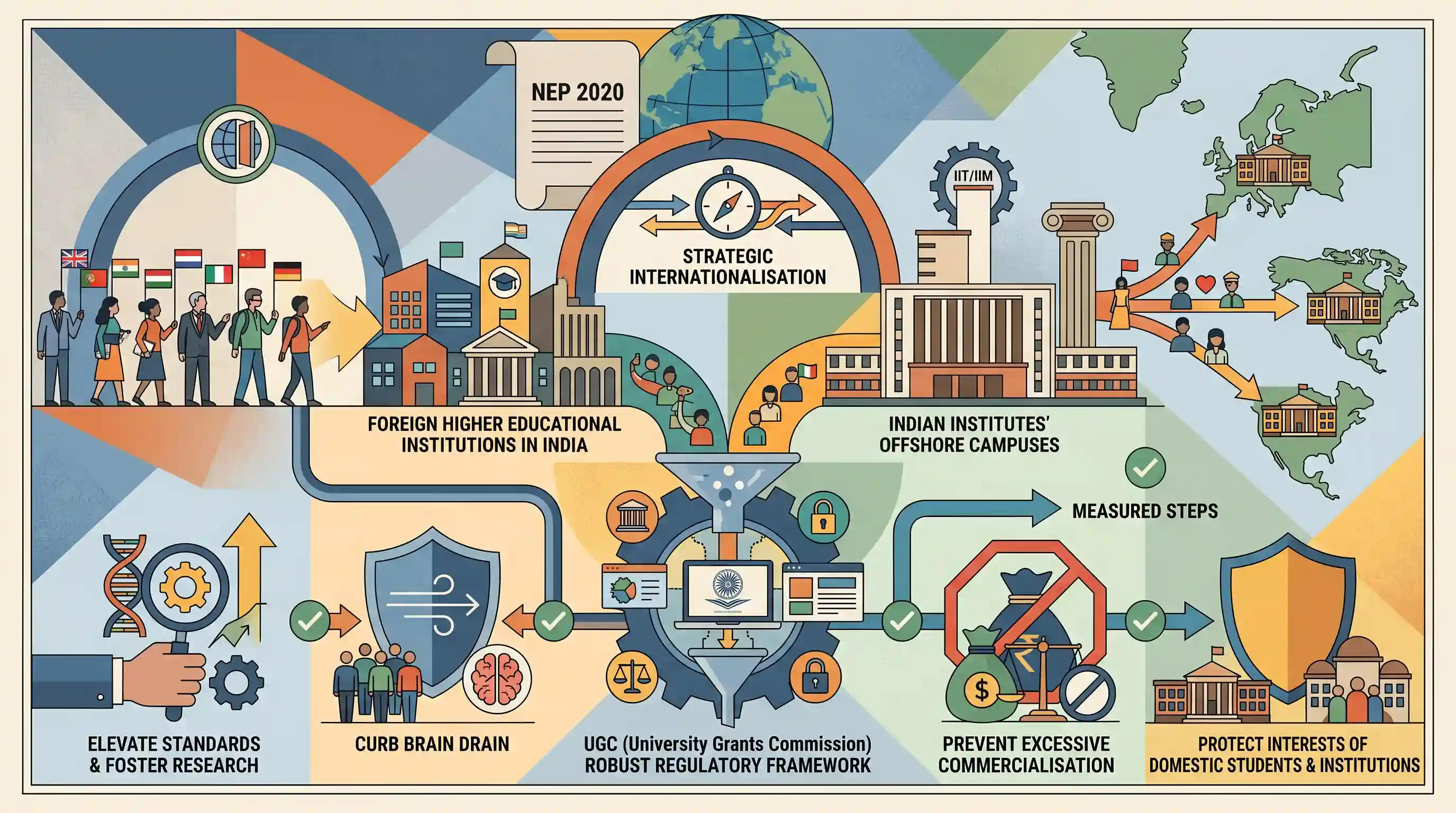
The article examines the strategic internationalisation of India's higher education sector under the National Education Policy (NEP) 2020. It highlights the dual approach of opening 'global doors' by allowing Foreign Higher Educational Institutions (FHEIs) to establish campuses in India, and encouraging premier Indian institutes to set up offshore campuses. While these initiatives are designed to elevate academic standards, foster research, and curb brain drain, the author emphasizes the need for 'measured steps.' This involves implementing a robust regulatory framework by the UGC to ensure quality control, prevent excessive commercialisation, and protect the interests of domestic students and educational institutions.
Key Points
- The National Education Policy (NEP) 2020 advocates for the internationalisation of India's higher education, facilitating the entry of Foreign Higher Educational Institutions (FHEIs).
- Opening 'global doors' aims to enhance academic quality, foster global research collaborations, and retain domestic talent by providing world-class education within India.
- The approach relies on 'measured steps' through robust UGC regulations to ensure academic standards are maintained and to prevent the commercialisation of education.
- Encouraging premier Indian institutions to establish offshore campuses serves to expand India's global educational footprint and soft power.
- A cautious balance is necessary to integrate foreign institutions without exacerbating educational inequality or undermining domestic universities.
Important Terms
National Education Policy (NEP) 2020

A comprehensive 21st-century policy framework aiming to overhaul India's education system, emphasizing internationalisation, research collaborations, and making India a 'Vishwa Guru' (global teacher) through academic mobility and structural reforms.
UPSC context
GS Paper II: Government Policies and Interventions; crucial for questions on social sector development and educational reforms.
University Grants Commission (UGC)
The statutory body responsible for maintaining standards in higher education. It issued the 2023 regulations enabling foreign universities to establish campuses in India while ensuring quality and regulatory compliance.
UPSC context
GS Paper II: Statutory, Regulatory, and various Quasi-judicial bodies; tests knowledge of educational governance.
Foreign Higher Educational Institutions (FHEIs)
Top-ranked global universities (top 500 overall/subject-wise) or institutions of repute permitted to establish branch campuses in India to offer degrees equivalent to those at their home campuses.
UPSC context
GS Paper II: Education/Social Sector; relevant for discussions on 'Internationalisation at Home' and brain drain.
UGC (Setting up and Operation of Campuses of FHEIs in India) Regulations, 2023
Specific rules allowing high-ranked foreign universities to operate in India with autonomy in admissions and fee structures, while mandating that education quality remains on par with their home campus.
UPSC context
GS Paper II: Important aspects of governance and regulatory frameworks in the education sector.
Offshore Campuses
International branches of premier Indian institutes (e.g., IITs) established abroad to enhance India's global academic footprint and promote traditional Indian knowledge systems internationally.
UPSC context
GS Paper II/III: Issues relating to development and Indian diaspora; tests India’s 'soft power' through education.
Institutions of Eminence (IoE)
A prestigious designation for select Indian higher education institutions granted greater autonomy to help them break into the top 500 global rankings and establish campuses abroad.
UPSC context
GS Paper II: Governance and Education; focuses on excellence and global competitiveness in Indian academia.
Prelims Trap
Foreign Higher Educational Institutions (FHEIs) can set up campuses to offer full-time, online, and distance learning programs.
Aspirants often assume liberalized entry means all modes of education are allowed. However, UGC rules strictly prohibit FHEIs from offering online or distance learning programs.
Static Concepts Connected
What is the statutory mandate of the University Grants Commission (UGC)?
- Establishment: It is a statutory body established by the UGC Act, 1956 under the Ministry of Education.
- Core Mandate: Its primary role is the coordination, determination, and maintenance of standards of university education in India.
- Advisory and Funding: It advises the Central and State governments on measures necessary for the improvement of university education and disburses grants.
How do FEMA (1999) and FCRA (2010) differ in regulating foreign funds?
- FEMA: Regulates foreign exchange transactions (trade, investment, repatriation) to facilitate external trade and maintain the forex market (administered by Ministry of Finance/RBI).
- FCRA: Strictly regulates the acceptance of foreign donations/grants by entities to ensure they do not adversely affect internal security (administered by Ministry of Home Affairs).
Cross-Topic Patterns
Educational diplomacy in Africa and Gulf
IIT campuses in Zanzibar and Abu Dhabi represent India's pivot towards leveraging higher education for soft power, deepening strategic bilateral ties in Africa and the Middle East.
Demographic dividend and brain retention
Establishing top-tier global campuses domestically aims to absorb India's demographic dividend, curbing massive forex outflows and the systemic emigration of high-skilled youth.

A multi-statement question on UGC's FHEI rules, specifically testing the ban on online courses and FEMA/FCRA compliance, is highly likely.
Linked PYQs · 2
Linked PYQs · 2
- 2015MainsGS2
The quality of higher education in India requires major improvements to make it internationally competitive. Do you think that the entry of foreign educational institutions would help improve the quality of higher and technical education in the country? Discuss.
- 2020MainsGS2
National Education Policy 2020 is in conformity with the Sustainable Development Goal-4 (2030). It intends to restructure and reorient education system in India. Critically examine the statement.
