ग्लोबल कार्बन प्रोजेक्ट और स्वच्छ ऊर्जा निवेश
स्रोत:इंडियन एक्सप्रेस ↗
क्यों मायने रखता है
The Global Carbon Project's findings and COP negotiations are central to the UPSC GS3 syllabus on environmental conservation and climate change. Understanding India's progress in reducing emission intensity through renewable energy alongside global challenges in meeting Paris Agreement targets is crucial for evaluating India's climate policy and international standing.
सारांश
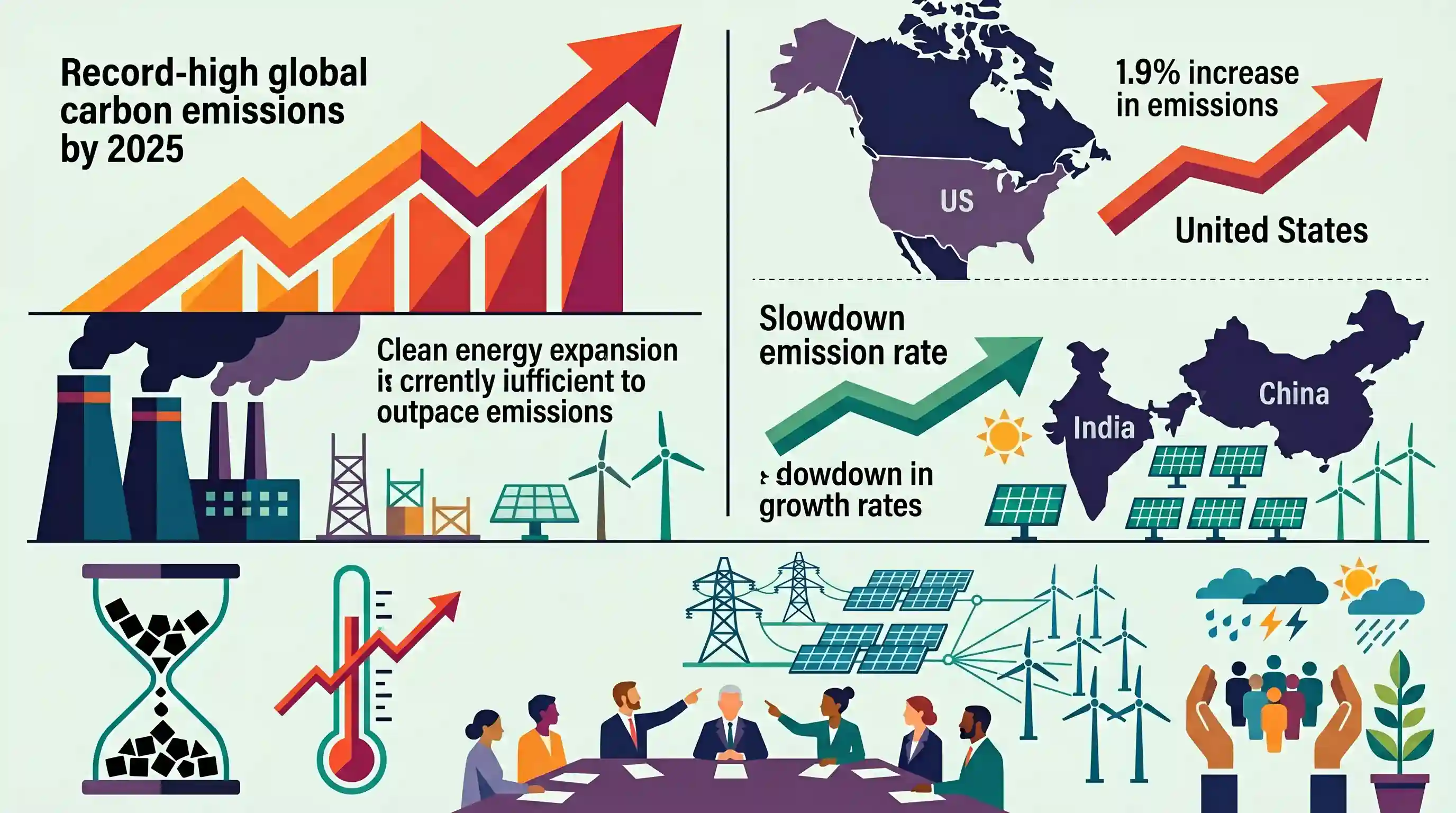
According to the latest Global Carbon Project report released during the COP 30 summit, global carbon emissions are projected to hit a record high by the end of 2025. While India and China managed to slow their emission growth rates through extensive deployment of renewable energy, the US saw a 1.9% increase, reversing its previous downward trend. Although the expansion of renewables has outpaced coal to some extent, the persistent global reliance on fossil fuels indicates that the current decarbonisation drive is insufficient. With the world dangerously close to exhausting its carbon budget and on track for a 2.6-degree temperature rise, the editorial stresses that COP 30 must urgently prioritize investments in clean energy infrastructure and enhance the resilience of vulnerable populations against climate extremes.
मुख्य बिंदु
- The Global Carbon Project estimates that global carbon emissions will reach a record high by the end of 2025.
- Emissions in the US increased by 1.9%, reversing a downward trend, while growth in India and China slowed down due to significant renewable energy deployment.
- India's emission growth rate has slowed down consistently, reducing from 6.4% in 2004-2015 to 3.6% in 2015-2024, showing success in decoupling growth from emissions.
- Despite growth in renewables, the overall reliance on fossil fuels hasn't decreased sufficiently, keeping the world on track for a dangerous 2.6-degree temperature rise.
- The article emphasizes that COP 30 must focus heavily on securing investments in clean energy and building resilience to protect lives and livelihoods from climate impacts.
महत्वपूर्ण शब्द
Global Carbon Project (GCP)

An international research project established in 2001 that provides scientific data on greenhouse gas emissions and the global carbon cycle to inform climate policy.
UPSC context
GS पेपर 3: पर्यावरण; वैश्विक उत्सर्जन निगरानी और जलवायु कार्रवाई के वैज्ञानिक आधारों की समझ का परीक्षण करता है।
COP 30
The 30th UN Climate Change Conference (2025) in Belém, Brazil, focusing on updating national climate targets and advancing the 'Baku to Belém' roadmap for finance.
UPSC context
GS Paper 2 & 3: International Relations/Environment; key for tracking global climate diplomacy and multilateral agreements.
Carbon Budget
The cumulative amount of carbon dioxide emissions permitted globally to stay within a specific temperature limit, such as 1.5°C or 2°C above pre-industrial levels.
UPSC context
GS Paper 3: Environment; central to debates on 'Net Zero' and equity in global carbon space.
Paris Agreement (Paris Climate Pact)
A 2015 legally binding international treaty aimed at limiting global warming to well below 2°C, preferably 1.5°C, through nationally set emission targets.
UPSC context
GS पेपर 3: पर्यावरण; अंतर्राष्ट्रीय पर्यावरण कानूनों के लिए आधारभूत संधि और भारत की पंचामृत प्रतिबद्धताएं।
Climate Resilience
The ability of social, economic, and environmental systems to withstand and recover from climate-related shocks and disasters while maintaining essential functions.
UPSC context
GS Paper 3: Disaster Management/Environment; focuses on adaptation strategies and safeguarding vulnerable populations.
Nationally Determined Contributions (NDCs)
Climate action plans submitted by countries under the Paris Agreement to outline their targets for reducing emissions and adapting to climate impacts.
UPSC context
GS Paper 3: Environment; essential for assessing India's progress toward global climate goals and self-imposed targets.
प्रारंभिक ट्रैप
"India recorded an absolute decrease in its carbon emissions in 2024-2025 due to massive renewable energy deployment."
India achieved 'relative decoupling'—meaning its emission growth rate slowed to 3.6%, but total emissions are still growing. Absolute reduction has not yet been achieved.
संबंधित अवधारणाएँ
What is the Global Carbon Project (GCP) and how does it function?
- Origin: Established as a Global Research Project of 'Future Earth' and a research partner of the World Climate Research Programme.
- अधिदेश: It quantifies global greenhouse gas emissions and their causes, tracking the remaining global Carbon Budget.
What is 'Decoupling' in environmental economics?
- Relative Decoupling: When emissions or resource impacts grow, but at a slower rate than economic GDP growth. India currently exhibits this trend.
- Absolute Decoupling: When an economy grows while total environmental pressures or emissions absolutely decline. This is the ultimate goal of sustainable development.
अंतर-विषय पैटर्न
Clean energy finance & NCQG at COP
The GCP's call for clean energy investments feeds directly into the New Collective Quantified Goal (NCQG) debates, highlighting the developing world's demand for climate finance to fund transition infrastructure.
जलवायु न्याय और ऐतिहासिक उत्तरदायित्व
The US reversing its downward emission trend while developing giants slow their growth strengthens the Global South's demand for equity, CBDR-RC, and strict adherence to historical responsibility in negotiations.

A 2026 Prelims statement will likely contrast the US's recent emission increase against India's relative decoupling and slower growth rate.
संबद्ध PYQ · 4
संबद्ध PYQ · 4
- 2022MainsGS3
Discuss global warming and mention its effects on the global climate. Explain the control measures to bring down the level of greenhouse gases which cause global warming, in the light of the Kyoto Protocol, 1997.
- 2025MainsGS3
Write a review on India's climate commitments under the Paris Agreement (2015) and mention how these have been further strengthened in COP26 (2021). In this direction, how has the first Nationally Determined Contribution intended by India been updated in 2022?
- 2022MainsGS3
Do you think India will meet 50 percent of its energy needs from renewable energy by 2030 ? Justify your answer. How will the shift of subsidies from fossil fuels to renewables help achieve the above objective ? Explain.
- 2023MainsGS3
The adoption of electric vehicles is rapidly growing worldwide. How do electric vehicles contribute to reducing carbon emissions and what are the key benefits they offer compared to traditional combustion engine vehicles?
