Global Carbon Budget and India Emission Trends
Source:Indian Express ↗
Why It Matters
This report provides critical insights into India's climate performance, balancing economic growth with emission intensity targets, which is central to GS3 Environment and Economy questions.
Summary
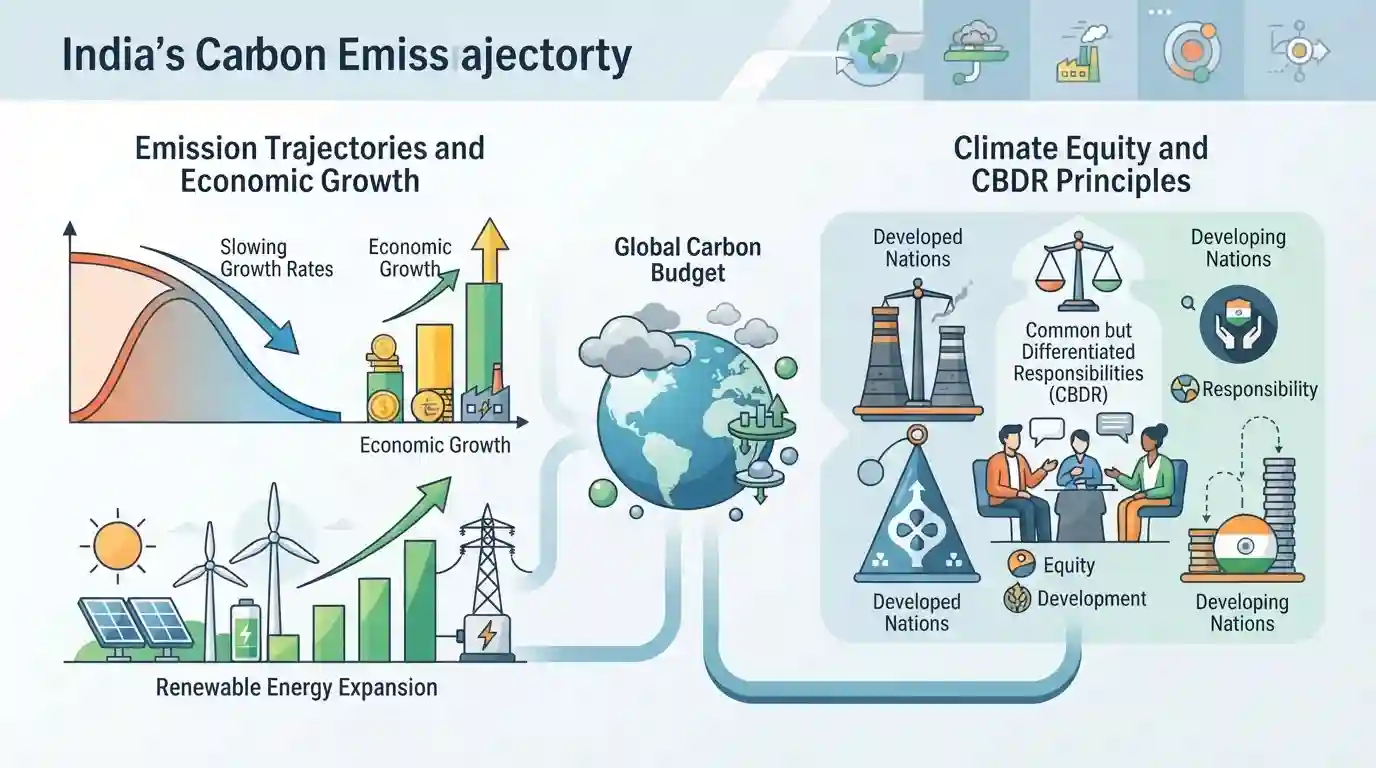
An analysis of the Global Carbon Budget report details India's evolving emission trajectories, highlighting slowing growth rates amidst economic growth, renewable energy expansion, and the ongoing global debate on climate equity and CBDR principles.
Key Points
- Global Carbon Budget report highlights trends in carbon dioxide emissions and the widening gap between global climate targets and actual emissions.
- India's emissions growth rate is slowing down relative to its economic expansion, reflecting increased renewable energy integration and energy efficiency measures.
- Despite positive domestic trends, per capita emissions in developing nations like India remain low compared to historical emitters, emphasizing the principle of Common But Differentiated Responsibilities (CBDR).
- The report underscores the urgency for accelerated global mitigation action and rapid phase-out of fossil fuels to stay within carbon budgets.
Important Terms
Global Carbon Project

An international research initiative under Future Earth that tracks, quantifies, and publishes annual budgets for global greenhouse gas emissions like carbon dioxide.
UPSC context
GS Paper III (Environment & Ecology) - Tests knowledge of international scientific bodies tracking global carbon sinks, sources, and emissions trends.
Paris Agreement
A legally binding international treaty adopted at UNFCCC COP21 aiming to limit global temperature rise to well below 2°C, driven by voluntary Nationally Determined Contributions.
UPSC context
GS Paper III (Environment & Ecology) - Central framework for global climate negotiations, NDCs, climate equity, and India's net-zero commitments.
Static Concepts Connected
What is the principle of Common But Differentiated Responsibilities and Respective Capabilities (CBDR-RC)?
- Historical Responsibility: Recognizes historical responsibility of developed nations for cumulative greenhouse gas emissions due to early industrialization.
- National Capacities: Acknowledges that developing countries need space for poverty eradication and economic growth while taking sustainable action.
- UNFCCC Framework: Enshrined in the 1992 UNFCCC and reinforced under the Paris Agreement as CBDR-RC in light of different national circumstances.
Cross-Topic Patterns
Carbon Budgets and Paris Agreement NDCs
The Global Carbon Budget data directly informs India's updated Nationally Determined Contributions (NDCs) under the Paris Agreement and international climate finance negotiations.

Global Carbon Budget + CBDR principle + decoupling of emissions from GDP is a classic multi-statement prelims / Mains GS-3 trap.
Linked PYQs · 2
Linked PYQs · 2
- 2025MainsGS3
Write a review on India's climate commitments under the Paris Agreement (2015) and mention how these have been further strengthened in COP26 (2021). In this direction, how has the first Nationally Determined Contribution intended by India been updated in 2022?
- 2022MainsGS3
Do you think India will meet 50 percent of its energy needs from renewable energy by 2030 ? Justify your answer. How will the shift of subsidies from fossil fuels to renewables help achieve the above objective ? Explain.
