Supreme Court mandates menstrual hygiene facilities in schools
Source:The Hindu ↗
Why It Matters
This judgment represents a significant expansion of Article 21, linking menstrual health and sanitation to the fundamental right to life and education. It provides a strong judicial backing for policies targeting girl child education, reducing school dropout rates, and promoting women's empowerment, making it highly relevant for Mains GS2 (Constitution and Social Justice).
Summary
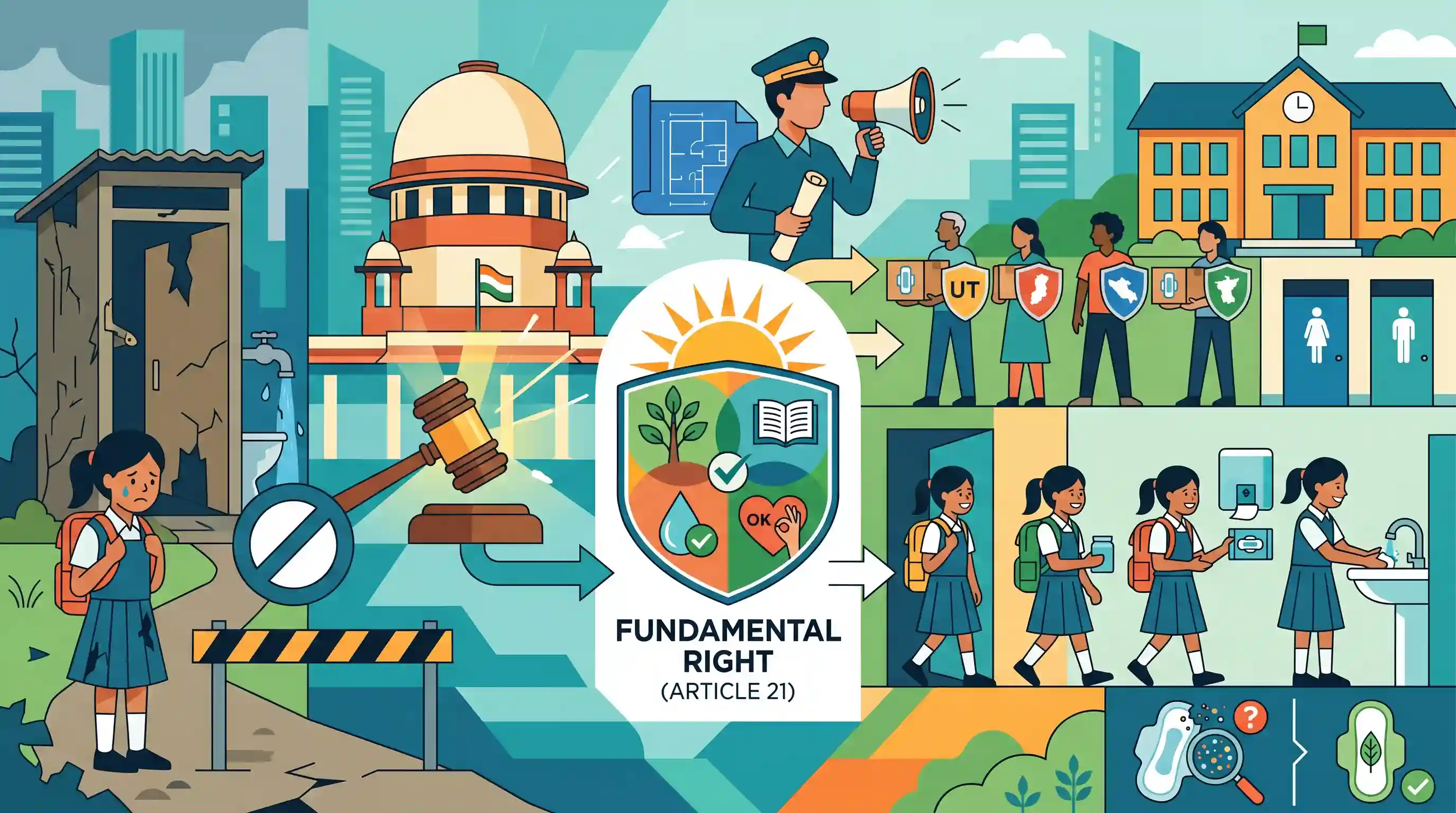
The Supreme Court of India, led by CJI Sanjiv Khanna, has ruled that a lack of sanitary napkins and functional gender-segregated toilets should not force girls to abandon their education. Emphasizing that menstrual and reproductive health are protected under the right to life (Article 21), the Court directed all States and Union Territories to provide free sanitary products and proper sanitation infrastructure in schools. The Ministry of Education has been appointed as the nodal ministry to ensure compliance. The judgment also briefly touched upon environmental concerns regarding 'oxo-biodegradable' sanitary pads and their potential to fragment into microplastics.
Key Points
- The Supreme Court directed States and UTs to ensure the provision of free sanitary napkins and functional gender-segregated toilets for girls in schools to prevent dropouts.
- The Court observed that the right to menstrual health and reproductive health is an integral part of the right to life under Article 21.
- The Ministry of Education was designated as the nodal ministry to monitor the submission of compliance reports by the states.
- An environmental concern was raised over 'oxo-biodegradable' napkins, which fragment into microplastics, highlighting challenges in sustainable solid waste management.
Important Terms
Article 21 of the Indian Constitution

A fundamental right guaranteeing protection of life and personal liberty. The Supreme Court expanded this to include 'menstrual health,' ruling that dignity requires facilities like sanitary napkins to prevent social exclusion.
UPSC context
GS Paper II (Polity). Tests understanding of the evolving scope of Fundamental Rights through judicial interpretation and the 'Right to Life' doctrine.
Supreme Court of India
The apex judicial body and guardian of the Constitution. It exercises 'continuing mandamus' in this case, meaning it maintains ongoing supervision over the government to ensure compliance with its orders.
UPSC context
GS Paper II (Judiciary). Tests the concept of judicial activism and the court's role in enforcing social justice through Public Interest Litigation (PIL).
Right of Children to Free and Compulsory Education (RTE) Act, 2009
Legislation making free and compulsory education a right for children (6-14). The Court ruled that lack of hygiene facilities violates this Act by creating structural barriers to attendance.
UPSC context
GS Paper II (Social Justice/Education). Tests statutory frameworks for educational equity and the state's obligation to provide necessary school infrastructure.
Ministry of Education
The central executive body responsible for national education policy. In this ruling, it is the designated 'nodal ministry' tasked with coordinating state compliance and data collection.
UPSC context
GS Paper II (Governance). Tests knowledge of executive implementation, inter-ministerial coordination, and the role of central ministries in social sector monitoring.
Oxo-biodegradable
Plastic designed to degrade through oxidation. While the Court mandated their use (standard ASTM D-6954), it noted concerns about their tendency to fragment into microplastics rather than fully decomposing.
UPSC context
GS Paper III (Environment). Tests awareness of plastic waste management technologies, environmental standards, and the impact of microplastics on ecosystems.
Menstrual Hygiene Management (MHM)
A holistic framework ensuring access to menstrual products, private facilities for washing and disposal, and awareness. The SC ruling elevates MHM from a welfare concern to a fundamental right.
UPSC context
GS Paper II (Social Justice/Women's Issues). Tests understanding of intersectional barriers to gender justice and policy interventions for female health.
Prelims Trap
The Ministry of Health and Family Welfare is the nodal ministry appointed to ensure compliance with school sanitary napkin distribution.
Aspirants often guess Health or Women & Child Development for hygiene issues. However, the SC explicitly designated the Ministry of Education to monitor school sanitary infrastructure and prevent dropouts.
Static Concepts Connected
Which major rights have been implicitly read into Article 21 by the Judiciary?
- Right to Privacy: Recognized as intrinsic to life and liberty in the Puttaswamy case; forms the basis for reproductive health and bodily autonomy.
- Clean Environment & Health: Recognized in the Subhash Kumar case; ensures protection against hazards, linking bodily health to safe environments.
- Right to Education: Initial recognition in the Unnikrishnan case paved the way for the 86th Amendment and the creation of Article 21A.
How do oxo-biodegradable plastics differ from genuine compostable plastics?
- Oxo-biodegradable plastics: Conventional plastics mixed with additives. They don't decompose naturally but fragment into hazardous microplastics via UV/heat exposure.
- Compostable plastics: Derived from renewable biomass. They fully break down into water, CO2, and organic compost under specific industrial composting conditions.
- Environmental impact: Oxo-plastics falsely market as 'green' but severely worsen microplastic contamination in soil and marine ecosystems, complicating solid waste management.
Cross-Topic Patterns
Sanitation links to demographic dividend
School dropouts directly suppress female labor force participation (FLFPR). Proper menstrual hygiene management bridges the gap between the Right to Education (Article 21A) and long-term economic empowerment.
Waste Rules vs. Pseudo-biodegradable materials
The intersection of Solid Waste Management Rules and sanitary product design highlights a critical governance gap in regulating pseudo-green 'oxo-biodegradable' materials that worsen microplastic pollution.

Expect a 2026 hybrid Prelims question pairing Article 21 expansions (menstrual health) with 'oxo-biodegradable' microplastics.
Linked PYQs · 3
Linked PYQs · 3
- 2025MainsGS2
Women's social capital complements in advancing empowerment and gender equity. Explain.
- 2023MainsGS2
“The Constitution of India is a living instrument with capabilities of enormous dynamism. It is a constitution made for a progressive society.” Illustrate with special reference to the expanding horizons of the right to life and personal liberty.
- 2018MainsGS3
What are the impediments in disposing the huge quantities of discarded solid wastes which are continuously being generated? How do we remove safely the toxic wastes that have been accumulating in our habitable environment?
