Babesia Infection Suspected in Gir Lion Cub Mortality
Source:The Hindu ↗
Why It Matters
Geographically isolated, single-population species like the Asiatic lion are uniquely vulnerable to rapid extinction events triggered by disease outbreaks (such as Babesiosis or CDV). This reinforces the core conservation debate regarding the necessity of creating a second geographically separate population (e.g., translocation to Kuno National Park) to ensure species survival.
Summary
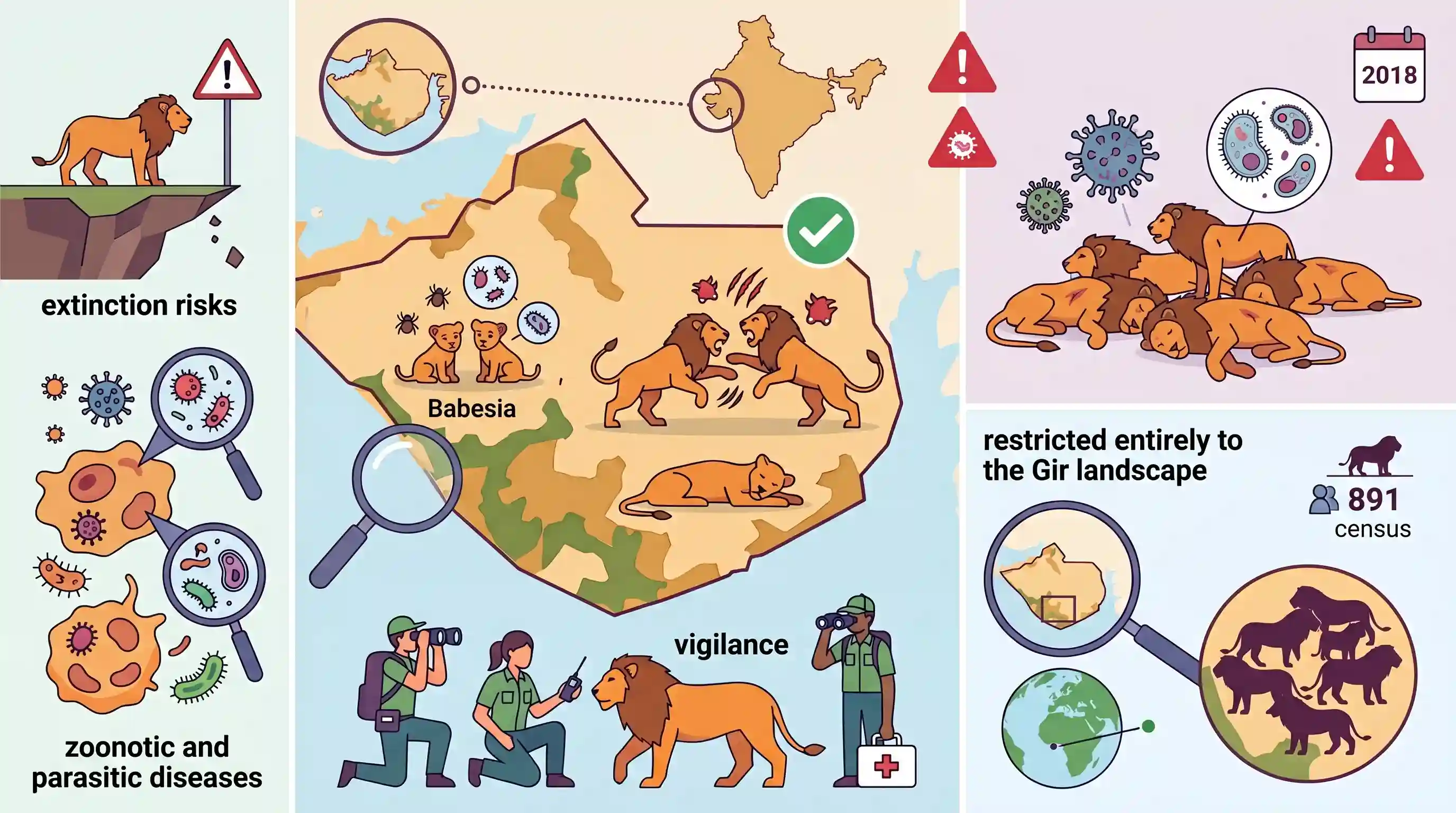
Two Asiatic lion cubs recently died in Gujarat's Gir National Park of a suspected Babesia infection, a tick-borne disease, while three other adults succumbed to natural causes and infighting. The Gujarat government has ruled out a large-scale outbreak, assuring that the deaths were isolated. However, the incidents recall the 2018 die-off where Canine Distemper Virus (CDV) combined with protozoal infections killed nearly 30 lions. The vulnerability of the Asiatic lion—restricted entirely to the Gir landscape with a 2025 census population of 891—highlights the severe extinction risks posed by concentrated geographic isolation and the ongoing need for vigilance against zoonotic and parasitic diseases.
Key Points
- Two Asiatic lion cubs died in Gir National Park from a suspected Babesia infection, a tick-borne parasitic disease, prompting health concerns.
- Three other lions died in separate incidents due to territorial infighting and natural causes, but authorities ruled out a widespread disease outbreak.
- Babesiosis destroys red blood cells and causes lethargy and respiratory distress, often worsening when the animal's immunity is compromised.
- The Gir landscape remains the only natural habitat for Asiatic lions, rendering the entire population vulnerable to localized epidemics.
- In 2018, an outbreak involving a combination of Canine Distemper Virus (CDV) and protozoal infection killed nearly 30 lions in the region.
- The 2025 lion census reported a population of 891 Asiatic lions across Gujarat's Saurashtra region.
Important Terms
Asiatic Lion

A lion subspecies (Panthera leo persica) found exclusively in Gujarat's Gir landscape. Known for a longitudinal fold of skin along its belly and a smaller mane than African lions.
UPSC context
GS3 (Biodiversity); frequent Prelims topic regarding scientific name, exclusive habitat, and IUCN status (recently updated to Vulnerable).
Babesiosis
A non-contagious, tick-borne disease caused by protozoan parasites of the genus Babesia. It infects red blood cells, leading to severe anemia, fever, and jaundice in wildlife and livestock.
UPSC context
GS3 (Environment/Health); tests knowledge of wildlife diseases and their role in species extinction risks for isolated populations.
Canine Distemper Virus (CDV)
A highly contagious viral disease caused by Morbillivirus, affecting the respiratory, gastrointestinal, and nervous systems of carnivores. Often spills over from domestic/stray dogs to wild big cats.
UPSC context
GS3 (Conservation); critical context for the 2018 Gir mass mortality event and ongoing wildlife health surveillance.
Gir National Park
A wildlife sanctuary and national park in Gujarat, established in 1965. It is the world's only natural habitat for Asiatic lions and comprises dry deciduous forests.
UPSC context
GS1 (Geography) & GS3 (Environment); key protected area (PA) frequently asked in map-based Prelims questions.
Project Lion
An initiative launched in 2020 for the conservation of Asiatic lions. It focuses on habitat improvement, technology-led monitoring, and mitigating human-wildlife conflict within the Gir landscape.
UPSC context
GS3 (Conservation); important for questions on species-specific government interventions similar to Project Tiger and Project Elephant.
Prelims Trap
"Babesiosis is a highly contagious viral infection that threatens the lion population."
Babesia is a protozoan parasite, not a virus. It is vector-borne (transmitted by tick bites), unlike Canine Distemper Virus (CDV), which is highly contagious.
Static Concepts Connected
What is the conservation status and natural habitat of the Asiatic Lion?
- Conservation Status: Listed as Endangered on the IUCN Red List, Schedule I of the Wildlife (Protection) Act, 1972, and CITES Appendix I.
- Habitat Endemism: Restricted entirely to the Gir National Park and the greater Saurashtra landscape in Gujarat. They are not found naturally anywhere else in the world.
- Distinct Physical Trait: Unlike African lions, Asiatic lions have a distinct longitudinal fold of skin running along their belly and typically have a sparser mane on top of the head.
Why is a second home proposed for the Asiatic Lion and where?
- Epidemic Vulnerability: Geographic concentration in a single landscape makes the entire species vulnerable to localized extinction from natural disasters or epidemic outbreaks (like CDV).
- Supreme Court Directive: In 2013, the Supreme Court ordered their translocation to Kuno National Park (MP), though this site currently hosts translocated African Cheetahs.
- Alternative Sites: Under 'Project Lion', the Gujarat government has been developing the Barda Wildlife Sanctuary as an alternative, closer second home within the state.
Cross-Topic Patterns
Wildlife disease + One Health approach
The spread of Babesia (via ticks) and CDV (often via feral dogs) into protected areas highlights the urgent need for a One Health approach integrating wildlife, domestic animal, and ecosystem management.
Apex predator carrying capacity
The growing lion population (891 in 2025) spilling out of Gir into the broader Saurashtra landscape raises critical questions about human-wildlife conflict and the ecological carrying capacity of Gujarat's protected areas.

Asiatic lion endemism, the Babesia protozoan vector (ticks), and the stalled Kuno translocation are ripe for a combined prelims question.
Linked PYQs · 2
Linked PYQs · 2
- 2017PrelimsGS1
Recently there was a proposal to translocate some of the lions from their natural habitat in Gujarat to which one of the following sites?
- 2024PrelimsGS1
Consider the following statements: 1. Lions do not have a particular breeding season. 2. Unlike most other big cats, cheetahs do not roar. 3. Unlike male lions, male leopards do not proclaim their territory by scent marking. Which of the statements given above are correct?
