Nishatpura Railway Station Non-Operational Status in Bhopal
Source:indiatoday ↗
Why It Matters
Demonstrates the ongoing challenges in regional infrastructure development and public project execution in Madhya Pradesh. An understanding of transport networks and localized governance issues is essential for the state administrative services.
Summary
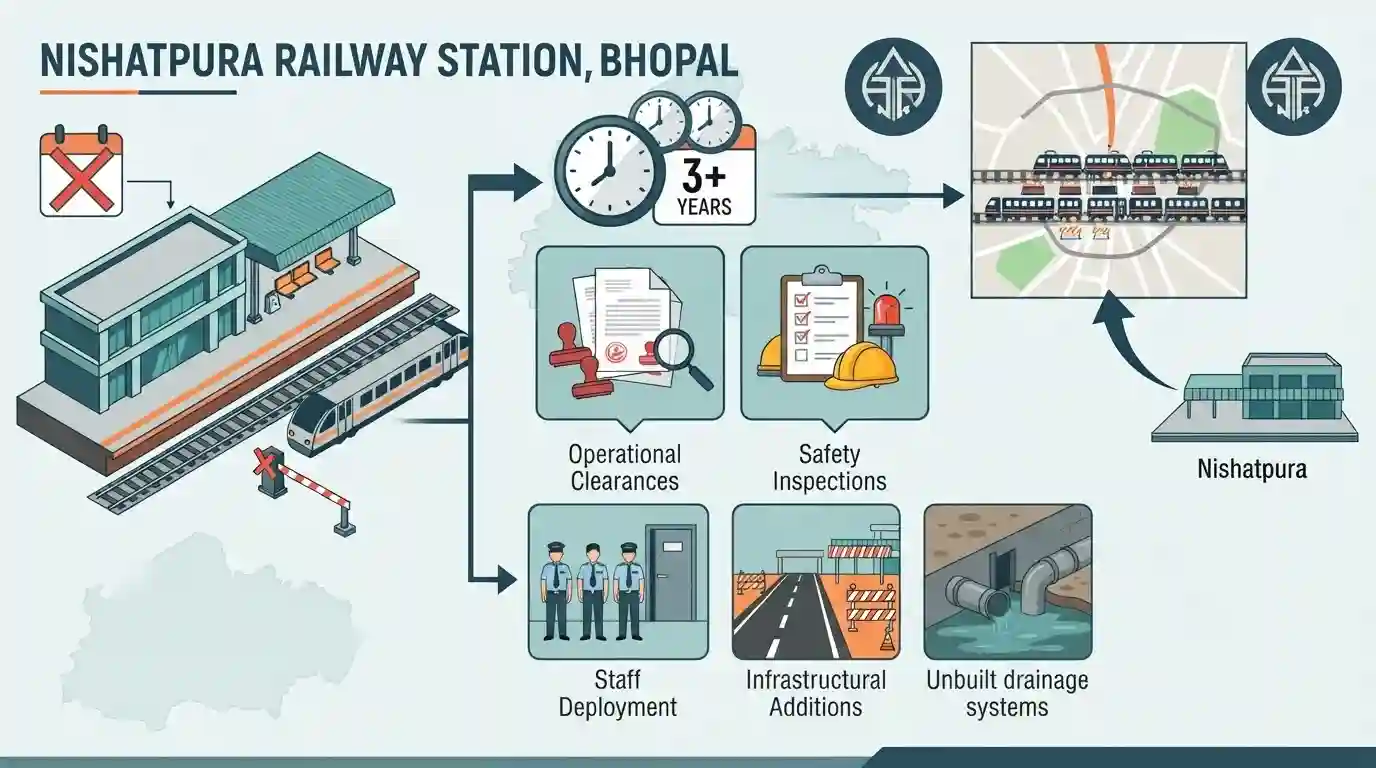
The Nishatpura railway station in Bhopal, built at a cost of approximately Rs 6 crore, remains non-operational more than three years after its completion in June 2023. Originally planned by the West Central Railway to decongest the main Bhopal Junction, the facility is waiting for crucial operational clearances, mandatory safety inspections, staff deployment, and essential infrastructural additions such as approach roads and proper drainage.
Key Points
- The Nishatpura railway station in Bhopal was completed in June 2023 at a cost of Rs 6 crore.
- The station was constructed by the West Central Railway to reduce congestion at the main Bhopal Junction.
- Despite its completion, the station remains non-operational for over three years due to pending operational clearances and safety inspections.
- Additionally, necessary infrastructure like approach roads and the deployment of railway personnel are yet to be finalized.
Important Terms
Nishatpura Railway Station

A terminal railway station in Bhopal, Madhya Pradesh, completed in 2023 for ₹6 crore. Intended to decongest Bhopal Junction, it remains completely non-operational due to pending safety clearances, lack of staff, and incomplete approach infrastructure.
UPSC context
Highlights governance challenges and bureaucratic delays in public infrastructure utilization. Relevant for GS Paper 2 (Governance) and GS Paper 3 (Infrastructure).
West Central Railway (WCR)
One of Indian Railways' zones, established in 2003 with its headquarters in Jabalpur. Covering parts of Madhya Pradesh, Rajasthan, and Uttar Pradesh, it was the first fully electrified railway zone in India and manages the Bhopal division.
UPSC context
GS Paper 3 (Infrastructure). Tests knowledge of India's railway zoning, administrative restructuring, and regional transport connectivity projects.
Commission of Railway Safety (CRS)
A statutory authority under the Ministry of Civil Aviation responsible for ensuring safety in Indian rail and metro operations. It conducts mandatory safety inspections, authorizes new lines, and investigates serious rail accidents to maintain operational independence.
UPSC context
GS Paper 2 (Statutory Bodies) and GS Paper 3 (Infrastructure). Tests understanding of institutional safety oversight mechanisms and administrative independence.
Indian Railways
India's national railway system operated by the Ministry of Railways. As one of the world's largest rail networks, it handles extensive passenger and freight traffic across various regional zones, playing a critical role in the country's economic integration.
UPSC context
GS Paper 3 (Infrastructure/Economy). Crucial for topics concerning national logistics, public sector asset management, and transport modernization.
Prelims Trap
"The Commissioner of Railway Safety conducts inspections and functions under the Ministry of Railways."
CRS deliberately operates under the Ministry of Civil Aviation, not Railways, to maintain independent oversight and avoid conflict of interest.
Static Concepts Connected
What is the mandate of the Commissioner of Railway Safety (CRS)?
- Administrative control: Functions independently under the Ministry of Civil Aviation, not the Ministry of Railways.
- Statutory basis: Derives its statutory powers and duties from the Railways Act, 1989.
- Core mandate: Conducts mandatory safety inspections of new lines and investigates serious train accidents.
What factors drive 'stranded infrastructure' and project delays in India?
- Inter-agency friction: Lack of coordination between central agencies (e.g., Railways) and local civic bodies (e.g., municipalities).
- Clearance bottlenecks: Protracted delays in statutory safety, environmental, land acquisition, or utility shifting approvals.
- Last-mile gaps: Main projects finish but remain non-operational due to missing approach roads or basic drainage.
Cross-Topic Patterns
PM Gati Shakti & Governance Silos
This story illustrates the exact departmental silos (Railways vs. local municipalities) that the PM Gati Shakti National Master Plan's integrated planning portal was designed to resolve.
Transit-Oriented Development (TOD)
Building peripheral satellite stations to decongest legacy city-center terminals is a classic Transit-Oriented Development (TOD) urban planning strategy frequently tested in GS-1 and GS-3.

Mains 2026 will likely test 'stranded infrastructure' and inter-ministerial silos as a core governance hurdle in GS-2 or GS-3.
Linked PYQs · 2
Linked PYQs · 2
- 2023MPPSC_PRELIMSGS1
Which of the following statements is not correct regarding the roadways of Madhya Pradesh according to Basic Road Statistics 2018-19?
- 2022MPPSC_PRELIMSGS1
Where was the Global Investors Summit - 2023 held in Madhya Pradesh?
