Karnataka Directs Strict Enforcement on Green Firecrackers
Source:The Hindu ↗
Why It Matters
The article highlights practical state-level governance measures to combat environmental degradation. Securing undertakings from traders acts as a preemptive regulatory tool against air pollution, while the adoption of EVs by the pollution control board itself serves as an excellent case study in 'walking the talk' on emission reductions and upgrading administrative capacity.
Summary
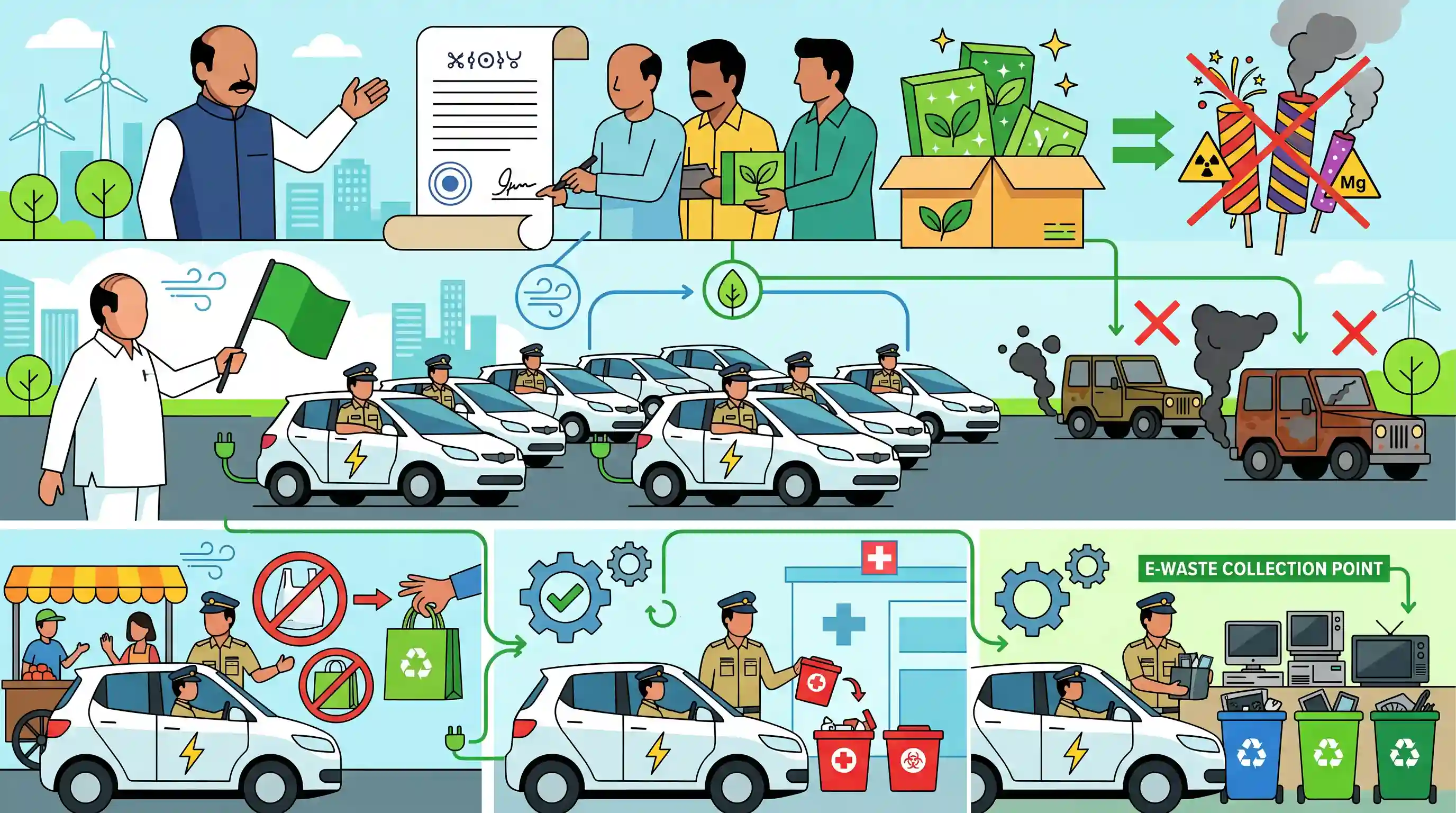
Karnataka's Environment and Forest Minister, Eshwar Khandre, has instructed the Karnataka State Pollution Control Board (KSPCB) to secure written commitments from traders to sell exclusively "green crackers" during Deepavali, thereby preventing the sale of hazardous fireworks laden with heavy metals. In a parallel push to strengthen environmental governance and monitoring, Chief Minister Siddaramaiah flagged off 68 electric vehicles (EVs) for KSPCB officers. These EVs will replace older, polluting 15-year-old diesel vehicles and will be utilized to actively monitor environmental compliance, including bans on single-use plastics and the proper disposal of medical and e-waste.
Key Points
- Karnataka's Environment Minister directed the KSPCB to obtain written undertakings from traders ensuring they sell only green crackers during Deepavali.
- The move aims to strictly enforce the ban on conventional crackers that contain harmful chemicals and heavy metals, curbing seasonal air and noise pollution.
- The Chief Minister flagged off 68 electric vehicles (EVs) for KSPCB environmental officers to enhance their mobility for field monitoring and enforcement.
- These EVs will be used to monitor compliance regarding single-use plastics, e-waste, and medical waste management across the state.
- The deployment of EVs is also part of a greener administrative push to phase out polluting 15-year-old diesel vehicles in government fleets.
Important Terms
Green Crackers

Environmentally friendly fireworks developed by CSIR-NEERI that reduce emissions (PM, SO2, NO2) by at least 30% compared to traditional ones, excluding hazardous chemicals like barium nitrate.
UPSC context
GS Paper III: Environment (Pollution and Mitigation). Important for Prelims (composition/certification) and Mains (pollution control strategies).
State Pollution Control Board (SPCB)
Statutory bodies established under the Water Act, 1974, responsible for enforcing environmental laws, monitoring pollution levels, and issuing 'Consent to Establish/Operate' for industries within their jurisdiction.
UPSC context
GS Paper II: Statutory/Regulatory Bodies; GS Paper III: Environmental Governance. Tests knowledge of environmental administration in India.
Single-use Plastics (SUP)
Plastic items intended for a single use before being discarded, regulated under the Plastic Waste Management Rules, 2016 (amended 2021) due to low utility and high littering potential.
UPSC context
GS Paper III: Environmental Pollution. Relevant for Mains discussions on waste management challenges and legislative enforcement.
Bio-medical Waste (BMW)
Any waste generated during diagnosis, treatment, or immunization of humans or animals, governed by the 2016 Rules requiring color-coded segregation and scientific disposal (e.g., incineration).
UPSC context
GS Paper III: Environmental Pollution and Degradation. Specific focus on public health and scientific waste disposal mechanisms.
E-waste
Discarded electronic or electrical equipment (EEE) managed under 2022 Rules that mandate recycling targets for producers and formalize the disposal process via registered recyclers.
UPSC context
GS Paper III: Environment (E-waste Management). Frequently tested in Prelims regarding toxic releases (e.g., lead, mercury).
Extended Producer Responsibility (EPR)
A policy approach under which producers are given significant responsibility—financial and/or physical—for the treatment or disposal of post-consumer products (e.g., e-waste, plastics).
UPSC context
GS Paper III: Environment/Conservation. A key principle in modern waste management rules often appearing in Prelims and Mains.
Prelims Trap
"State Pollution Control Boards (SPCBs) were established under the Air (Prevention and Control of Pollution) Act, 1981."
SPCBs were actually constituted under the Water (Prevention and Control of Pollution) Act, 1974, not the Air Act or EPA. They were only later entrusted with enforcing the Air Act (1981).
Static Concepts Connected
Which heavy metals are responsible for specific colors in traditional fireworks?
- Barium: Produces green light. It is highly toxic and explicitly banned by the Supreme Court for use in firecrackers.
- Strontium: Produces red light. It can negatively impact bone growth in children when inhaled as particulate matter.
- Copper: Produces blue light. When combusted with organic compounds, it can form highly toxic dioxins.
- Sodium: Produces yellow light. While creating vivid colors, it contributes heavily to aerosolized microscopic particulate matter.
What are the three main categories of Green Crackers developed by CSIR-NEERI?
- SWAS (Safe Water Releaser): Releases water vapor upon combustion, acting as an in-situ dust suppressant to significantly reduce particulate matter.
- STAR (Safe Thermite Cracker): Eliminates the use of potassium nitrate and sulphur entirely from the pyrotechnic composition.
- SAFAL (Safe Minimal Aluminium): Substitutes aluminium with magnesium to reduce both particulate emissions and noise levels without losing visual effect.
Cross-Topic Patterns
Vehicle Scrappage + Circular Economy
Phasing out 15-year-old government diesel vehicles directly connects the National Vehicle Scrappage Policy (2021) with India's broader EV transition and circular economy goals.
Judicial mandates + Executive enforcement
The ban on Barium in crackers stems from Supreme Court directives. SPCBs securing written undertakings demonstrates the executive implementation of judicial environmental mandates.

Expect a match-the-following question pairing fireworks heavy metals (Barium/Strontium/Copper) with their flame colors or health impacts.
Linked PYQs · 2
Linked PYQs · 2
- 2023MainsGS3
The adoption of electric vehicles is rapidly growing worldwide. How do electric vehicles contribute to reducing carbon emissions and what are the key benefits they offer compared to traditional combustion engine vehicles?
- 2024PrelimsGS1
Consider the following statements : Statement-I: Activated carbon is a good and an attractive tool to remove pollutants from effluent streams and to remediate contaminants from various industries. Statement-II : Activated carbon exhibits a large surface area and a strong potential for adsorbing heavy metals. Statement-III : Activated carbon can be easily synthesized from environmental wastes with high carbon content. Which one of the following is correct in respect of the above statements?
