Germanwatch Climate Risk Index Ranks India Among Vulnerable Nations
Source:The Hindu ↗
Why It Matters
Provides crucial data and international ranking regarding India's vulnerability to extreme weather, which is essential for GS3 answers on climate-induced disaster management and India's stance in global climate justice (GS2/GS3).
Summary
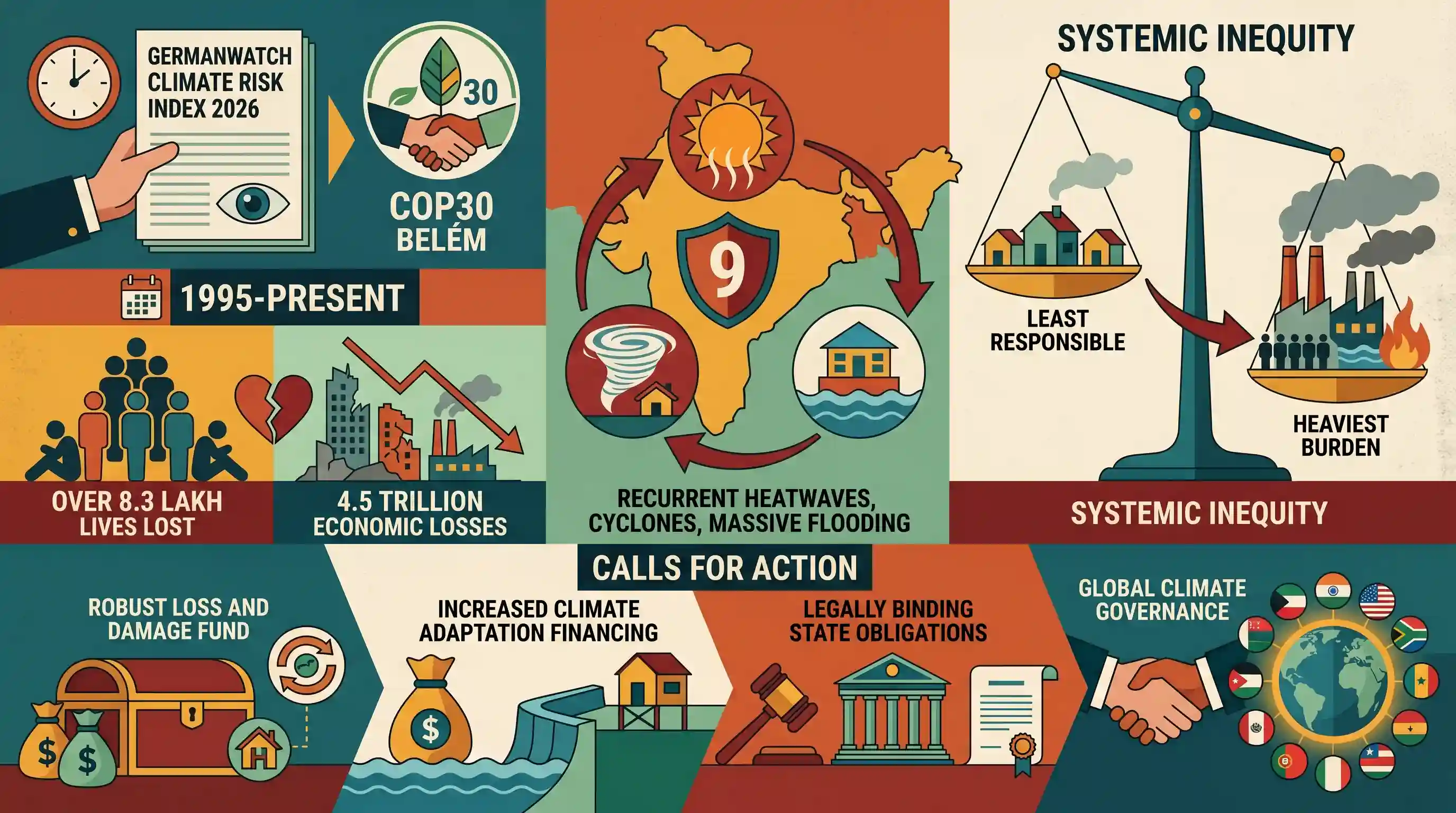
According to the newly released Germanwatch Climate Risk Index 2026, presented at COP30 in Belém, extreme weather events have claimed over 8.3 lakh lives and inflicted $4.5 trillion in global economic losses since 1995. India is ranked as the 9th most affected nation, repeatedly devastated by a combination of deadly heatwaves, cyclones, and massive flooding. The index highlights the ongoing systemic inequity wherein the least responsible nations bear the heaviest burden of climate change. The findings amplify calls for a robust Loss and Damage Fund, increased climate adaptation financing, and legally binding state obligations as per the ICJ's recent advisory opinion.
Key Points
- The Climate Risk Index (CRI) 2026 by Germanwatch, released at COP30 in Belém, reports extreme weather caused over 8.3 lakh deaths and $4.5 trillion in losses from 1995 to 2025.
- India ranks as the 9th most climate-vulnerable country, facing recurring floods, severe cyclones (like Amphan), droughts, and heatwaves exceeding 50°C.
- The index highlights systemic climate injustice: lower-income nations suffer disproportionately despite contributing least to historical emissions.
- The report underscores the critical need for a fully operational Loss and Damage Fund, bridging the climate finance gap, and references the ICJ's landmark advisory opinion on states' legal climate obligations.
Important Terms
Germanwatch Climate Risk Index

An annual report by the NGO Germanwatch ranking countries based on fatalities and economic losses from extreme weather events. The 2026 index ranks India as the 9th most affected nation globally (1995–2024).
UPSC context
GS3 (Environment/Disaster Management); tests knowledge of India's climate vulnerability and global risk assessment methodologies.
Loss and Damage Fund
A UN-established financial mechanism to provide financial assistance to vulnerable nations facing irreversible climate-induced harm. At COP30, it issued its first $250 million call for proposals via the Barbados Implementation Modalities.
UPSC context
GS3 (Environment/Economy); critical for understanding climate justice, finance, and the "Common But Differentiated Responsibilities" (CBDR) principle.
ICJ Advisory Opinion on Climate Change
A landmark July 2025 ruling stating that states have legally binding obligations under international law to protect the climate. It established that failure to meet these duties constitutes an internationally wrongful act.
UPSC context
GS2 (International Relations/Judiciary); tests understanding of the evolving legal framework and state responsibility in global climate governance.
COP30 (Belém)
The 30th UN Climate Change Conference held in Belém, Brazil (November 2025). It resulted in the "Mutirão decision," setting a $1.3 trillion annual climate finance trajectory by 2035.
UPSC context
GS3 (International Conventions); vital for tracking global implementation of the Paris Agreement and new finance targets.
Germanwatch
A Bonn-based non-governmental organization (est. 1991) focusing on global equity and sustainable development. It publishes the Climate Risk Index and the Climate Change Performance Index (CCPI).
UPSC context
Prelims (International Organizations); frequently tested in the context of major environmental reports and indices.
UNFCCC
The 1992 international treaty that established a framework for global cooperation to combat climate change by stabilizing greenhouse gas concentrations. It hosts the annual Conference of Parties (COP).
UPSC context
GS3 (Environment); the foundational framework for all international climate negotiations and institutional architecture.
Warsaw International Mechanism (WIM)
The primary UN mechanism (est. 2013) to promote approaches for addressing loss and damage associated with climate change impacts in developing countries. It remains a core pillar of the L&D architecture.
UPSC context
GS3 (Disaster Management/Environment); tests specific knowledge of international institutional responses to climate-induced losses.
Prelims Trap
The Global Climate Risk Index is an official publication released annually by the UNFCCC or WMO.
The Climate Risk Index is published by Germanwatch, an independent environmental think tank (NGO), not a United Nations agency or intergovernmental body.
Static Concepts Connected
What is the Loss and Damage (L&D) Fund and its UN origins?
- COP Origins: Agreed upon at COP27 (Egypt, 2022) and officially operationalized at COP28 (UAE, 2023).
- Primary Purpose: Finances rescue and rehabilitation for climate impacts that exceed a country's capacity to adapt, such as permanent sea-level rise or severe cyclones.
- Interim Host: The World Bank serves as the interim trustee and host of the fund for its first four years.
What is the legal standing of an ICJ Advisory Opinion?
- Non-binding nature: Unlike judgments in contentious cases between states, advisory opinions carry no direct legally binding force on UN member states.
- Authorized Requesters: Only authorized UN organs (like the General Assembly) and specialized agencies can request them, not individual countries.
- Legal Weight: Despite being non-binding, they carry immense moral and legal authority, often shaping international customary law and state obligations.
Cross-Topic Patterns
Climate Risks & Sovereign Credit Ratings
India's 9th place ranking highlights geographical vulnerabilities that global rating agencies increasingly factor into sovereign credit ratings, directly linking climate risks to macroeconomic borrowing costs.
ICJ Advisory & Climate Justice
The ICJ’s recognition of legal climate obligations shifts the Loss and Damage debate from voluntary international aid to a rights-based legal demand under customary international law.

Expect a multi-statement question pairing Germanwatch's CRI with the World Bank's role in the Loss & Damage Fund and ICJ's climate ruling.
Linked PYQs · 5
Linked PYQs · 5
- 2021MainsGS3
Describe the major outcomes of the 26th session of the Conference of the Parties (COP) to the United Nations Framework Convention on Climate Change (UNFCCC). What are the commitments made by India in this conference?
- 2024MainsGS3
Flooding in urban areas is an emerging climate-induced disaster. Discuss the causes of this disaster. Mention the features of two such major floods in the last two decades in India. Describe the policies and frameworks in India that aim at tackling such floods.
- 2019MainsGS3
Vulnerability is an essential element for defining disaster impacts and its threat to people. How and in what ways can vulnerability to disasters be characterized? Discuss different types of vulnerability with reference to disasters.
- 2022MainsGS2
‘Clean energy is the order of the day.’ Describe briefly India's changing policy towards climate change in various international fora in the context of geopolitics.
- 2022PrelimsGS1
"Climate Action Tracker" which monitors the emission reduction pledges of different countries is a :
