German Army Artificial Intelligence Military Decision Making
Source:The Hindu ↗
Why It Matters
As AI becomes a central component of modern warfare (as seen in Ukraine), civil servants and policymakers must understand its strategic benefits (speed, data synthesis) alongside the critical ethical limitations (human-in-the-loop requirement) and international interoperability (NATO standards).
Summary
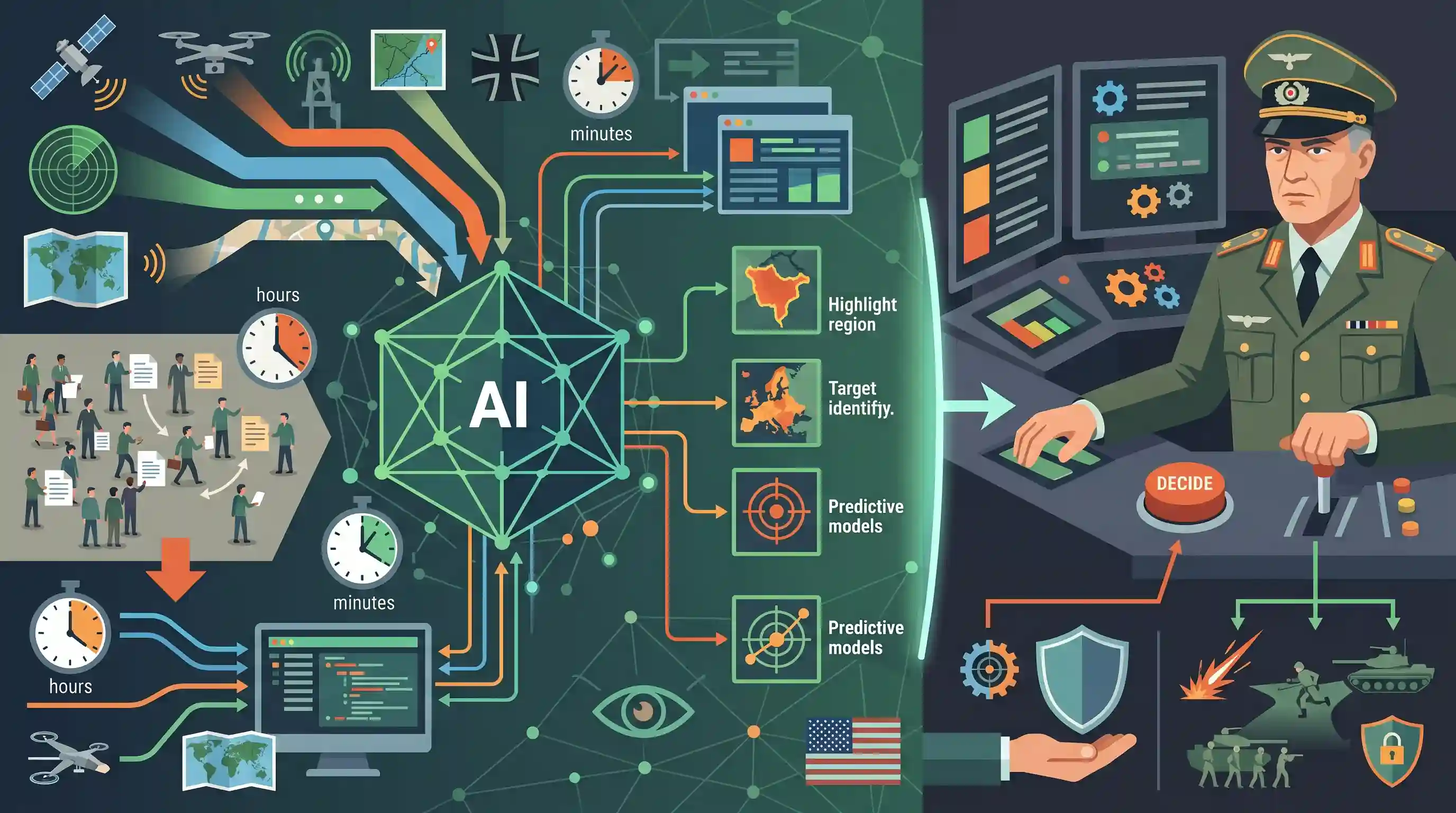
The German army is increasingly looking to integrate Artificial Intelligence (AI) into its military operations to expedite wartime decision-making, taking critical lessons from the ongoing war in Ukraine. AI's primary utility will be in rapidly analyzing massive volumes of intelligence data, reducing a process that typically takes hundreds of personnel days to mere minutes. Despite recognizing the technological advantages—and eyeing existing U.S. systems like Palantir's Maven for NATO compatibility—German military officials maintain that AI will remain strictly advisory. Human commanders will retain the ultimate authority over all decisions involving the use of force, addressing ethical concerns surrounding autonomous warfare.
Key Points
- The German army (Bundeswehr) is exploring the adoption of Artificial Intelligence (AI) to accelerate complex wartime decision-making, drawing lessons from the Ukraine conflict.
- AI will act as a force multiplier by rapidly synthesizing and analyzing vast quantities of intelligence data, such as drone feeds and enemy troop movements.
- Ethical constraints are firmly emphasized: AI will serve solely in an advisory capacity, ensuring that the ultimate decision to deploy lethal force remains with human commanders.
- Germany is looking at advanced U.S. solutions like Palantir's Project Maven, aiming for cross-compatibility with NATO allies to maintain interoperability.
Important Terms
Project Maven

A U.S. Department of Defense AI initiative (Algorithmic Warfare Cross-Functional Team) that uses computer vision and machine learning to analyze vast surveillance data and automate target identification.
UPSC context
GS Paper 3 (S&T/Security); tests understanding of AI's role in modernizing defense and the global AI arms race.
Human-in-the-loop (HITL)
A design principle where human oversight is required before executing high-stakes actions, particularly lethal force, to ensure ethical accountability and prevent fully autonomous warfare.
UPSC context
GS Paper 4 (Ethics); tests ability to analyze accountability and human agency in automated military systems.
Kill Chain
A military concept describing the end-to-end process of an attack: finding, fixing, tracking, targeting, engaging, and assessing a target; AI aims to "compress" or accelerate this cycle.
UPSC context
GS Paper 3 (Internal Security); examines the transformation of warfare through technology and rapid decision-making cycles.
Bundeswehr
The unified armed forces of Germany, comprising the Army, Navy, Air Force, and the Cyber and Information Domain Service, along with their civil administration.
UPSC context
GS Paper 2 (International Relations); relevant for studies of European security architecture and India-Germany bilateral defense cooperation.
Maven Smart System (MSS)
A digital command platform developed by Palantir that fuses data from satellites, drones, and sensors into a single interface to provide target recommendations and battlefield situational awareness.
UPSC context
GS Paper 3 (S&T); tests awareness of specific defense technologies and the role of private-sector contractors in national security.
NATO
An intergovernmental military alliance of 32 member states from Europe and North America committed to mutual defense and collective security.
UPSC context
GS Paper 2 (International Relations); tests knowledge of global security groupings and their influence on regional stability.
Prelims Trap
Project Maven is a US initiative to develop Lethal Autonomous Weapons Systems (LAWS) that independently execute strike decisions.
Project Maven is an intelligence and data-analysis tool to compress the OODA loop. It relies on a "Human-in-the-Loop" and does not independently authorize lethal force.
Static Concepts Connected
What is the "Human-in-the-Loop" (HITL) principle in military AI?
- HITL Definition: A system architecture requiring a human operator to confirm or authorize critical actions, especially the deployment of lethal force.
- LAWS Contrast: Also known as "killer robots," these are systems that can search for, identify, and engage targets without human intervention, violating HITL principles.
- International Regulation: The UN Convention on Certain Conventional Weapons (CCW) is the primary international forum currently debating the regulation of autonomous weapons.
What is the OODA loop in military strategy and how does AI affect it?
- OODA Basics: Observe, Orient, Decide, Act. It is a decision-making model originally developed by military strategist John Boyd for fighter pilots.
- AI Compression: AI drastically reduces the time required for the "Observe" and "Orient" phases by rapidly synthesizing massive intelligence feeds, compressing the overall loop.
Cross-Topic Patterns
GS4 Ethics meets GS3 Defense Tech
The "black box" nature of military AI creates an accountability vacuum, making the "Human-in-the-Loop" principle a crucial bridge between technological superiority in GS3 and ethical warfare in GS4.
Defense AI and Tech Sovereignty
Germany adopting US systems like Palantir highlights the modern geopolitical tension between achieving rapid NATO military interoperability and maintaining European strategic autonomy in critical technologies.

A 2026 GS3/GS4 crossover question will likely ask candidates to balance the tactical advantages of military AI against ethical LAWS risks.
Linked PYQs · 4
Linked PYQs · 4
- 2024MainsGS4
The application of Artificial Intelligence as a dependable source of input for administrative rational decision-making is a debatable issue. Critically examine the statement from the ethical point of view.
- 2023MainsGS3
Introduce the concept of Artificial Intelligence (AI). How does Al help clinical diagnosis? Do you perceive any threat to privacy of the individual in the use of Al in healthcare?
- 2023MainsGS2
‘The expansion and strengthening of NATO and a stronger US-Europe strategic partnership works well for India.’ What is your opinion about this statement ? Give reasons and examples to support your answer.
- 2023MainsGS3
The use of unmanned aerial vehicles (UAVs) by our adversaries across the borders to ferry arms/ammunitions, drugs, etc., is a serious threat to the internal security. Comment on the measures being taken to tackle this threat.
