GERC New Grid Code for Power Scheduling and Renewable Integration
Source:saurenergy ↗
Why It Matters
Crucial for understanding how state electricity regulatory commissions (SERCs) are adapting power system operations, forecasting, and scheduling frameworks to support India's ambitious renewable energy targets and grid integration challenges.
Summary
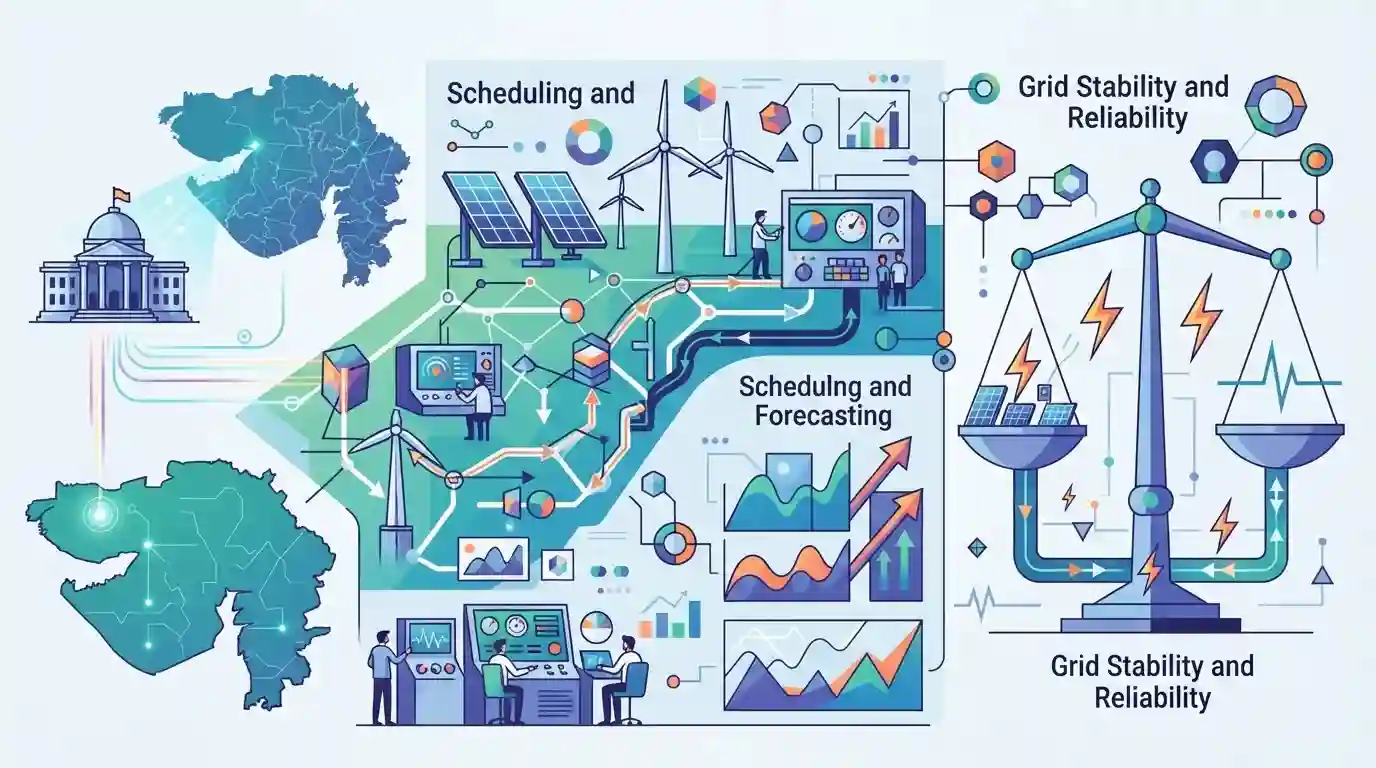
The Gujarat Electricity Regulatory Commission (GERC) has notified a new grid code aimed at revising rules for power scheduling, forecasting, and renewable energy integration. The updated guidelines address the operational dynamics and technical complexities of absorbing high shares of renewable energy (solar and wind) into Gujarat's power grid while ensuring overall grid stability and reliability.
Key Points
- GERC has notified a new grid code revising rules for power scheduling, forecasting, and renewable energy integration in Gujarat.
- The updated framework addresses technical challenges arising from high renewable energy penetration (solar and wind) into the state grid.
- It aims to ensure grid stability, streamline deviation settlement mechanisms, and align state regulations with evolving national grid standards.
Important Terms
Gujarat Electricity Regulatory Commission (GERC)

The statutory body responsible for regulating Gujarat's electricity sector, determining tariffs, issuing licenses, promoting renewable energy, and formulating intra-state grid codes under the Electricity Act, 2003.
UPSC context
Important for GPSC Paper 3 (Economy, Infrastructure, and Energy Sector Governance); tests knowledge of state-level regulatory bodies and power sector reforms.
Prelims Trap
The Central Electricity Regulatory Commission (CERC) directly enforces and updates intra-state grid codes for all generating stations within Gujarat.
Aspirants often assume CERC has direct jurisdiction over intra-state scheduling; however, state-level scheduling, forecasting, and intra-state grid codes are under the exclusive domain of the State Electricity Regulatory Commission (GERC) and SLDC.
Static Concepts Connected
What are the statutory functions of a State Electricity Regulatory Commission (SERC) under the Electricity Act, 2003?
- Tariff Determination: Determine tariffs for electricity generation, supply, transmission, and wheeling within the state.
- Power Procurement: Regulate electricity purchase and procurement process of distribution licensees.
- Licensing Power: Issue licenses for transmission, distribution, and trading of electricity within the state.
- Dispute Resolution: Adjudicate disputes between licensees and generating companies and refer them to arbitration.
Cross-Topic Patterns
State Grid Codes & Federal Power Dynamics
The integration of high-penetration solar and wind into state grids ties power regulation directly to federalism, where CERC sets national baselines and GERC implements state-level compliance under the Electricity Act, 2003.
Renewables, Open Access, & Industrial Tariffs
Grid stability mechanisms intersect with industrial policy, as open-access consumers and green hydrogen manufacturers depend on predictable scheduling and 15-minute block settlement regimes for captive power.

Expect statement-based questions on the respective roles of CERC (national) vs GERC (state) and SLDC functions under the Electricity Act.
Linked PYQs · 2
Linked PYQs · 2
- 2025GPSC_PRELIMSGS1
Under the Green Open Access Rules, 2022, the minimum size of the renewable energy project eligible for open access is
- 2025GPSC_PRELIMSGS1
A key technical feature of the "One Nation - One Grid - One Frequency" system in India is
