Genome India Project Objectives and Personalized Medicine Applications
Source:Indian Express ↗
Why It Matters
The Genome India Project represents a critical leap in India's biotechnology capabilities. It directly ties into the GS3 syllabus on awareness in the fields of biotechnology and indigenization of technology, as well as the GS2 focus on public health interventions. Understanding genome sequencing and its applications is highly relevant for both Prelims (factual science applications) and Mains (policy implications in healthcare).
Summary
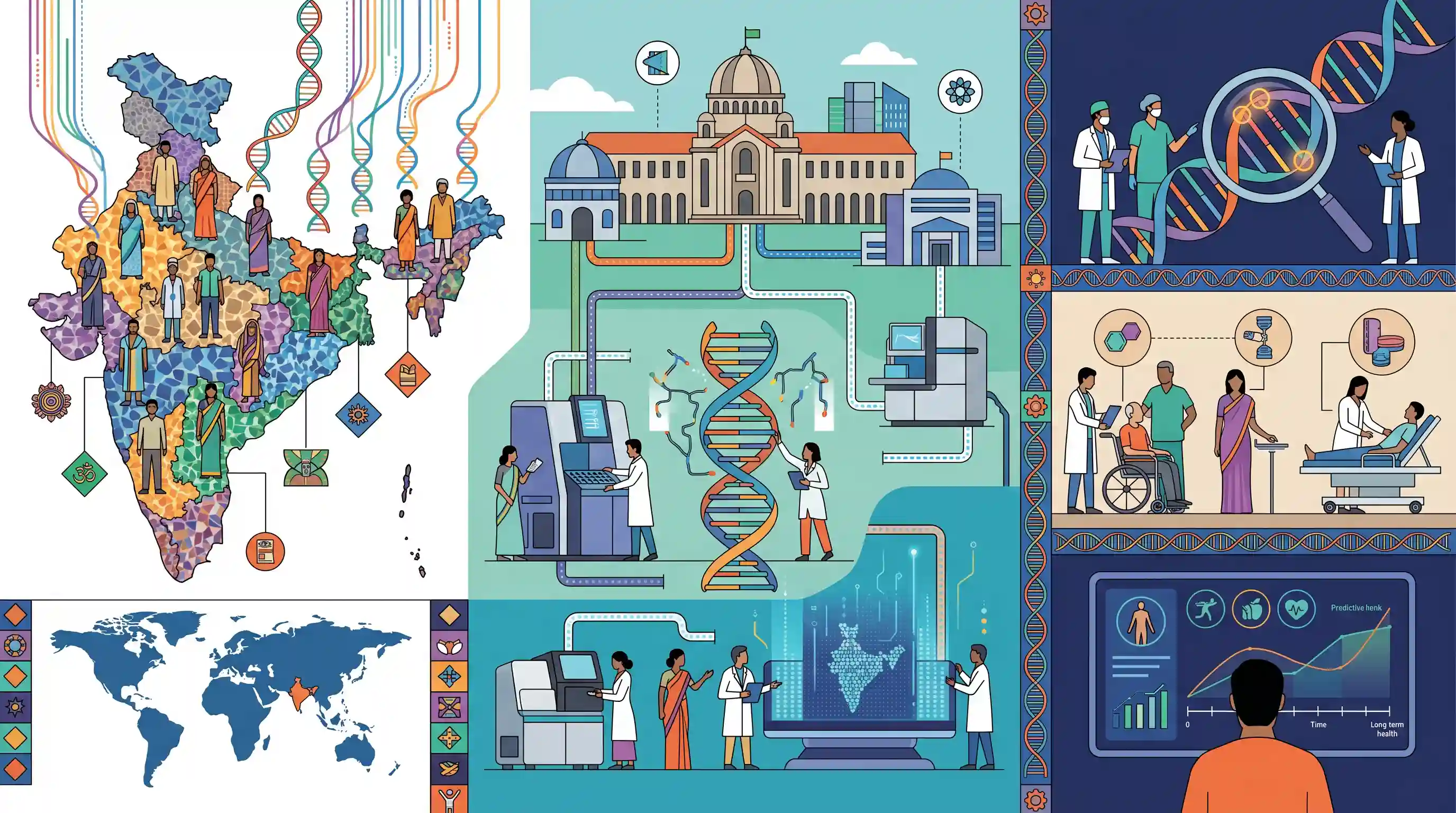
The Genome India Project (GIP) is a landmark scientific initiative launched by the Department of Biotechnology (DBT) to sequence 10,000 whole genomes from diverse population groups across India. Executed by a consortium of 20 institutions led by the Centre for Brain Research at IISc Bengaluru, the project seeks to build a comprehensive reference genome for India. Because of long-standing endogamy and vast diversity, the Indian population contains unique genetic profiles largely missing from global databases. GIP is fundamental for developing personalized medicine, identifying genetic mutations responsible for rare diseases, and advancing predictive healthcare uniquely suited to the Indian population.
Key Points
- The Genome India Project (GIP) aims to sequence 10,000 human genomes to create a representative genetic map of India's diverse population.
- Spearheaded by the Department of Biotechnology (DBT), the project is a collaborative effort involving 20 leading national research institutions led by the Centre for Brain Research (CBR).
- India's population exhibits vast genetic diversity and high rates of endogamy, leading to unique population-specific genetic variations and disease vulnerabilities.
- Existing global genomic databases are heavily skewed toward European populations, making a native reference genome crucial for accurate diagnosis and medical interventions in India.
- The resulting database will facilitate breakthroughs in predictive and personalized medicine, help identify genetic markers for rare diseases, and revolutionize targeted healthcare strategies.
Important Terms
Genome India Project (GIP)

A national initiative launched in 2020 by the Department of Biotechnology to sequence 10,000 whole genomes, creating a comprehensive reference database for India's diverse population groups.
UPSC context
GS Paper III (Science & Technology); critical for biotechnology, indigenization of technology, and national health missions.
Whole Genome Sequencing (WGS)
A high-throughput laboratory procedure that determines the entire DNA sequence of an organism's genome in a single process, enabling the identification of genetic variations and mutations.
UPSC context
GS Paper III (S&T); frequently tested in Prelims regarding biotechnology applications in medicine and agriculture.
Department of Biotechnology (DBT)
A department within the Ministry of Science and Technology that serves as the nodal agency for biotechnology research, development, and commercialization in India.
UPSC context
GS Paper III (S&T); important for understanding the institutional framework and government initiatives in the biotech sector.
Personalized Medicine
Medical care tailored to an individual’s genetic profile, environment, and lifestyle, moving away from 'one-size-fits-all' treatments to improve efficacy and reduce adverse drug reactions.
UPSC context
GS Paper III (S&T); key application of genomics in healthcare and a frequent topic in Mains discussions.
Endogamy
The social practice of marrying within a specific community (caste, tribe, or religion), which in the Indian context has created unique genetic clusters and increased prevalence of population-specific recessive disorders.
UPSC context
GS Paper I (Society) and GS Paper III (S&T); bridges social structures with biological consequences and public health outcomes.
Reference Genome
A digital nucleic acid sequence database assembled by scientists as a representative example of a species’ set of genes; GIP aims to build this specifically for the Indian population.
UPSC context
GS Paper III (S&T); essential technical concept for understanding how population-specific genetics differ from global (primarily Caucasian) benchmarks.
Prelims Trap
"Genome India Project is spearheaded by the Ministry of Health and Family Welfare."
GIP is a scientific initiative led by the Department of Biotechnology (DBT) under the Ministry of Science and Technology, not the Health Ministry.
Static Concepts Connected
What is the difference between Genome and Exome sequencing?
- Whole Genome (WGS): Maps the entire DNA sequence of an organism, including both protein-coding (exons) and non-coding regions.
- Whole Exome (WES): Sequences only the protein-coding regions (exons), which make up about 1-2% of the human genome but house the majority of disease-causing mutations.
How does endogamy influence India's genetic profile?
- Founder Effect: Marrying within specific caste/ethnic groups for centuries creates isolated genetic pools, amplifying specific genetic traits rather than blending them.
- Recessive Diseases: High endogamy increases the probability of inheriting two mutated copies of a gene, leading to a higher prevalence of population-specific rare genetic disorders.
Cross-Topic Patterns
Genome Mapping + Rare Disease Policy
The National Policy for Rare Diseases struggles with diagnostic delays. GIP's native reference genome accelerates the discovery of localized genetic markers, aiding orphan drug development.
Caste Endogamy + Population Genetics
GS1's Indian Society themes merge with GS3 Biotech here; historical caste-based endogamy directly causes the high prevalence of recessive genetic mutations currently being mapped by GIP.

Expect a 2026 Prelims statement distinguishing DBT's Genome India Project (10k genomes) from CSIR's earlier IndiGen project.
Linked PYQs · 4
Linked PYQs · 4
- 2017PrelimsGS1
With reference to agriculture in India, how can the technique of 'genome sequencing', often seen in the news, be used in the immediate future? 1. Genome sequencing can be used to identify genetic markers for disease resistance and drought tolerance in various crop plants. 2. This technique helps in reducing the time required to develop new varieties of crop plants. 3. It can be used to decipher the host-pathogen relationships in crops. Select the correct answer using the code given below:
- 2023PrelimsGS1
'Microsatellite DNA' is used in the case of which one of the following?
- 2013PrelimsGS1
Recombinant DNA technology (Genetic Engineering) allows genes to be transferred 1. across different species of plants 2. from animals to plants 3. from microorganisms to higher organisms Select the correct answer using the codes given below.
- 2021MainsGS3
What are the research and developmental achievements in applied biotechnology? How will these achievements help to uplift the poorer sections of the society?
