IARI Develops India First Genome Edited Rice Variety
Source:The Hindu ↗
Why It Matters
Genome-edited crops are the frontier of climate-resilient agriculture, helping combat both climate-stress and malnutrition faster than traditional breeding. Understanding the regulatory, IPR, and scientific differences between genome editing (like CRISPR-Cas9) and traditional Genetically Modified (GM) crops is vital for both Prelims and GS3 Mains.
Summary
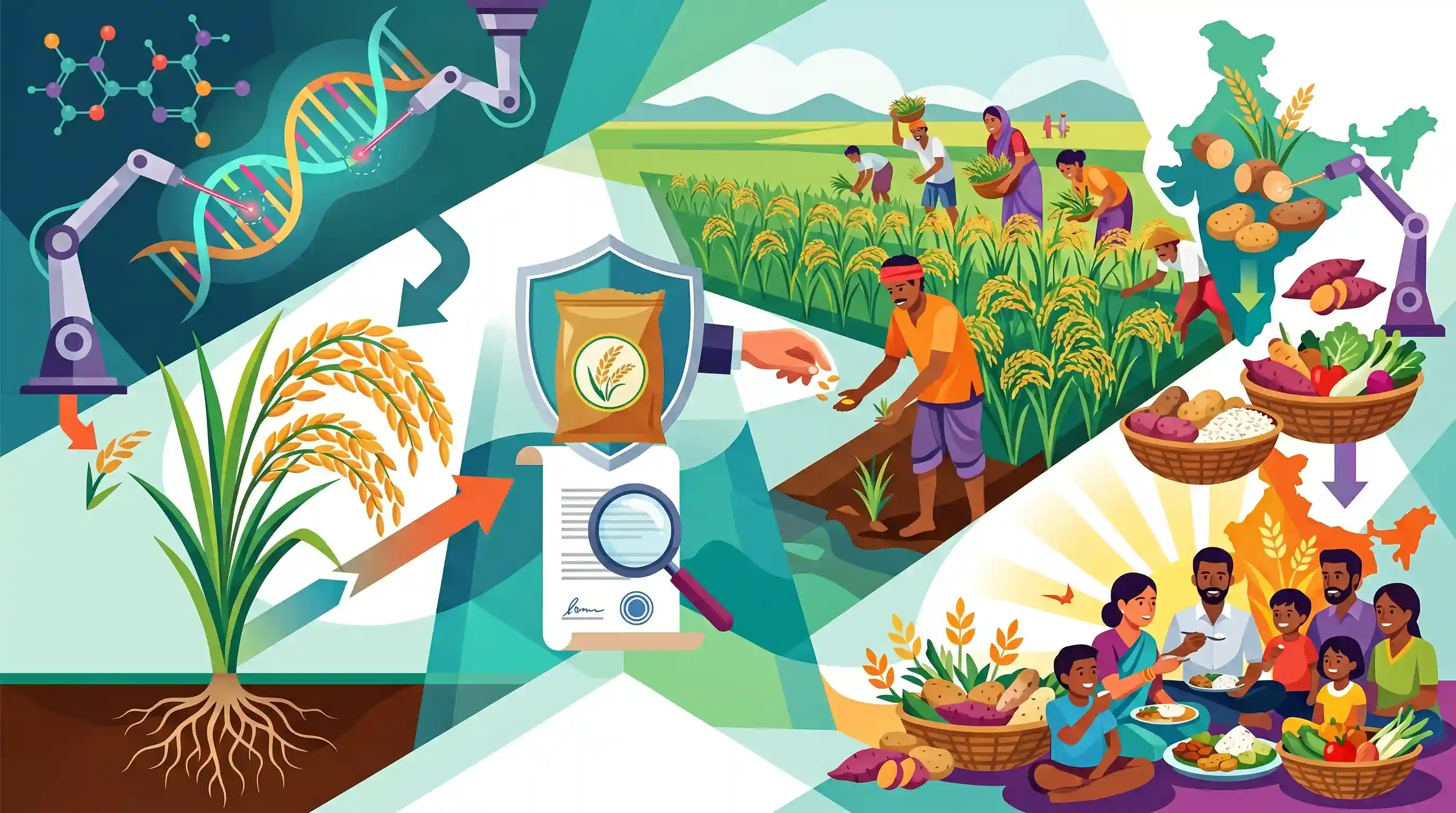
The development of 'Pusa DST Rice-1', India's first genome-edited rice variety by ICAR-IARI, represents a major milestone in agricultural biotechnology. Pending the completion of intellectual property procedures, the seed is slated to reach farmers within a year. Unlike conventional breeding, genome editing technologies such as CRISPR allow scientists to rapidly introduce targeted, desirable traits to crops to build resilience and enhance yields. Experts anticipate widespread cultivation of genome-edited crops within 5-6 years and note that extending this technology to tuber crops could play a crucial role in tackling malnutrition and ensuring holistic food and nutritional security in India.
Key Points
- 'Pusa DST Rice-1', India's first genome-edited rice variety developed by ICAR-IARI, is expected to reach farmers within a year after concluding intellectual property (IP) procedures.
- Genome editing enables scientists to add specific desirable traits (like drought/salinity tolerance) and overcome limitations of seeds much faster than conventional breeding.
- Large-scale commercial cultivation of various genome-edited agricultural crops is anticipated within the next five to six years.
- Experts emphasized the critical role of tuber crops in ensuring food and nutritional security, suggesting that genome editing could significantly boost their yield and quality to combat malnutrition.
Important Terms
Pusa DST Rice-1

India’s first genome-edited rice variety developed from MTU1010. It uses CRISPR-Cas9 technology to target the DST gene, providing enhanced drought and salinity tolerance without introducing any foreign DNA.
UPSC context
GS3: Science & Tech (Biotechnology) and Agriculture. Tests knowledge of climate-resilient crops and biotech applications in food security.
Genome Editing (CRISPR-Cas9)
A precise biotechnology tool used to modify specific segments of an organism's DNA. In India, SDN1 and SDN2 categories are exempt from strict GMO regulations because they do not introduce foreign genetic material.
UPSC context
GS3: Science & Technology. Essential for distinguishing between GE and GM crops and understanding India's biotechnology regulatory framework.
ICAR-IARI
India's premier national institute for agricultural research and education. Popularly known as the Pusa Institute, it led the Green Revolution and develops advanced high-yielding, disease-resistant crop varieties to ensure food security.
UPSC context
GS3: Agriculture and Food Security. Tests understanding of the institutional framework driving agricultural productivity and innovation in India.
ICAR-CTCRI
The world's only research organization dedicated exclusively to tropical tuber crops like cassava and sweet potato. It focuses on genetic improvement, sustainable production, and ensuring nutritional security through climate-resilient root crops.
UPSC context
GS3: Agriculture and Food Security. Important for discussions on crop diversification, malnutrition, and the role of tubers in sustainable systems.
ISRC (Indian Society for Root Crops)
A scientific society established in 1972 at ICAR-CTCRI. It promotes research and development of tropical root and tuber crops, fostering professional collaboration to enhance the socio-economic status of farming communities.
UPSC context
GS3: Agriculture. Relevant to institutional support for specialized crop research and the role of scientific societies in agricultural extension.
JNTBGRI
An autonomous Kerala-based institute specializing in the conservation and sustainable use of tropical plant resources. It maintains a massive living collection of rare, medicinal, and endemic plants from the Western Ghats.
UPSC context
GS3: Environment and Biodiversity. Tests knowledge of ex-situ conservation and the management of plant genetic resources in India.
Prelims Trap
Genome-edited crops like Pusa DST Rice-1 require GEAC approval prior to commercial cultivation.
SDN-1 and SDN-2 genome-edited crops lack foreign DNA and are exempt from GEAC clearance in India, needing only Institutional Biosafety Committee (IBSC) approval.
Static Concepts Connected
What are the three categories of Site-Directed Nuclease (SDN) technologies?
- SDN-1: Produces small genetic modifications (insertions/deletions) without introducing foreign DNA. Exempt from GEAC approval in India.
- SDN-2: Uses a small DNA template to induce specific edits, but no foreign DNA is ultimately retained. Also exempt from GEAC.
- SDN-3: Involves inserting foreign genes or large DNA sequences. Strictly regulated as Genetically Modified Organisms (GMOs) by the GEAC.
What is the mandate and statutory backing of the GEAC?
- Nodal Ministry: Functions under the Ministry of Environment, Forest and Climate Change (MoEFCC).
- Statutory Origin: Established under the Rules, 1989 of the Environment (Protection) Act, 1986.
- Core Mandate: Approves the large-scale use of hazardous recombinants and the environmental release of Genetically Modified (GM) crops.
Cross-Topic Patterns
IP Rights and Genome-Edited Seeds
Genome-edited varieties developed by public institutions (like ICAR) will test the limits of the Protection of Plant Varieties and Farmers' Rights (PPV&FR) Act, distinct from patent battles seen with private GM seeds.
CRISPR for Climate Resilient Agriculture
Pusa DST Rice-1 combats soil salinity, directly connecting modern biotechnology to India's climate-resilient agriculture goals (like NICRA) and the reclamation of alkaline soils.

Expect a 2026 Prelims question testing the difference in regulatory pathways between SDN-1/SDN-2 (genome-edited) and SDN-3 (transgenic).
Linked PYQs · 4
Linked PYQs · 4
- 2019PrelimsGS1
What is Cas9 protein that is often mentioned in news?
- 2019MainsGS3
How can biotechnology help to improve the living standards of farmers?
- 2024MainsGS3
What is the present world scenario of intellectual property rights with respect to life materials? Although, India is second in the world to file patents, still only a few have been commercialized. Explain the reasons behind this less commercialization.
- 2013MainsGS3
Food Security Bill is expected to eliminate hunger and malnutrition in India. Critically discuss various apprehensions in its effective implementation along with the concerns it has generated in WTO.
