Synthetic Biology Dual Use Technology Governance and Biosecurity
Source:The Hindu ↗
Why It Matters
Synthetic biology and genetic engineering are recurring themes in GS3 Science & Technology. Understanding the balance between scientific innovation (power) and dual-use security threats (peril) is crucial for both Mains answers on biotechnology and internal security (bioterrorism).
Summary
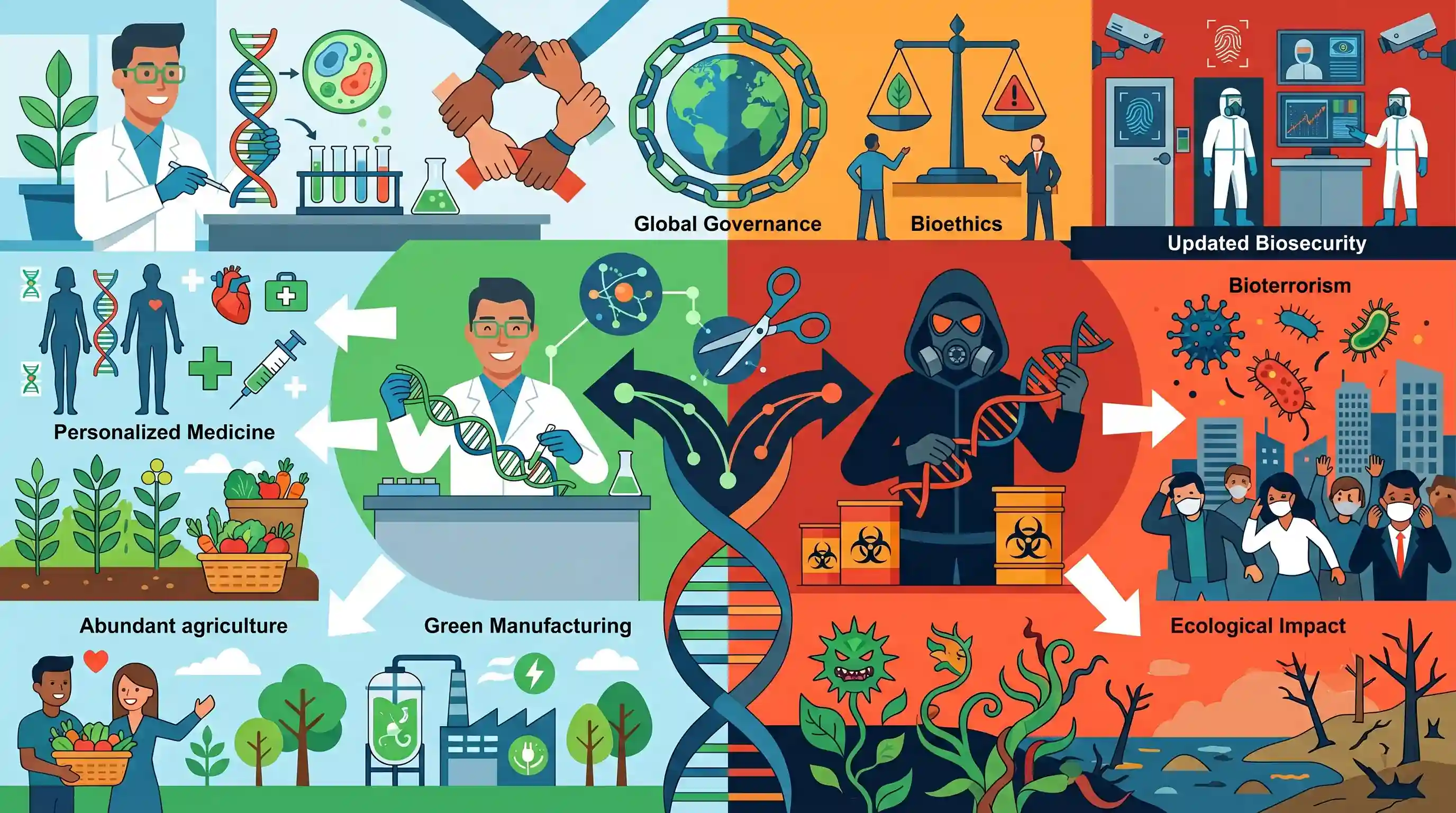
The article explores the dual-use nature of synthetic biology, highlighting both its revolutionary capabilities and its existential risks. While genetic engineering technologies like CRISPR promise breakthroughs in personalized medicine, agriculture, and sustainable manufacturing, they also pose severe threats if misused. The 'democratization' of biotechnology increases the risk of bioterrorism through engineered pathogens and poses unpredictable environmental hazards. The piece emphasizes the urgent need for robust global governance, ethical scientific frameworks, and updated biosecurity measures to safely harness the power of synthetic biology without succumbing to its perils.
Key Points
- Synthetic biology combines biology and engineering to design and construct new biological entities, offering unprecedented control over genetic material.
- The 'power' of the technology lies in its applications for targeted healthcare (such as CRISPR and CAR-T cell therapy), climate-resilient agriculture, and sustainable bio-manufacturing.
- The 'peril' is defined by the dual-use nature of genetic engineering, raising severe concerns about bioterrorism and the creation of engineered pathogens.
- Unintended ecological consequences remain a major risk if synthetic organisms escape or are intentionally released into natural ecosystems.
- Addressing these challenges requires stringent global governance, robust lab biosecurity protocols, and bio-ethical frameworks to prevent misuse while fostering innovation.
Important Terms
Synthetic Biology

An interdisciplinary field of science involving the redesign of organisms by engineering them with new abilities, such as stitching together DNA sequences to create novel biological systems.
UPSC context
GS Paper 3 (Biotechnology); essential for discussing advancements in healthcare, biofuels, and sustainable agriculture alongside regulatory challenges.
Biological Weapons Convention (BWC)
The first multilateral disarmament treaty to ban an entire category of Weapons of Mass Destruction (WMD), prohibiting the development, production, acquisition, and stockpiling of biological and toxin weapons.
UPSC context
GS Paper 2 (International Treaties) and GS Paper 3 (Security); key for global disarmament and biosecurity governance.
CRISPR-Cas9
A precise gene-editing tool using the Cas9 enzyme as 'molecular scissors' and a guide RNA to add, remove, or alter DNA sequences within a genome.
UPSC context
GS Paper 3 (Science & Technology); frequently tested in Prelims and Mains regarding genetic engineering breakthroughs and ethical dilemmas.
Dual-Use Technology
The 'dual-use dilemma' refers to technologies, materials, or knowledge designed for legitimate civilian benefits (e.g., vaccine development) that can be repurposed for military or malicious use.
UPSC context
GS Paper 3 (Security and Science & Tech); critical for analyzing export control regimes and the ethics of scientific innovation.
Bioterrorism
The intentional release of viruses, bacteria, or other germs to cause illness or death in people, animals, or plants, often enhanced by modern biotechnology.
UPSC context
GS Paper 3 (Internal Security); involves unconventional threats and India's national biosecurity architecture.
Bioethics
A branch of ethics that examines the moral, social, and legal implications of advances in biology and medicine, balancing scientific progress with human dignity.
UPSC context
GS Paper 4 (Ethics) and GS Paper 3; relevant for evaluating 'designer babies,' GMOs, and human experimentation.
Prelims Trap
Gene drive technology relies on standard Mendelian inheritance to spread traits in wild populations.
Gene drives actively override Mendelian inheritance (50% chance) to push a modified trait's inheritance rate close to 100%, forcing it through a population rapidly.
Static Concepts Connected
How do CRISPR-Cas9 and Gene Drive technologies function?
- CRISPR-Cas9: Acts as molecular scissors (endonuclease) guided by RNA to cut DNA at targeted locations, allowing precise addition or deletion of genetic material.
- Gene Drives: A genetic engineering technique that ensures a modified gene is inherited by nearly all offspring, rapidly spreading a specific trait through a species.
- Ecological Application: Highly effective for controlling vector-borne diseases (e.g., rendering mosquitoes sterile), but poses severe unintended ecological risks if introduced to wild ecosystems.
What are the key features of the Biological Weapons Convention (BWC)?
- Scope & Mandate: First multilateral disarmament treaty (1975) banning an entire category of WMDs by prohibiting the development, production, and stockpiling of biological agents.
- Verification Gap: Unlike the Chemical Weapons Convention (CWC), the BWC critically lacks a formal, institutionalized verification or inspection mechanism to ensure compliance.
- India's Stance: India has ratified the convention and actively advocates for a comprehensive, legally binding protocol to strengthen the treaty's implementation.
Cross-Topic Patterns
Dual-use tech and asymmetric warfare
The democratization of DIY CRISPR kits makes bioterrorism a credible internal security threat. Expect questions linking loose biotech regulations to asymmetric warfare and non-state actors.
Engineered extinction vs Ecological conservation
Gene drives overriding natural selection pose unprecedented threats to local food webs. UPSC frequently links genetic intervention tools to biodiversity loss and the Environment Protection Act.

Expect a 2026 multi-statement question contrasting synthetic biology, CAR-T, and CRISPR, alongside the ecological risks of gene drives.
Linked PYQs · 4
Linked PYQs · 4
- 2019PrelimsGS1
What is Cas9 protein that is often mentioned in news?
- 2021MainsGS3
What are the research and developmental achievements in applied biotechnology? How will these achievements help to uplift the poorer sections of the society?
- 2019MainsGS3
How can biotechnology help to improve the living standards of farmers?
- 2019PrelimsGS1
With reference to the recent developments in science, which one of the following statements is not correct?
