Youth Unrest and Political Instability in Nepal
Source:The Hindu ↗
Why It Matters
Understanding Nepal's internal political instability is crucial for UPSC aspirants as it directly impacts India's Neighborhood First Policy, border security, and regional stability in South Asia. Furthermore, the theme of demographic dividend turning into a disaster due to unemployment is highly relevant to India's own socio-economic landscape.
Summary
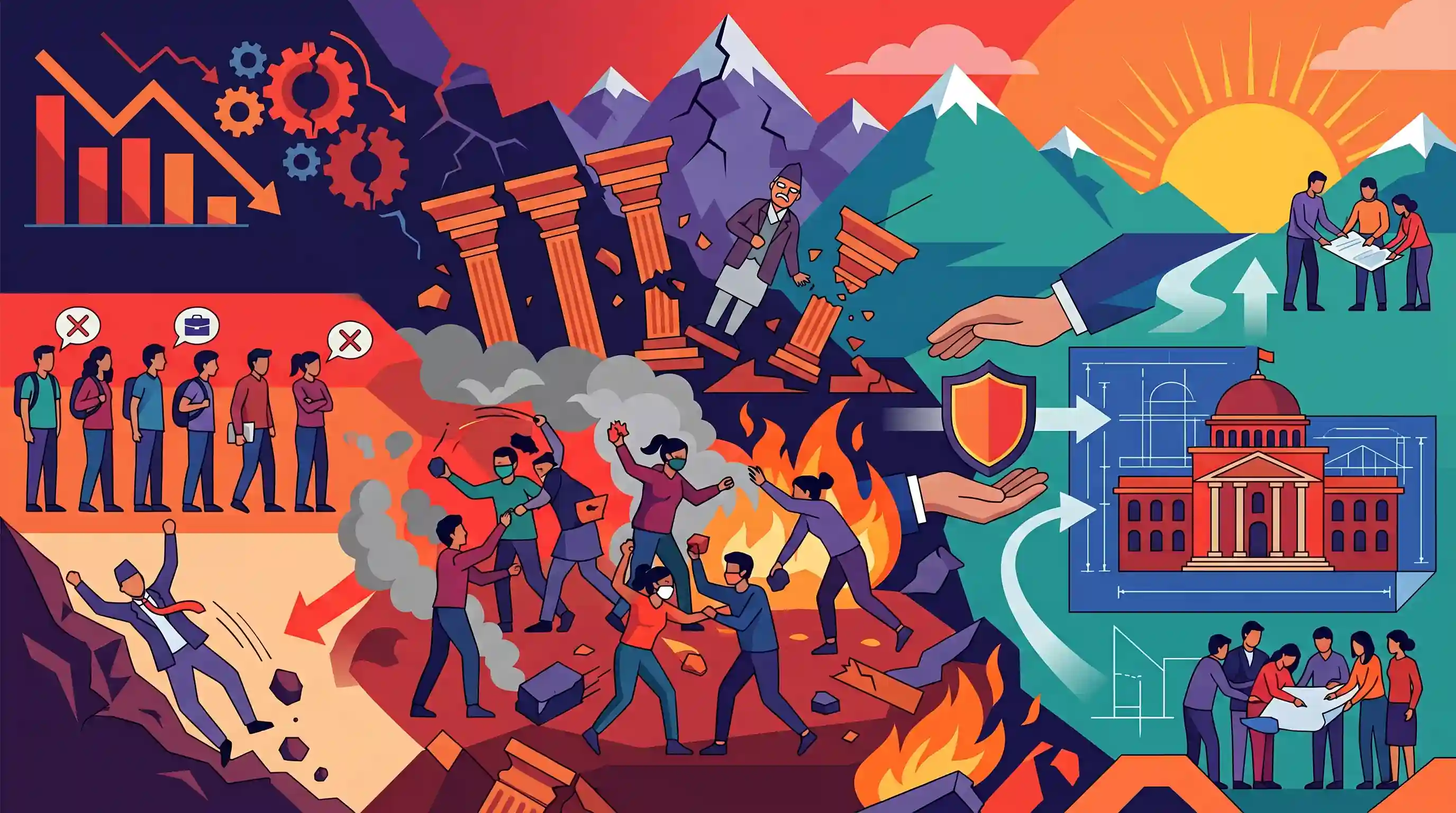
The editorial examines the violent political upheaval in Nepal, driven by a disillusioned 'Gen Z' reacting to decades of chronic instability, soaring youth unemployment, and economic mismanagement. It warns that while the traditional political class has failed, abandoning democratic norms for violent nihilism risks severe democratic backsliding. The piece advocates for immediate stabilization and long-term constitutional reforms, such as a presidential system, to break the cycle of dysfunction and secure a stable future for Nepal.
Key Points
- Violent 'Gen Z' protests have erupted in Nepal due to deep frustration over chronic political dysfunction, economic stagnation, and soaring youth unemployment.
- The traditional political establishment has failed to deliver stability, with Nepal witnessing 13 heads of government across 30 tenures since the 1990s.
- Economic challenges, including a heavy reliance on remittances and high youth out-migration, have severely stunted development and fueled disillusionment.
- New political forces have emerged, but calls by some leaders to unconstitutionally dissolve Parliament raise fears of democratic backsliding, similar to recent events in Bangladesh.
- The editorial suggests that achieving a stable 'Naya Nepal' requires immediate peace facilitated by the Nepali Army and long-term constitutional reforms, such as a shift to a presidential system with direct elections.
Important Terms
Jan Andolan II

The 2006 mass uprising that ended King Gyanendra’s absolute rule, resulting in the abolition of the monarchy and Nepal’s transition into a federal democratic republic.
UPSC context
GS Paper II: International Relations. Vital for understanding Nepal’s democratic evolution and constitutional history.
Rashtriya Swatantra Party (RSP)
A centrist Nepalese party founded in 2022; it represents a youth-led 'alternative politics' movement that displaced traditional parties in the 2026 elections following widespread protests.
UPSC context
GS Paper II: Neighborhood relations. Analyzes the impact of youth-driven political shifts on regional stability.
Nepali Congress
Nepal’s oldest democratic party, historically central to anti-monarchy movements and the 2006 peace process, but recently criticized as part of the failed traditional establishment.
UPSC context
GS Paper II: International Relations. Essential for tracking traditional power structures and democratic transitions in Nepal.
CPN-Maoist Centre
A major political party led by Pushpa Kamal Dahal, formed from former Maoist insurgents who transitioned to mainstream politics following the 2006 Comprehensive Peace Agreement.
UPSC context
GS Paper II: Security and Neighborhood relations. Tests knowledge of the insurgency-to-democracy transition in South Asia.
CPN-UML
One of Nepal’s two major communist factions, historically a dominant player in coalition governments and a key rival to the Nepali Congress and Maoists.
UPSC context
GS Paper II: Neighborhood relations. Important for studying ideological shifts and political volatility in India’s periphery.
Directly Elected Executive
A proposed constitutional reform to replace the current parliamentary system with a presidential-style leader elected by citizens, intended to ensure government stability and accountability.
UPSC context
GS Paper II: Governance and Constitution. Relevant for comparative study of executive systems and administrative reforms.
Prelims Trap
Nepal currently operates under a Presidential system of government.
Nepal is actually a federal parliamentary republic. The article notes that political forces are merely advocating for a shift to a presidential system to cure instability.
Static Concepts Connected
Why do politically unstable nations often debate switching to a Presidential system?
- Direct Mandate: The executive head is elected directly, avoiding the fragility of shifting coalition politics and hung parliaments.
- Fixed Tenure: Unlike a Prime Minister dependent on a legislative majority, a President has a fixed term, ensuring stability and policy continuity.
- Separation of Powers: Stricter separation allows the executive to function independently of legislative gridlock and daily parliamentary disruptions.
How does heavy reliance on remittances stunt domestic economic development?
- Labor Shortages: Mass out-migration of working-age youth drains domestic talent, leading to agricultural decline and low domestic labor productivity.
- Currency Appreciation: High remittance inflows can artificially inflate the local currency's value, making domestic exports uncompetitive globally (Dutch Disease).
- Consumption over Investment: Remittances typically fund daily household consumption rather than long-term capital formation, industrialization, or infrastructure development.
Cross-Topic Patterns
Regional instability: Nepal and Bangladesh parallels
Both nations are witnessing youth-led ('Gen Z') anti-establishment protests targeting economic stagnation, raising regional security concerns for India's Neighborhood First policy.
Demographic dividend turning into a destabilizer
Nepal's crisis exemplifies how a youth bulge without commensurate job creation shifts a demographic dividend into demographic disaster, fuelling violent political nihilism.

Expect a GS-2 mains question comparing parliamentary fragilities of South Asian neighbors with India's safeguards against instability.
Linked PYQs · 2
Linked PYQs · 2
- 2012MainsGS2
Discuss the contentious issues that have caused the prolonged constitutional logjam in Nepal.
- 2014MainsGS3
While we flaunt India's demographic dividend, we ignore the dropping rates of employability. What are we missing while doing so? Where will the jobs that India desperately needs come from? Explain.
