Gender Disparities and Caregiving Gaps in Indian Research Funding
Source:The Hindu ↗
Why It Matters
Understanding the intersection of social justice, legal rights (maternity benefits), and research funding is crucial for UPSC aspirants. It highlights the practical barriers to women's empowerment in STEM and touches upon governance issues related to policy formulation (ANRF) and gender budgeting.
Summary
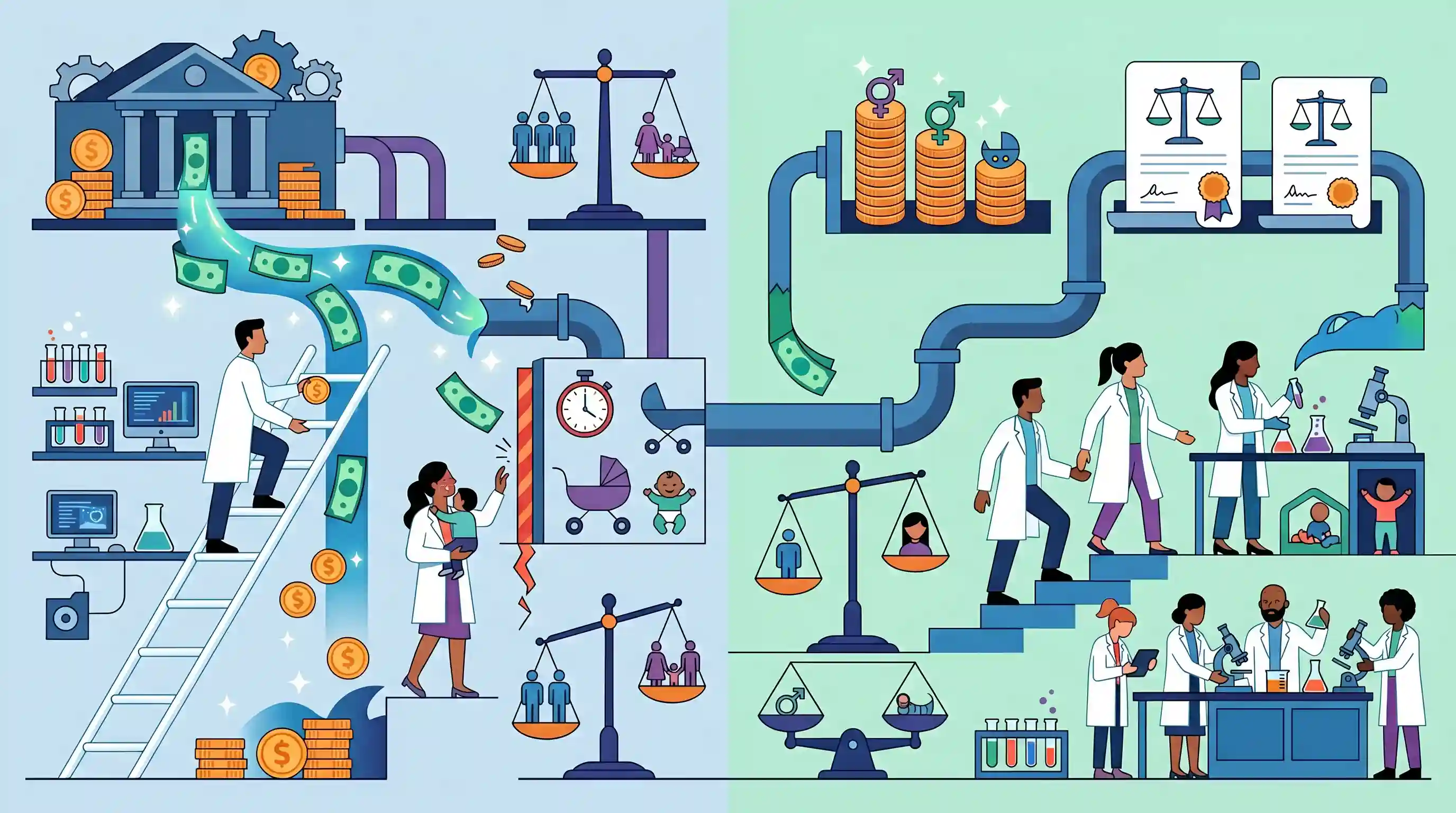
The article highlights the systemic gender disparities in Indian research funding, particularly concerning the lack of provisions for caregiving and maternity leave. Despite broader legislative frameworks like the Maternity Benefit Act, primary research funding bodies such as the DST and the newly formed Anusandhan National Research Foundation (ANRF) often fail to integrate these protections into their grant conditions. This oversight exacerbates the "leaky pipeline" in STEM, where women drop out of academia due to the disproportionate burden of caregiving. The author argues for structural reforms, including gender-responsive budgeting and explicit legal mandates within research grants, to support women researchers and ensure gender parity in India's scientific ecosystem.
Key Points
- Women researchers in India face significant challenges in securing and utilizing research funding due to the disproportionate burden of caregiving and a lack of supportive policies in grants.
- Major funding bodies like the Science and Engineering Research Board (SERB) and the upcoming Anusandhan National Research Foundation (ANRF) lack explicit guidelines for maternity or childcare leave in their grant policies.
- The absence of caregiving support in research funding acts as a systemic barrier, directly impacting gender parity in STEM (Science, Technology, Engineering, and Mathematics) fields in India.
- Incorporating gender-responsive budgeting and legally mandated maternity benefits within research funding frameworks is essential to empower women scientists and retain them in academia.
Important Terms
Anusandhan National Research Foundation (ANRF)

Statutory apex body established in 2023 to provide strategic direction for scientific research in India, replacing SERB and emphasizing industry-academia collaboration.
UPSC context
GS III: Science & Technology. Tests understanding of research governance, funding mechanisms, and private sector R&D integration.
Maternity Benefit Act
Social security law regulating women's employment during pregnancy; its 2017 amendment increased paid leave to 26 weeks and mandated creche facilities.
UPSC context
GS II: Social Justice/Welfare. Tests knowledge of labor laws and structural barriers to women's workforce participation.
Gender-responsive budgeting
Fiscal strategy integrating a gender perspective into the budgetary process to ensure public resources address disparities and promote women's empowerment.
UPSC context
GS III: Economy/GS I: Social Issues. Evaluates understanding of tools for inclusive fiscal policy and gender mainstreaming.
Leaky pipeline in STEM
Metaphor describing the systematic loss of women at successive career stages in STEM despite high initial educational attainment.
UPSC context
GS I: Social Issues/GS III: S&T. Analyzes socio-structural challenges preventing women-led development in research.
Science and Engineering Research Board (SERB)
Statutory body established in 2008 (now subsumed into ANRF) to fund basic research and support women through initiatives like SERB-POWER.
UPSC context
GS III: Science & Technology. Relevant for historical context of research funding and gender-specific scientific schemes.
Department of Science and Technology (DST)
Nodal department under the Ministry of Science and Technology (est. 1971) responsible for formulating S&T policies and coordinating national research.
UPSC context
GS III: S&T/Governance. Tests knowledge of the institutional framework for scientific development and policy.
Prelims Trap
The Anusandhan National Research Foundation (ANRF) functions alongside the Science and Engineering Research Board (SERB) to fund STEM research.
False. The ANRF Act 2023 repealed the SERB Act 2008 and subsumed SERB into the newly created ANRF, meaning SERB no longer exists independently.
Static Concepts Connected
What are the key features of the Anusandhan National Research Foundation (ANRF)?
- Statutory Body: Established under the ANRF Act 2023, replacing and subsuming the Science and Engineering Research Board (SERB).
- Leadership Structure: The Prime Minister is the ex-officio President of the Governing Board; the Principal Scientific Adviser chairs the Executive Council.
- Funding Model: Estimated ₹50,000 crore over five years, with ~70% expected to be raised from private and non-government sources.
How is Gender Responsive Budgeting (GRB) structured in India?
- Origin: Introduced in the Union Budget in 2005-06 to ensure resource allocation actively addresses systemic gender disparities.
- Part A: Contains schemes with 100% allocation exclusively for women (e.g., POSHAN Abhiyaan, Nirbhaya Fund).
- Part B: Contains schemes where at least 30% of the total allocation is earmarked for women (e.g., MGNREGS, Samagra Shiksha).
Cross-Topic Patterns
Leaky pipeline and Demographic Dividend
The "leaky pipeline" in STEM directly undercuts India's demographic dividend by artificially suppressing female labor force participation (FLFP) in high-value, innovation-driven sectors.
Maternity benefits beyond formal employment
Just like gig workers, research scholars on fellowships fall into a legal gray area where the Maternity Benefit Act's employer-employee mandate fails to protect them.

Expect a multi-statement question interlinking the ANRF's statutory structure with specific schemes for women in STEM like WISE-KIRAN.
Linked PYQs · 4
Linked PYQs · 4
- 2024MainsGS1
Distinguish between gender equality, gender equity and women's empowerment. Why is it important to take gender concerns into account in programme design and implementation?
- 2020MainsGS2
In order to enhance the prospects of social development, sound and adequate health care policies are needed particularly in the fields of geriatric and maternal health care. Discuss.
- 2019PrelimsGS1
Which of the following statements is/are correct regarding the Maternity Benefit (Amendment) Act, 2017? 1. Pregnant women are entitled for three months pre-delivery and three months post-delivery paid leave. 2. Enterprises with crèches must allow the mother minimum six crèche visits daily. 3. Women with two children get reduced entitlements. Select the correct answer using the code given below.
- 2016MainsGS3
Women empowerment in India needs gender budgeting. What are the requirements and status of gender budgeting in the Indian context?
