Legal Definitions of Biological Sex and Transgender Rights in UK Law
Source:The Hindu ↗
Why It Matters
It provides international legal context to the evolving debate around gender identity versus biological sex, directly tying into UPSC syllabus themes of gender justice, fundamental rights, and the welfare of marginalized communities (like the transgender community). It is highly relevant for comparative constitutional perspectives in GS Paper 2 and societal issues in GS Paper 1.
Summary
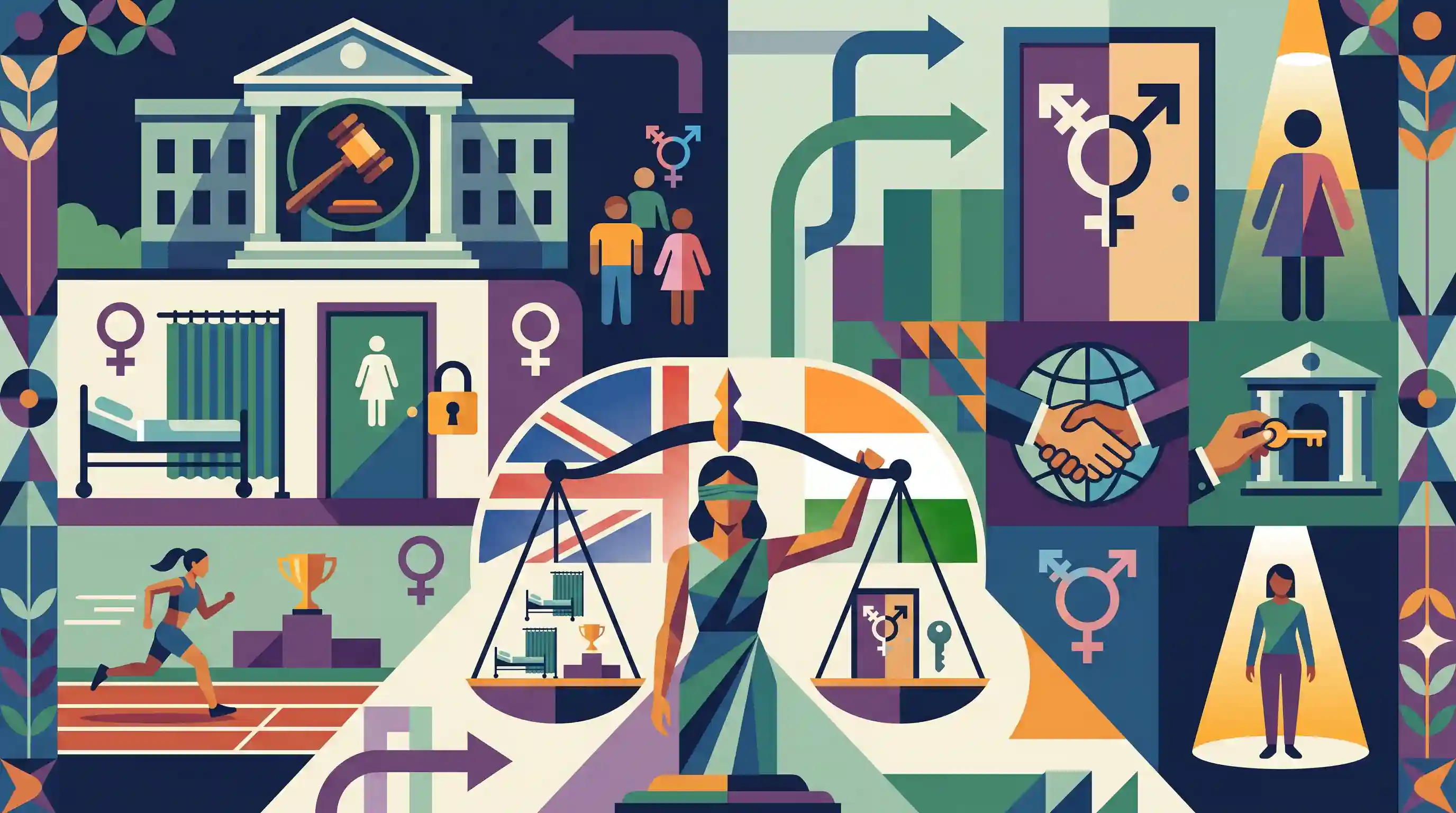
The UK Supreme Court recently ruled that the term "woman" under Britain's Equality Act 2010 refers solely to biological women, excluding transwomen. This landmark decision clarifies that biological women retain exclusive access to single-sex spaces (e.g., toilets, hospital wards) and women-only sports, addressing safety and fairness concerns raised by gender-critical groups. However, the ruling also underscores the critical necessity of establishing unisex or gender-neutral facilities so that trans individuals are not denied basic human rights and access to public spaces. From a UPSC perspective, this development offers a vital comparative lens on gender jurisprudence, highlighting the delicate balance between protecting women's rights and ensuring social justice for transgender communities, a theme relevant to India's implementation of the Transgender Persons (Protection of Rights) Act, 2019.
Key Points
- The UK Supreme Court ruled that the definition of a "woman" under Britain's Equality Act 2010 refers strictly to biological women and excludes transwomen, even those with gender recognition certificates.
- This decision resolves ongoing tensions between transgender rights supporters and gender-critical groups, partly fueled by previous controversies involving trans women in female-only spaces.
- The ruling permits the reservation of single-sex spaces—such as changing rooms, toilets, hospital wards, and women-only sports categories—exclusively for biological women.
- Authorities emphasize that while safeguarding biological women's spaces, the state must concurrently establish adequate unisex and gender-neutral facilities to protect the basic human rights and dignity of trans people.
- For India, this international legal precedent highlights the ongoing complexities of implementing the Transgender Persons (Protection of Rights) Act, 2019, emphasizing the need to balance competing gender rights without marginalizing vulnerable communities.
Important Terms
Equality Act 2010 (UK)

A UK law consolidating anti-discrimination measures across nine 'protected characteristics,' including sex and gender reassignment, recently interpreted by the Supreme Court to define 'sex' as biological sex.
UPSC context
GS Paper II (Comparative Constitutions/Polity). It illustrates how different democracies balance competing rights of vulnerable groups through statutory interpretation.
Transgender Persons (Protection of Rights) Act, 2019 (India)
An Indian legislation providing legal recognition to transgender persons, prohibiting discrimination in education and employment, and establishing the National Council for Transgender Persons (NCTP).
UPSC context
GS Paper II (Welfare schemes for vulnerable sections). Tests knowledge of India's legislative framework for gender-diverse communities and social justice.
NALSA Judgment (2014)
The landmark Indian Supreme Court ruling that recognized transgender persons as a 'third gender' and affirmed the right to self-perceived gender identity under the Constitution.
UPSC context
GS Paper II (Judiciary/Fundamental Rights). A foundational case for gender identity rights, essential for discussing Article 14, 15, and 21.
For Women Scotland
A UK gender-critical advocacy group that successfully challenged the Scottish Government's definition of 'woman,' leading to the Supreme Court's 'biological sex' ruling.
UPSC context
GS Paper II (Polity). Demonstrates the role of civil society and pressure groups in shaping legal interpretations of gender and equality.
Equality and Human Rights Commission (EHRC)
A UK-based statutory body that monitors human rights and enforces the Equality Act 2010, responsible for issuing guidance on single-sex spaces post-ruling.
UPSC context
GS Paper II (Statutory Bodies). Useful for comparing international human rights monitoring mechanisms with India's NHRC or NCTP.
Gender Recognition Certificate (GRC)
A document in the UK that allows a person to change their legal gender; however, the 2025 ruling clarifies this does not change their 'sex' under the Equality Act.
UPSC context
GS Paper II (Social Justice). Relevant for discussing the difference between 'legal' and 'biological' status in international rights frameworks.
Prelims Trap
"The Transgender Persons Act 2019 mandates sex reassignment surgery to be legally recognized as transgender in India."
India's 2019 Act recognizes self-perceived identity without medical intervention. Surgery is only required if applying for a revised certificate to change gender specifically to "male" or "female".
Static Concepts Connected
What were the landmark mandates of the NALSA v. Union of India (2014) judgment?
- Third Gender: Legally recognized transgender individuals as a distinct "third gender" for constitutional rights and protections.
- Self-Identification: Upheld the right to self-perceived gender identity without the prerequisite of medical intervention or sex reassignment surgery.
- Affirmative Action: Directed the government to treat transgender persons as socially and educationally backward classes for extending reservation benefits.
How does the Transgender Persons (Protection of Rights) Act, 2019 operationalize gender identity?
- Certificate of Identity: Issued by the District Magistrate based on a person's self-declared identity, without requiring medical proof.
- Anti-Discrimination: Prohibits unfair treatment in education, employment, healthcare, and access to public goods and facilities.
- Revised Certificate: To change the certificate strictly to "male" or "female", proof of medical intervention (surgery) must be provided to the Magistrate.
Cross-Topic Patterns
Competing Rights under Articles 14 & 15
The UK ruling highlights a classic rights-based dilemma: where expanding inclusive rights for one marginalized group (trans individuals) creates friction with the protective affirmative-action spaces of another (biological women).
Sports ethics and biological determinism
Debates around biological determinism directly intersect with global sporting federations (like World Athletics) revising rules to exclude trans women from female categories to ensure competitive fairness.

Expect GS2 to contrast India's NALSA self-identification framework with Western judicial shifts towards biological determinism in gender spaces.
Linked PYQs · 3
Linked PYQs · 3
- 2023MainsGS2
Explain the constitutional perspectives of Gender Justice with the help of relevant Constitutional Provisions and case laws.
- 2024MainsGS1
Despite comprehensive policies for equity and social justice, underprivileged sections are not yet getting the full benefits of affirmative action envisaged by the Constitution. Comment.
- 2024MainsGS1
Distinguish between gender equality, gender equity and women's empowerment. Why is it important to take gender concerns into account in programme design and implementation?
