Gen Z Demands for Mental Health Urge Overhaul of Education System
Source:The Hindu ↗
Why It Matters
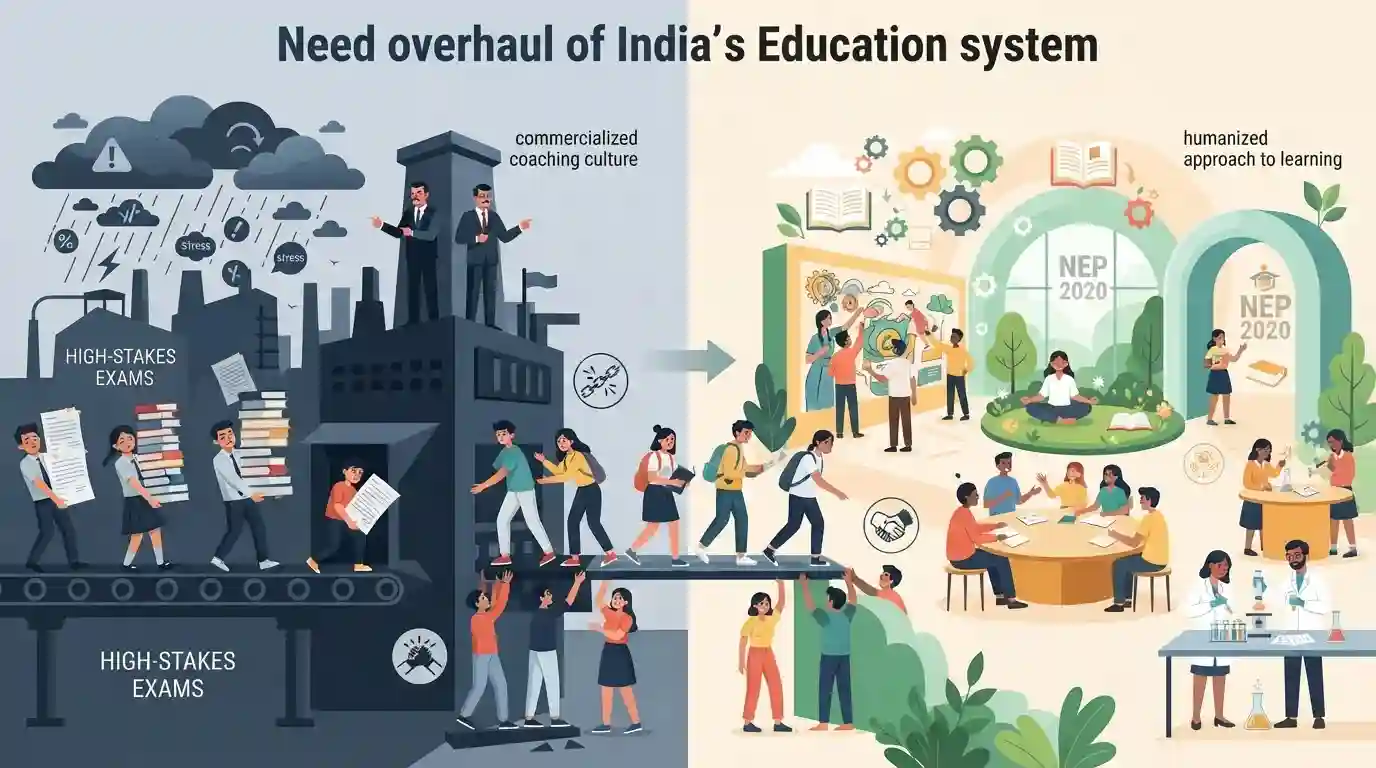
The mental health crisis among students and the need for educational reform are pressing social and governance issues in India. The nation's demographic dividend can only be realized if the youth are mentally resilient, empathetic, and holistically educated, rather than burned out by a hyper-competitive and transactional education system.
Summary
The article argues for an urgent overhaul of India's hyper-competitive and stressful education system, driven by Generation Z's vocal demands for mental health prioritization and a humane approach to learning. It highlights the detrimental impact of a commercialized coaching culture and high-stakes examinations on students' psychological well-being. By questioning toxic productivity and relentless societal pressure, Gen Z is advocating for a pedagogical shift towards holistic development and empathy in educational institutions. Realizing the vision of the National Education Policy (NEP) 2020 requires robust mental health infrastructure, regulation of the coaching industry, and a societal paradigm shift to treat students as human beings rather than mere academic commodities.
Key Points
- Generation Z is actively challenging toxic productivity and the traditional 'grind culture', demanding a greater focus on mental health and work-life balance over purely academic outcomes.
- India's hyper-competitive education system, defined by high-stakes exams and commercial coaching hubs, has led to severe mental health crises, burnout, and tragic student suicides.
- A 'humane education system' is necessary to replace rote-learning and rank-chasing with holistic learning that fosters critical thinking, creativity, empathy, and emotional intelligence.
- Systemic reforms must include the pedagogical shifts outlined in NEP 2020, mandatory professional psychological counseling in educational institutions, and strict regulation of the coaching industry.
- There is an urgent need for parents, educators, and society to view children not as investments for social mobility, but as individuals whose agency and well-being must be nurtured.
Important Terms
National Education Policy (NEP) 2020

A comprehensive framework launched to reform India's school and higher education systems, introducing a flexible 5+3+3+4 structure, multidisciplinary curricula, and targeting a public investment of 6% of GDP in education.
UPSC context
GS Paper II (Social Sector/Education); tests understanding of educational governance reforms, curriculum restructuring, and human resource development policies.
Coaching Institutes
Private centers offering commercialized academic and entrance prep, subject to the Ministry of Education's 2024 guidelines that restrict enrolling students under 16 and mandate strict mental health and safety safeguards.
UPSC context
GS Paper II (Government Interventions) and GS Paper IV (Ethics); tests comprehension of educational commercialization, consumer protection, and student welfare regulation.
NEET (National Eligibility cum Entrance Test)
A high-stakes, centralized national exam in India conducted by the National Testing Agency (NTA) for admissions to undergraduate medical and dental programs in all recognized institutions.
UPSC context
GS Paper II (Education/Social Sector); tests issues concerning federalism in education, standardized testing controversies, and student psychological stress.
JEE (Joint Entrance Examination)
A highly competitive, two-tier national engineering entrance test in India determining admissions to premier technical colleges, including the Indian Institutes of Technology (IITs) and National Institutes of Technology (NITs).
UPSC context
GS Paper II (Human Resources/Education); evaluates challenges in high-stakes testing ecosystems, dummy schools, and student developmental issues.
UPSC (Union Public Service Commission)
An independent constitutional body established under Articles 315–323 of the Indian Constitution, responsible for merit-based recruitment to the All India Services and Central Civil Services (Group A and B).
UPSC context
GS Paper II (Constitutional Bodies); tests administrative framework, recruitment neutrality, and provisions governing public service commissions in India.
Prelims Trap
"The Manodarpan initiative is a national mental health scheme launched by the Ministry of Health and Family Welfare."
Manodarpan is an initiative of the Ministry of Education, whereas the Tele-MANAS programme is spearheaded by the Ministry of Health and Family Welfare.
Static Concepts Connected
How does NEP 2020 propose to reform the school assessment system?
- Formative Shift: Moves away from high-stakes summative, rote-learning assessments toward continuous, regular formative evaluations.
- 360-Degree Card: Introduces a holistic, multidimensional report card reflecting a student's cognitive, affective, and psychomotor progress.
- PARAKH Establishment: Creates a National Assessment Centre (PARAKH) to set norms, standards, and guidelines for student assessment across boards.
What is the role of educational institutions in value inculcation?
- Character Building: Moves beyond mere academic instruction to develop emotional intelligence, critical thinking, and a robust civic sense.
- Socialization: Acts as a vital secondary socializing agent, teaching peer collaboration, empathy, inclusivity, and tolerance.
- Ethical Modeling: Teachers and healthy institutional environments serve as role models, passively embedding values of integrity, fairness, and compassion.
Cross-Topic Patterns
Mental health as an economic variable
Rising youth suicides directly undermine India's Demographic Dividend, linking systemic educational stress (GS2) to long-term human capital erosion and macroeconomic productivity (GS3).
Toxic productivity vs. Virtue Ethics
Gen Z's pushback against 'grind culture' highlights a shift from utilitarian academic milestones to virtue ethics, emphasizing empathy, emotional intelligence, and well-being in institutions (GS4).

Mains 2026 GS2/GS4: Expect a question linking coaching commercialization, youth mental health crises, and the regulatory mandate of NEP 2020.
Linked PYQs · 4
Linked PYQs · 4
- 2016MainsGS2
Demographic Dividend in India will remain only theoretical unless our manpower becomes more educated, aware, skilled and creative." What measures have been taken by the government to enhance the capacity of our population to be more productive and employable?
- 2023MainsGS2
The crucial aspect of development process has been the inadequate attention paid to Human Resource Development in India. Suggest measures that can address this inadequacy.
- 2023MainsGS1
Explain why suicide among young women is increasing in Indian society.
- 2020MainsGS4
Discuss the role of ethics and values in enhancing the following three major components of Comprehensive National Power (CNP) viz. human capital, soft power (culture and policies) and social harmony.
