UP deploys young civil servants to mentor Gen Z school students
Source:uniindia ↗
Why It Matters
Illustrates an innovative governance and public service delivery approach in Uttar Pradesh, highlighting how the civil service can directly engage in human resource development and youth empowerment. Useful as a case study for GS2 (Governance/Role of Civil Services) and UP Special papers.
Summary
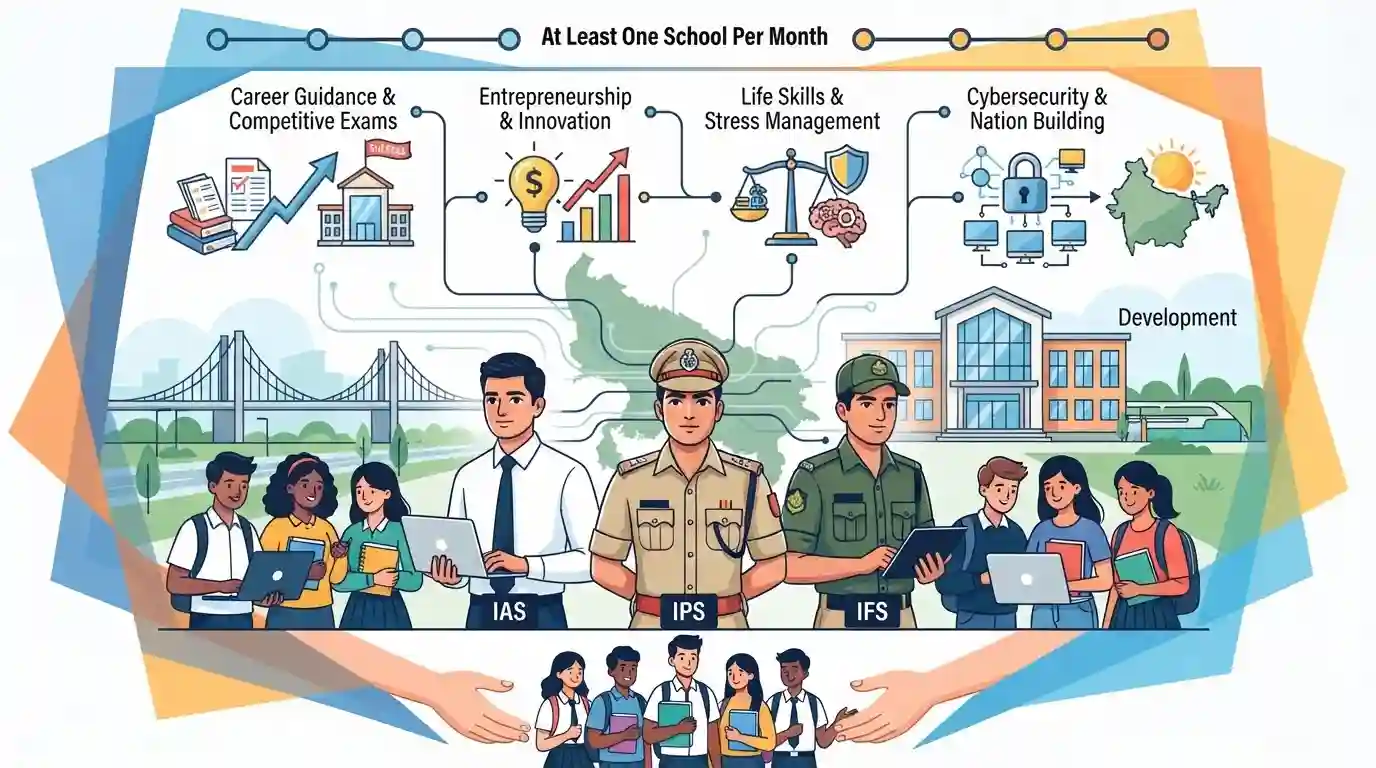
The Uttar Pradesh government has launched an interactive initiative utilizing young IAS, IPS, and IFS officers to engage with "Gen Z" students at intermediate-level schools. The program mandates these civil servants to visit at least one school per month to provide mentorship on career opportunities, competitive exam preparation, entrepreneurship, and life skills like stress management and cybersecurity. Administered under the oversight of District Magistrates and the Secondary Education Department, the initiative aims to guide the state's youth, resolve their career-related anxieties, and positively channel their potential toward nation-building and public service.
Key Points
- The UP government has directed young IAS, IPS, and IFS officers to visit at least one intermediate-level school monthly to mentor Gen Z students.
- Interactive sessions will replace formal lectures to guide students on career planning, higher education, entrepreneurship, and competitive exams (UPSC, UPPSC, JEE, NEET, etc.).
- The program covers life skills and social issues such as cybersecurity, financial literacy, stress management, and drug de-addiction.
- District Magistrates are responsible for implementing the program, preparing a monthly calendar, and reporting to the Secondary Education Department.
- The initiative seeks to channel the state's demographic dividend, build self-confidence among youth, and foster a positive attitude towards public service and governance.
Important Terms
Uttar Pradesh Government

The state executive body responsible for sub-national governance, policy formulation, and welfare in Uttar Pradesh. It actively initiates programs like civil service youth mentorship to channel student potential toward nation-building.
UPSC context
GS Paper 2 (Government Policies). Evaluates state-level interventions for social sector development and human resource capacity building.
Secondary Education Department
A state administrative body overseeing intermediate-level education. It coordinates logistics and school administration, functioning as a vital link between educational institutions and visiting civil servants for youth mentorship programs.
UPSC context
GS Paper 2 (Issues Relating to Education). Important for understanding the institutional framework managing human resources and schooling.
Rashtriya Swayamsevak Sangh (RSS)
A prominent socio-cultural volunteer organization in India. It often acts as an influential non-state actor whose leadership perspectives can impact public policy and social outreach initiatives adopted by governments.
UPSC context
GS Paper 2 (Role of Civil Society). Illustrates how socio-cultural organizations influence governance, public policy, and youth engagement strategies.
Union Public Service Commission (UPSC)
A constitutional body and India's premier central recruiting agency. It oversees appointments to All India Services and Central Civil Services, setting benchmarks for merit-based bureaucracy and public service careers.
UPSC context
GS Paper 2 (Constitutional Bodies). Central to understanding the structure, recruitment, and role of civil services in a democracy.
Uttar Pradesh Public Service Commission (UPPSC)
The constitutional state agency authorized to conduct examinations for entry-level appointments to the civil services of Uttar Pradesh. It plays a pivotal role in recruiting administrative talent and shaping careers.
UPSC context
GS Paper 2 (State Constitutional Bodies). Crucial for understanding state-level administrative recruitment, civil service roles, and public employment mechanisms.
Prelims Trap
India's demographic dividend exclusively refers to the 15-29 'youth' age bracket as defined by the National Youth Policy.
The demographic dividend specifically refers to the working-age population (15-59 years), whereas India's National Youth Policy categorizes 'youth' distinctly as the 15-29 age cohort.
Static Concepts Connected
What are the evolving developmental roles of civil servants in India?
- Capacity Building: Civil servants are increasingly acting as change agents and mentors, moving beyond top-down administration to foster human capital.
- Participatory Governance: Direct interactions with citizens build trust and social capital, bridging the gap between the state and the youth.
- Welfare Delivery: They play a pivotal role in operationalizing welfare schemes and guiding demographic potential toward productive economic sectors.
What is the Demographic Dividend and what is India's operational window?
- Definition: Economic growth potential resulting from a demographic shift where the working-age population exceeds the non-working-age dependents.
- India's Window: India's window is available until roughly 2055-56, peaking around 2041 when 59% of the population will be in the 15-59 age group.
- Prerequisites: It requires massive, timely investments in health, quality education, and skill development; otherwise, it risks becoming a demographic disaster.
Cross-Topic Patterns
Civil services and human capital
The traditional 'law and order' mandate of civil servants is increasingly merging with direct human capital interventions, which is crucial for reaping India's demographic dividend before the window closes.
Sub-national youth empowerment models
UP's "Mukhyamantri Abhyudaya Yojana" and this mentorship drive reflect a growing governance trend of states creating localized models to directly cultivate and upskill their massive youth populations.

GS2 2026 may ask how the 'steel frame' of civil services must evolve into a 'mentorship frame' to harness India's demographic dividend.
Linked PYQs · 4
Linked PYQs · 4
- 2021UPPSC_PRELIMSGS1
What is the theme of World Youth Skills Day, 2021 ?
- 2022UPPSC_PRELIMSGS1
The demographic dividend is
- 2024UPPSC_PRELIMSGS1
Which of the following statements are correct with regard to ICT-based e-Governance? 1. e-Governance reduces the transparency of Government. 2. e-Governance reduces the cost of Government. 3. e-Governance increases citizens input into Government. 4. e-Governance increases bureaucratic red tapism. Select the correct answer from the codes given below:
- 2021UPPSC_PRELIMSGS1
Which among the following is NOT a major factors of economic growth?
