Algorithmic Precarity and Gig Economy Vulnerabilities for Youth
Source:Indian Express ↗
Why It Matters
This article provides a critical developmental economics perspective on the structural vulnerabilities of the modern Indian labor force. It highlights how the convergence of historical economic liberalisation with cutting-edge technology (AI and algorithmic automation) could trigger deep inequality and mass displacement of white-collar and service-sector workers, offering novel policy prescriptions like AI as a public utility and Universal Basic Services.
Summary
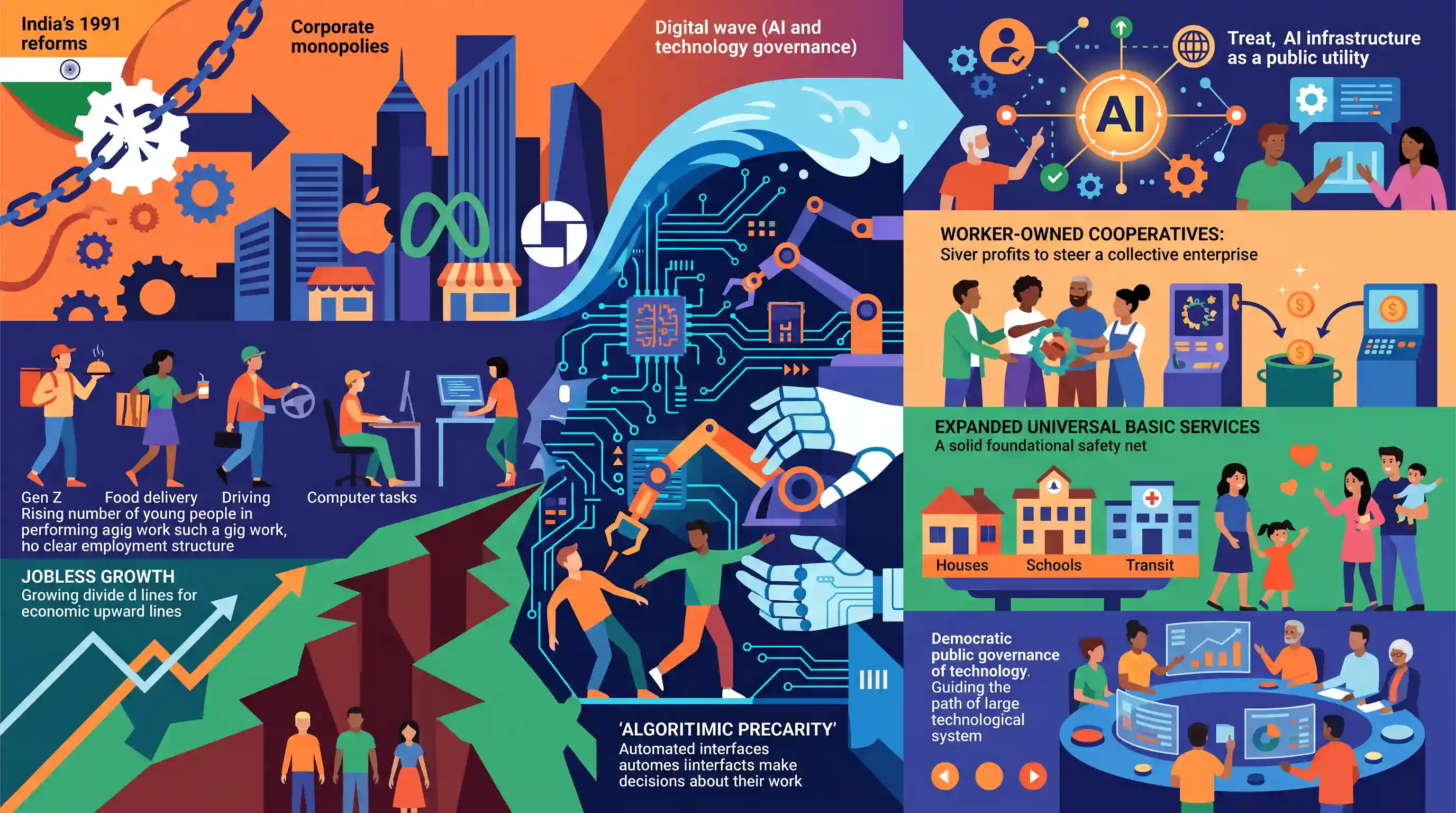
The article examines the intersection of India's 1991 economic reforms and the rise of advanced Artificial Intelligence (AI). It argues that the competitive, growth-oriented model of liberalisation has devolved into corporate monopolies and precarious gig-work for Generation Z. As AI advances, it threatens to eliminate even these insecure service-sector jobs, leaving young workers in a state of 'algorithmic precarity' where decisions are controlled by automated systems and unaccountable corporations. To address these systemic flaws, the author recommends treating AI infrastructure as a public utility, empowering worker-owned cooperatives to share automation gains, expanding universal basic services to buffer against technological displacement, and adopting a democratic public governance model for technology.
Key Points
- Thirty-five years after the 1991 economic liberalisation, the promise of competitive markets and upward mobility has given way to high corporate concentration, stagnating middle-class wages, and precarious gig work.
- Generation Z faces a fragmented labor landscape characterized by contract work, platform labor, and algorithmic management, where workers bear all operational risks while corporations evade traditional employer responsibilities.
- Artificial Intelligence (AI) and automation (including autonomous vehicles, automated accounting, and AI software development) threaten to eliminate even insecure service-sector and IT-allied jobs, creating a state of 'algorithmic precarity'.
- The high capital and computational requirements of advanced AI systems further entrench monopoly power, as smaller firms cannot afford the necessary resources to compete.
- The author proposes transforming AI infrastructure into a public utility focused on public interest areas like healthcare, education, agriculture, and climate research.
- To counter technological displacement, the author suggests socialising automation gains through worker-owned cooperatives, expanding Universal Basic Services (healthcare, education, housing, food), and building publicly governed AI systems.
Important Terms
1991 Economic Reforms

A comprehensive structural adjustment program introducing Liberalisation, Privatisation, and Globalisation (LPG) to dismantle state controls, open the economy to foreign capital, and address a severe balance of payments crisis.
UPSC context
GS Paper III (Indian Economy). Crucial for questions on industrial policy, economic growth, and the transition to a market-driven economy.
Licence Raj
The elaborate system of strict government regulations, licenses, and red tape that controlled private enterprise and industrial expansion in India between 1947 and 1990.
UPSC context
GS Paper III (Indian Economy). Essential for understanding the pre-reforms economic model, planned development, and subsequent deregulation.
Gig Economy
A labor market characterized by the prevalence of short-term, flexible, and task-based contract work, typically mediated through digital platform aggregators, rather than permanent employer-employee relationships.
UPSC context
GS Paper III (Employment) and GS II (Social Justice). Tests dynamics of labor reforms, social security, and informalization.
Jobless Growth
An economic phenomenon where a nation's Gross Domestic Product (GDP) expands steadily without a proportional increase in employment opportunities, leading to high underemployment and structural unemployment.
UPSC context
GS Paper III (Indian Economy & Employment). Relevant for examining demographic dividend, skill mismatches, and inclusive growth.
Algorithmic Precarity
A state of labor vulnerability where workers face unpredictable income, intense surveillance, and arbitrary decisions mediated by opaque, automated digital platform management systems without grievance redressal.
UPSC context
GS Paper III (Technology & Labor) and GS II (Social Justice). Tests governance of AI-driven labor markets and digital regulation.
Universal Basic Services
A welfare policy model proposing that all citizens receive unconditional, free access to essential public services—such as healthcare, education, transport, and shelter—funded through progressive taxation.
UPSC context
GS Paper II (Welfare Schemes) and GS III (Inclusive Growth). Tests structural alternatives to cash transfers for poverty reduction.
Prelims Trap
The Code on Social Security, 2020, funds social security for gig workers exclusively through direct budgetary allocations from the Consolidated Fund.
The Code mandates funding primarily via digital aggregators contributing 1% to 2% of their annual turnover, not direct central budgetary allocations.
Static Concepts Connected
How does the Code on Social Security, 2020, distinguish gig workers from platform workers?
- Gig Workers: Those performing work outside traditional employer-employee relationships, including offline freelancers and independent contractors.
- Platform Workers: Specifically access work and customers via an online platform or digital aggregator.
- Statutory distinction: Defined under separate clauses of the Code, recognizing distinct regulatory requirements for digital-intermediary ecosystems.
What is the 'Lewis transition' and why has India bypassed it?
- Standard model: Envisions surplus agricultural labor moving smoothly to high-productivity, formal manufacturing sectors.
- Indian divergence: Transitioned directly to a service sector that is now increasingly informalized, skipping manufacturing-led formalization.
- Technological barrier: Advanced AI and automation now threaten to eliminate entry-level service jobs, preventing traditional labor absorption.
Cross-Topic Patterns
Sovereign AI + Digital Public Infrastructure
The IndiaAI Mission's public GPU compute model extends India's DPI logic to physical hardware, preventing monopoly market control by foreign big-tech firms.
Labor federalism + Welfare divergence
Rajasthan's platform worker law versus the delayed central Code on Social Security highlights states pioneering localized welfare delivery before national implementation.

Analysis of the Code on Social Security's aggregator funding vs state-level gig laws will likely be a high-yield GS-3 question in 2026.
Linked PYQs · 3
Linked PYQs · 3
- 2016MainsGS3
How globalization has led to the reduction of employment in the formal sector of the Indian economy? Is increased informalization detrimental to the development of the country?
- 2023MainsGS3
What is the status of digitalization in the Indian economy? Examine the problems faced in this regard and suggest improvements.
- 2023MainsGS3
Most of the unemployment in India is structural in nature. Examine the methodology adopted to compute unemployment in the country and suggest improvements.
