Border Religious Site Demolitions Trigger Political Row in Rajasthan
Source:The Hindu ↗
Why It Matters
This topic highlights the critical intersection of border security management, federal governance, and communal harmony in the sensitive India-Pakistan border region of Rajasthan, making it highly relevant to administrative and security-related polity questions.
Summary
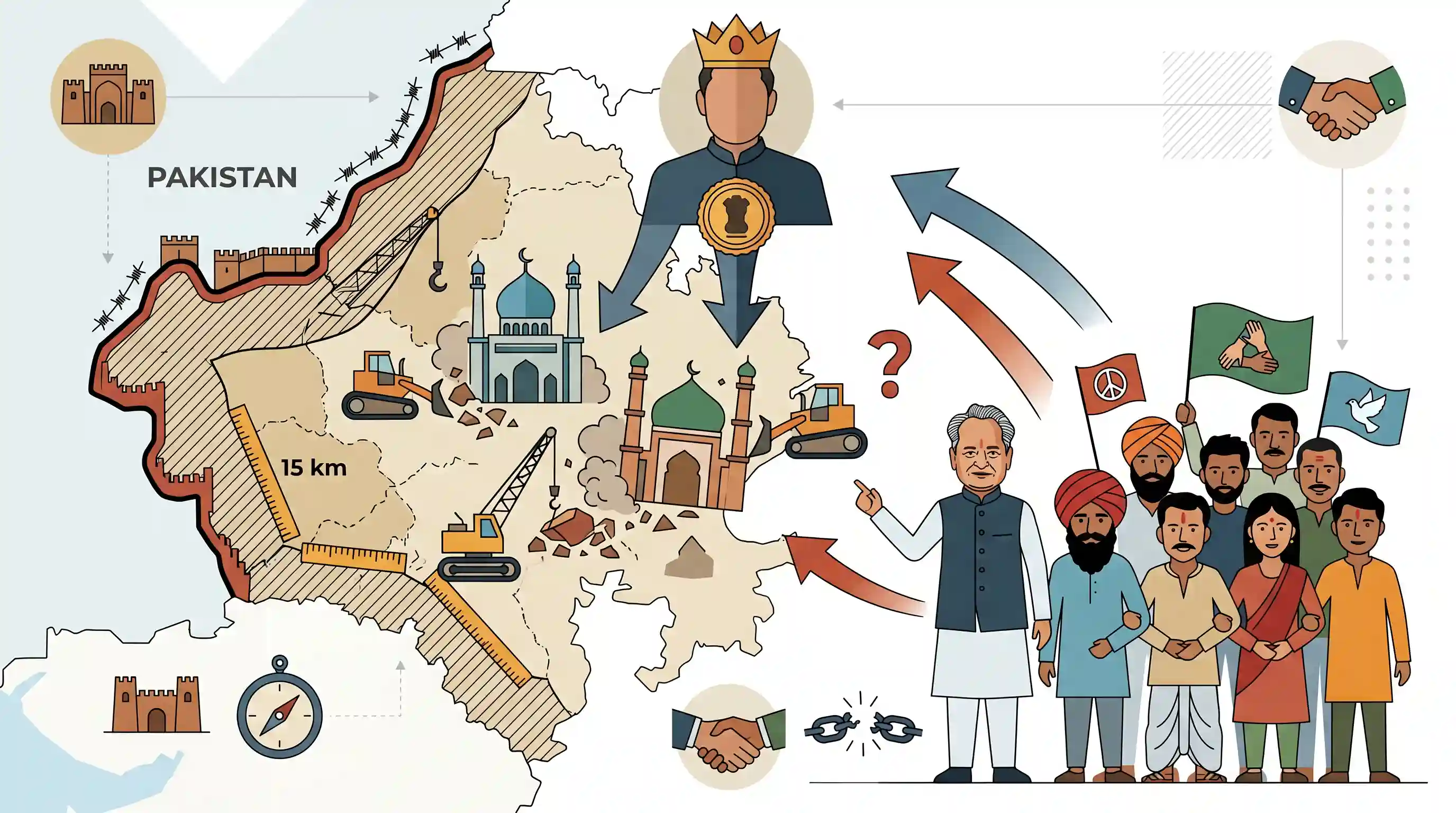
Former Rajasthan Chief Minister Ashok Gehlot questioned the Union government's intent behind the demolition of Muslim religious sites in the sensitive border areas of Rajasthan adjoining Pakistan. The demolitions followed Union Home Minister Amit Shah's directive to remove illegal structures within 15 km of the international border. Gehlot alleged that the drive is politically motivated and targets historical religious sites, disrupting the traditional communal harmony of the border region where local Hindus are also protesting the administrative action.
Key Points
- Former Rajasthan Chief Minister Ashok Gehlot criticized the demolition of several decades-old Muslim religious sites along the Rajasthan-Pakistan border following Union Home Minister Amit Shah's directive to clear structures within 15 km of the border.
- Gehlot alleged that the demolition drive, executed under the guise of removing encroachments, is politically motivated and intended to disrupt the social fabric and create political polarization.
- He emphasized that the western border region of Rajasthan has a rich history of deep communal harmony, pointing out that local Hindus have also vocally opposed the administrative action.
- Gehlot urged the Ministry of Home Affairs (MHA) to clarify its stance, stating that maintaining peace, social harmony, and security in sensitive border areas is a crucial constitutional responsibility of the Union government.
Important Terms
Radcliffe Line

The boundary demarcation line between India and Pakistan drawn during partition in 1947, defining the international border along Rajasthan, Gujarat, Punjab, and Jammu & Kashmir.
UPSC context
GS Paper I (Partition History) and GS Paper III (Border Security); tests spatial awareness of India’s international boundaries.
Ministry of Home Affairs
A key Indian ministry responsible for internal security, border management, administration of central police forces, center-state relations, and the implementation of national security directives.
UPSC context
GS Paper II (Polity) and GS Paper III (Internal Security); tests governance framework and central administrative structures.
Indian National Congress
A major national political party in India, founded in 1885, currently serving as the primary opposition voicing federalism and security concerns.
UPSC context
GS Paper II (Polity - Role of opposition); tests knowledge of the multiparty system, political history, and federal dynamics.
Border Management
The strategic regulation, security, and infrastructure development across land and maritime frontiers to prevent trans-border crimes and foster community integration.
UPSC context
GS Paper III (Internal Security); tests capabilities in managing porous borders and integrating regional developmental schemes.
Vibrant Villages Programme-II
A 100% centrally funded scheme approved in 2025 to comprehensively develop infrastructure, livelihood, and connectivity in border villages to counter out-migration and bolster national security.
UPSC context
GS Paper II (Government Policies) and GS Paper III (Internal Security); tests developmental strategies for border-area empowerment.
Prelims Trap
The 2021 notification increased the BSF's operational jurisdiction in Rajasthan from 15 km to 50 km to match other states.
Rajasthan's BSF jurisdiction was already 50 km prior to 2021; the uniform notification only standardized it in Punjab, West Bengal, Assam, and Gujarat.
Static Concepts Connected
What is the Border Area Development Programme (BADP)?
- Nodal Ministry: Administered by the Department of Border Management, Ministry of Home Affairs.
- Primary Objective: To meet special development needs of border populations and integrate them into national security frameworks.
- Geographic Coverage: Covers land borders across multiple states, prioritising habitations within 0-10 km of the international border.
Who was Baba Ramdevji of Rajasthan?
- Syncretic Deity: A 14th-century ruler revered as an incarnation of Vishnu by Hindus and Rama Shah Peer by Muslims.
- Social Reform: He actively opposed caste discrimination, untouchability, and ritualism, establishing the Kamadiya sect.
- Major Shrine: His primary shrine at Ramdevra (Jaisalmer) houses his samadhi alongside graves of five Sufi saints from Mecca.
Cross-Topic Patterns
Border securitisation vs. Cultural heritage
MHA border clearing directives often clash with historical syncretic sites, highlighting the tension between physical border security and local, multi-faith social fabrics.
BSF Act and federal friction
Extending central security mandates within border zones overlaps with State List subjects like land and public order, testing center-state cooperative federalism.

BSF Act Section 139 jurisdiction limits and its overlap with state police powers will likely feature as a GS-II federalism question.
Linked PYQs · 1
Linked PYQs · 1
- 2024RPSC_PRELIMSGS1
Which of the following group of districts/cities of Rajasthan are arranged in ascending order as per their distance from the border with Pakistan?
